• Fri frakt över 249 kr
  • •
  • Snabba leveranser
  • •
  • Billiga böcker
Kundservice

Du är på sajten för privatpersoner.

Företag, bibliotek eller offentlig verksamhet?

Du handlar på classic.bokus.com, där alla dina funktioner finns intakta.
Till classic.bokus.com
Bokus logotyp. Gå till startsidan.
  • Erbjudanden
  • Nyheter
  • Student
  • Topplistor
  • Barn & ungdom
  • Bokus Play
  • E-böcker
  • Pocketböcker
  • Spel & pussel

10% rabatt på allt med kod NYSTART10 →

Sidfot

Mina sidor

    Hjälp

    • Kundservice
    • Vanliga frågor och svar
    • Frakt och leverans
    • Retur vid ångerrätt
    • Reklamera vara
    • Betalning
    • Köpvillkor
    • Allmänna villkor
    • Information om webbplatsens tillgänglighet

    Om Bokus

    • Om oss
    • Pressrum
    • För studenter
    • För företag
    • För bibliotek och offentlig verksamhet
    • För leverantörer
    • Hållbarhet

    Populärt

    • Aktuella erbjudanden
    • Presentkort
    • Studentlitteratur
    • Nya böcker
    • Topplistor
    • Signerade böcker
    • Engelska böcker

    Inspiration

    • Boktips
    • BookTok
    • Populära bokserier
    • Barnbokskaraktärer
    • Populära författare
    Logotyp för Bokus
    Följ oss på Facebook (extern länk)Följ oss på Instagram (extern länk)Följ oss på YouTube (extern länk)Följ oss på TikTok (extern länk)
    bokus @ CookiesAnpassa cookiesIntegritetspolicyKöpvillkor
    Till Citymail hemsida (extern länk)Till Budbee hemsida (extern länk)Till Postnord hemsida (extern länk)Till Schenker hemsida (extern länk)Till Early Bird hemsida (extern länk)Till Walleys hemsida (extern länk)
    1. Naturvetenskap och teknik
    2. Geovetenskap
    3. Miljövetenskap och miljöpolitik

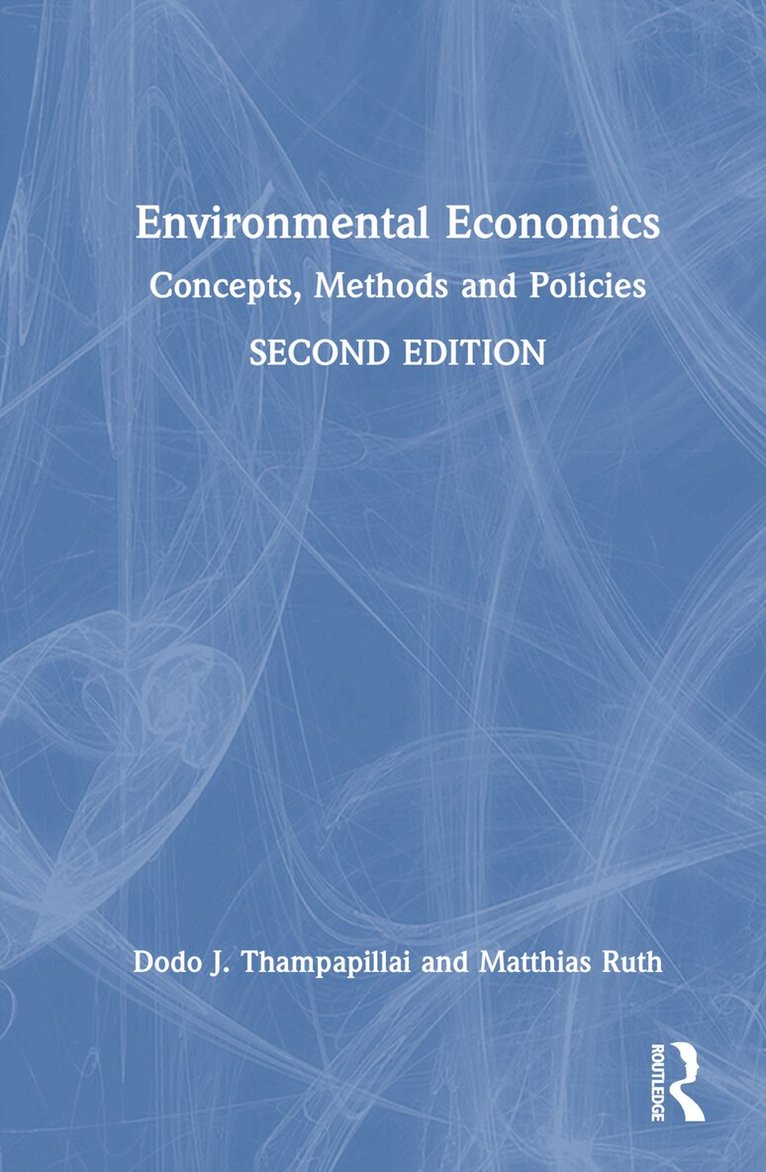
    Environmental Economics

    Concepts, Methods and Policies

    AvDodo J. Thampapillai,Matthias Ruth

    Inbunden, Engelska, 2024

    2 495 kr

    Beställningsvara. Skickas inom 10-15 vardagar. Fri frakt över 249 kr.

    Fler format och utgåvor

    Häftad

    586 kr

    Beskrivning

    Environmental Economics explores the ways in which economic theory and its applications, as practised and taught today, must be modified to explicitly accommodate the goal of sustainability and the vital role played by environmental capital.Pivoting around the first and second laws of thermodynamics, as well as the principles of ecological resilience, this book is divided into five key parts, which include extensive coverage of environmental microeconomics and macroeconomics. It drills down into issues and challenges including consumer demand; production and supply; market organisation; renewable and non-renewable resources; environmental valuation; macroeconomic stabilisation and international trade and globalisation. Drawing on case studies from forestry, water, soil, air quality and mining, this book will equip readers with skills that enable the analyses of environmental and economic policy issues with a specific focus on the sustainability of the economy. This new edition has been updated throughout and provides further coverage on topics such as energy transition, market organisation and the role of environmental economics in regulatory decision-making including critiques of contemporary policy directives like tradable pollution permits and net zero emissions. Challenges to achieving stabilisation and emission reduction have been expanded to include wars and conflicts such as those in the Middle East and the Russian invasion of Ukraine. This book further reinforces the premise that there are clear limits to growth and that modesty and moderation are superior alternatives.Rich in pedagogical features, including key concept boxes and review questions at the end of each chapter, this book will be a vital resource for upper-level undergraduate and postgraduate students studying not only environmental economics/ecological economics but also economics in general.

    Produktinformation

    • Utgivningsdatum:2024-11-27
    • Mått:156 x 234 x 25 mm
    • Vikt:870 g
    • Format:Inbunden
    • Språk:Engelska
    • Antal sidor:358
    • Upplaga:2
    • Förlag:Taylor & Francis Ltd
    • ISBN:9781032528243

    Utforska kategorier

    • Miljövetenskap och miljöpolitik inom Naturvetenskap och teknik
    • Miljöekonomi inom Ekonomi och Ledarskap

    Mer om författaren

    Dodo J. Thampapillai is an honorary professor in the School of Natural Sciences at Macquarie University, where he previously held a personal chair in environmental economics. He is currently a senior fellow in executive education at the Lee Kuan Yew School of Public Policy, National University of Singapore, where he was previously a professor. He also held Visiting Professorships/Fellowships at Simon Fraser University, Swedish University of Agricultural Sciences, Christian Albrechts University of Keil and the Australian National University. Dodo Thampapillai has been teaching economics and environmental economics for over 50 years leading him towards a serious rethink of how economics is taught and practised. Matthias Ruth is Pro-Vice-Chancellor for Research at the University of York, York, United Kingdom. He previously served as Vice-President for Research and Innovation at the University of Alberta, Canada and in various other leadership positions in the USA and with academic appointments in numerous fields, including economics, engineering, geography, public policy and urban affairs. His research focuses on dynamic modelling of natural resource use, industrial and infrastructure systems analysis and environmental economics and policy. His theoretical work heavily draws on concepts from engineering, economics and ecology, while his applied research utilises methods of non-linear dynamic modelling as well as adaptive and anticipatory management. Applications of his work cover the full spectrum from local to regional, to national and global environmental challenges, as well as the investment and policy opportunities these challenges present.

    Innehållsförteckning

    • List of FiguresList of TablesList of BoxesPrefaceAcknowledgementsPART-I. NATURE-CAPITAL (KN) AND THE ECONOMY1. KN AND ECONOMICSEnvironmental Economics and EconomicsKN and Limits to GrowthKN issues of contemporary timesClimate change – The issue of this centuryThe organisation of this textREFERENCES2. THE ECONOMIC SYSTEM REVSEDThe Economic System: Standard VersionThe Economic System and Materials BalanceThe Economy and the Entropy LawFurther Adaptations of the Economic SystemEquilibrium in the Adapted SystemConcluding RemarksREVIEW QUESTIONSREFERENCESPART-II. MICROECONOMICS AND KN3. THE MARKET MODEL AND ITS FAILUREThe Functions of the MarketMarket demandMarket supplyThe marketKN Goods and Market FailurePrice Mechanism and Property RightsSome Further IssuesREVIEW QUESTIONSREFERENCES4. PUBLIC GOODS AND EXTERNALITIESPublic GoodsExternalitiesPublic Goods and ExternalitiesResidual ExternalitiesREVIEW QUESTIONSREFERENCES5. ECONOMICS OF RENEWABLE AND NON-RENEWABLE RESOURCESObjectives of Resource ManagementConflicts between EG and KN-Q ObjectivesThe framework based on the market modelThe framework for conflicts between groupsConflicts Due to Intergenerational ConcernA framework for non-renewable resourcesA framework for renewable resourcesSome Resource Management PoliciesRenewable resourcesNon-renewable resourcesREVIEW QUESTIONSREFERENCES6. ECONOMICS OF NON-RENEWABLE RESOURCES WITH RENEWABLE SERVICESA Simple Framework for Pollution ControlStandardsTaxes and chargesEmissions TradingNet Zero EmissionsOther Incentives and DisincentivesREVIEW QUESTIONSREFERENCES7. CONSUMER DEMAND AND KNUtility Functions, Indifference Curves and DemandThe standard theoryAdapting the Standard Theory for Effects pertaining to KNPertinent assumptionsThe elicitation of demand curvesThe Market Demand Curve and KN EffectsElasticity of Demand and KNConcluding RemarksREVIEW QUESTIONSREFERENCES8. PRODUCTION, COSTS SUPPLY AND KNThe Production Function and KNProduction and Assimilative CapacityDesired output and the generation of entropyTransfer of entropy and timeIsoquants, Substitution, and Input mixesAnalysis of CostsImplicationsREVIEW QUESTIONSREFERENCES9. MARKET ORGANISATION AND KNPerfect Competition and SustainabilityPC versus PCS and Preference RelationsMonopolyOligopolyMonopolistic CompetitionPerfect Information and Full Employment of KNConcluding RemarksREVIEW QUESTIONSREFERENCESPART-III. MACROECONOMICS AND KN10. SOME IMPORTANT CONCEPTS IN MACROECONOMICSNational ProductReal Values and Price Level IndexesFinal ExpendituresEconomic Performance and Goals of MacroeconomicsMeasurement of NPThe Relationship between NP and InflationQNP measured as the sum of real final expendituresQNP measured as the sum of real incomesAD–AS FrameworkConcluding RemarksREVIEW QUESTIONSREFERENCES11. KN: INVESTMENT AND DEPRECIATIONKN and the EconomyDistinguishing KN Investments from Depreciation of KNKN investmentsDepreciation of KNSustainable IncomeA Conceptual Framework for DKN(t)Some Empirical EvidenceConcluding RemarksREVIEW QUESTIONSREFERENCES12. ENVIRONMENTAL MACROECONOMICS: SHORT-RUN ANALYSIS-IEquilibrium Income without DKNEquilibrium Income with DKN: Linear FrameworkEquilibrium Income with DKN: Non-linear FrameworkIncome Determination and Policy AnalysesUnited StatesChina Indonesia and VietnamMongoliaFurther Thoughts on DKN and KN InvestmentsConcluding RemarksREVIEW QUESTIONSREFERENCES13. ENVIRONMENTAL MACROECONOMICS: SHORT-RUN ANALYSIS-IIThe Standard FrameworkProduction function (factor utilisation)Aggregate supply (AS)Aggregate demand (AD)Display of the standard frameworkThe Environmental Macroeconomic FrameworkReformulated production function (factor utilisation)Reformulated AD–AS frameworkDisplay of the environmental macroeconomic frameworkConcluding RemarksREVIEW QUESTIONSREFERENCES14. ENVIRONMENTAL MACROECONOMICS: LONG-RUN ANALYSISIntroductionThe Steady StateThe Harrod-Domar (H-D) Growth ModelThe standard version of the H-D growth modelThe H-D model revised with KNThe Swan-Solow ModelThe standard version of the Swan-Solow modelThe revised version of the Swan-Solow modelEndogenous Growth ModelsThe Romer ModelThe Generalized Endogenous Growth ModelAn Illustration – The South Korean EconomyConclusionsREVIEW QUESTIONSREFERENCES15. INTERNATIONAL TRADE AND GLOBALISATIONComparative Advantage and SpecialisationThe Factor Endowment and Trade FrameworkThe standard frameworkThe revised frameworkTrade Framework based on the Market ModelThe Market for Foreign ExchangeGlobal Issues and the Need for a Global ParadigmConcluding CommentsREVIEW QUESTIONSREFERENCESPART-IV. VALUATION16. VALUATION OF KN: MICROECONOMIC BASISThe Basis for ValuationMethods Based on Demand: KN as a Consumption GoodContingent valuation method (CVM)Choice modelling (CM)Travel-cost method (TCM)Game theory methodsMethods Based on Demand: KN as an Input in ProductionHedonic pricesDose-response methodsDose-response methodsDirect estimation of OCsReplacement costsCost savingsThreshold valuesConcluding remarksREVIEW QUESTIONSREFERENCES17. VALUATION OF KN: MACROECONOMIC BASIS – IUse Value of KN in MacroeconomicsIllustration of the Use Values of KN and the Scarcity of KNThe Relative Scarcity of KNThe efficiency of utilisation with respect to KNConcluding remarksREVIEW QUESTIONSREFERENCES18. VALUATION OF KN: MACROECONOMIC BASIS – IIStocks and Flows of KNThe Perpetual Inventory Method (PIM)Adapting the PIM for KNEmpirical illustrationConclusionREVIEW QUESTIONSREFERENCESPART-V. POLICY19. POLICIES FOR SUSTAINABLE DEVELOPMENTPolicies Aimed at Reducing DamagesTaxes and subsidiesRegulation and tradable permitsCommodity prices, interest rates and wagesProduct differentiationEducation attitudes and lifestylesPopulation pressuresProperty rights and land reformImproving the productivity of KNPolicies Aimed at Minimizing KN Damages towards Zero and Restoring KNClosed-loop production systemsBio-mimicryChanging the fundamental nature of the business modelRestore and expand KN assetsOverarching Policies – Social Capital (KS) – A PreconditionConcluding RemarksREVIEW QUESTIONSREFERENCES20. AN ENVIRONMENTAL ECONOMICS FOR SUSTAINABILITYThe Premises for SustainabilityBuilding KN into Economic ModelsThe Need for a New Kind of PolicyREFERENCESIndex