• Fri frakt över 249 kr
  • •
  • Snabba leveranser
  • •
  • Billiga böcker
Kundservice

Du är på sajten för privatpersoner.

Företag, bibliotek eller offentlig verksamhet?

Du handlar på classic.bokus.com, där alla dina funktioner finns intakta.
Till classic.bokus.com
Bokus logotyp. Gå till startsidan.
  • Erbjudanden
  • Student
  • Topplistor
  • Barn & ungdom
  • Bokus Play
  • E-böcker
  • Ljudböcker
  • Pocketböcker
  • Spel och pussel

5% studentrabatt – använd koden KURSBOK27 →

Sidfot

Mina sidor

    Hjälp

    • Kundservice
    • Vanliga frågor och svar
    • Frakt och leverans
    • Retur vid ångerrätt
    • Reklamera vara
    • Betalning
    • Köpvillkor
    • Allmänna villkor
    • Information om webbplatsens tillgänglighet

    Om Bokus

    • Om oss
    • Pressrum
    • För studenter
    • För företag
    • För bibliotek och offentlig verksamhet
    • För leverantörer
    • Hållbarhet

    Populärt

    • Aktuella erbjudanden
    • Presentkort
    • Studentlitteratur
    • Nya böcker
    • Topplistor
    • Signerade böcker
    • Engelska böcker

    Inspiration

    • Boktips
    • BookTok
    • Barnbokskaraktärer
    • Populära författare
    Logotyp för Bokus
    Följ oss på Facebook (extern länk)Följ oss på Instagram (extern länk)Följ oss på YouTube (extern länk)Följ oss på TikTok (extern länk)
    bokus @ CookiesAnpassa cookiesIntegritetspolicyKöpvillkor
    Till Citymail hemsida (extern länk)Till Budbee hemsida (extern länk)Till Postnord hemsida (extern länk)Till Schenker hemsida (extern länk)Till Early Bird hemsida (extern länk)Till Walleys hemsida (extern länk)
    1. Medicin
    2. Medicin: allmänt
    3. Samhällsmedicin och preventiv medicin
    4. Epidemiologi och medicinsk statistik

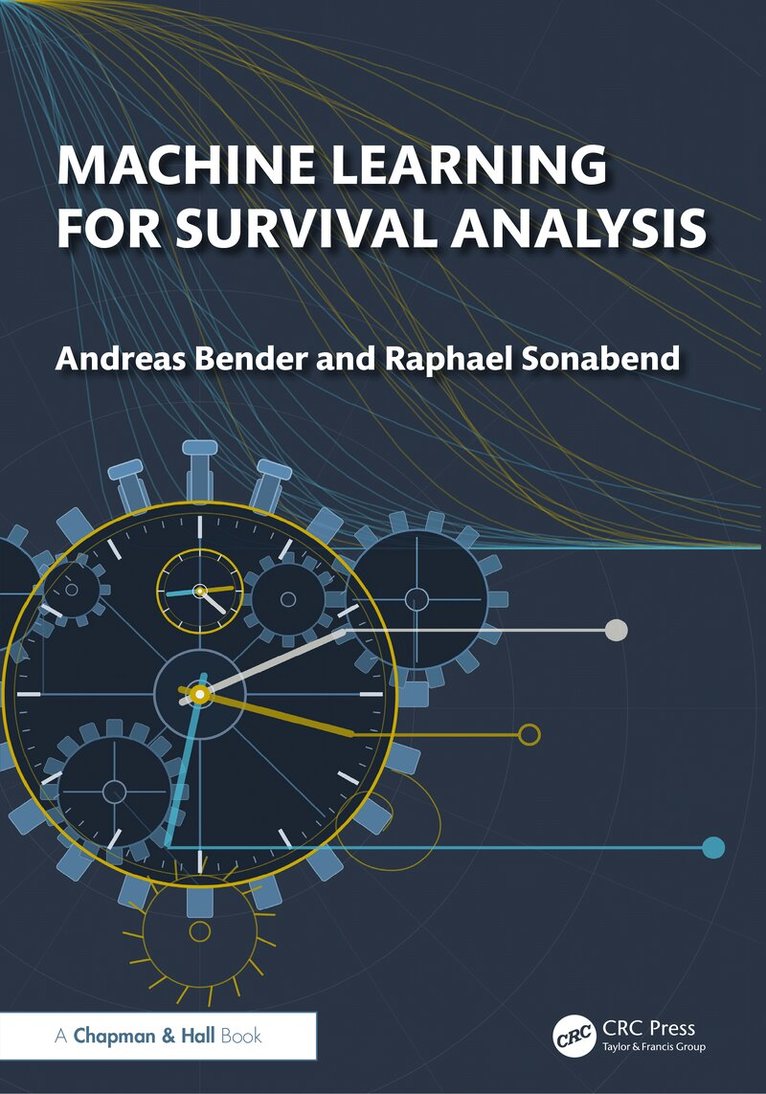
    Machine Learning for Survival Analysis

    AvAndreas Bender,Raphael Sonabend

    Inbunden, Engelska, 2026

    1 591 kr

    Kommande

    Beskrivning

    Survival analysis is a mature field with decades of methodological development, yet machine learning survival analysis is still taking shape as a discipline in its own right. While machine learning methods for time-to-event prediction are increasingly used in health care, clinical research, actuarial science, engineering, and industry, a critical gap remains in the literature: few texts bridge the theoretical foundations of survival analysis with the methods, workflows, and evaluation tools of modern machine learning. Machine Learning in Survival Analysis fills this gap by providing a systematic treatment of machine learning approaches to time-to-event prediction.From nonparametric estimators, Cox proportional hazards models and parametric models to random forests, support vector machines, gradient boosting machines, and neural networks, this book offers a rigorous yet accessible journey through the field. It formally defines the survival analysis machine learning task, introduces key prediction targets, and explains how censoring and truncation change the structure of standard predictive modeling problems. Beyond model fitting, the book gives detailed attention to model evaluation, including discrimination, calibration, scoring rules, censoring adjustment, and the assumptions required for valid comparison. The book covers single-event right-censored data, with extensions to other censoring mechanisms, truncation, competing risks, reduction methods, and event history analysis more generally.Key FeaturesComprehensive coverage from survival analysis foundations to modern machine learning methods, including non-parametric, semi-parametric, and fully parametric models, random forests, support vector machines, gradient boosting machines, and neural networksFormal treatment of survival analysis as a machine learning task, with clear definitions of censoring, truncation, competing risks, and multiple prediction targetsDetailed evaluation framework covering discrimination, calibration, scoring rules, censoring adjustment, and the practical limitations of commonly used measuresCoverage of reduction methods that connect survival analysis to standard regression and classification frameworksExtensions beyond single-event right censoring, including interval censoring, truncation, competing risks, and event history analysisThis book is designed for graduate students, researchers, and data science practitioners with foundational knowledge of statistics and machine learning. It serves as a textbook for courses in survival analysis, biostatistics, machine learning, and applied predictive modeling, as well as a reference for practitioners developing, evaluating, or deploying survival models in clinical, industrial, engineering, financial, or scientific settings. Whether the reader is learning survival analysis for the first time, moving from standard machine learning to time-to-event modeling, or seeking a unified treatment of classical and modern approaches, this book provides the theory needed to understand, evaluate, and apply machine learning methods to time-to-event data and temporal processes with partially observed information.

    Produktinformation

    • Utgivningsdatum:2026-12-16
    • Mått:178 x 254 x undefined mm
    • Format:Inbunden
    • Språk:Engelska
    • Antal sidor:280
    • Förlag:Taylor & Francis Ltd
    • ISBN:9781032537498

    Utforska kategorier

    • Epidemiologi och medicinsk statistik inom Medicin
    • Matematisk statistik inom Naturvetenskap och teknik
    • Elektronik och kommunikationer inom Naturvetenskap och teknik

    Mer om författaren

    Dr. Andreas Bender is a Senior Lecturer at the Department of Statistics, Head of the Machine Learning Consulting Unit (MLCU) at the Munich Center for Machine Learning (MCML), and founder of the Open Science Initiative in Statistics at LMU Munich. Machine Learning Survival Analysis is one of Andreas' main research areas. Andreas created several open-source packages and actively contributes to survival analysis software, including pammtools and mlr3proba.Dr. Raphael Sonabend-Friend is an Associate Director at the National Institute for Health and Care Excellence (NICE) and the CEO and Co-Founder of OSPO Now. Raphael holds a PhD focused on the accessible and transparent use of machine learning for survival analysis. Raphael has over a decade of experience at the intersection of AI and healthcare, including work with large philanthropies, small local charities, governmental bodies, and private sector organizations in the United Kingdom and globally. Raphael has created and maintained several software packages for survival analysis and machine learning, including mlr3proba, survivalmodels, and SurvivalAnalysis.jl. Raphael co-edited and co-authored Applied Machine Learning Using mlr3 in R.

    Innehållsförteckning

    • 1. Introduction. 2. Machine Learning. 3. Survival Analysis. 4. Event History Analysis. 5. Survival Task. 6. Discrimination. 7. Calibration. 8. Scoring Rules. 9. Distance Measures. 10. Choosing Measures. 11. Core Estimators, Models, and Methods. 12. Random Forests. 13. Support Vector Machines. 14. Gradient Boosting Machines. 15. Neural Networks. 16. Choosing Models. 17. Reductions for Survival Analysis. 18. IPCW Classification. 19. Pseudo-Value Regression. 20. Partition-Based Reductions. 21. Reductions for Event History Analysis.