• Fri frakt över 249 kr
  • •
  • Snabba leveranser
  • •
  • Billiga böcker
Kundservice

Du är på sajten för privatpersoner.

Företag, bibliotek eller offentlig verksamhet?

Du handlar på classic.bokus.com, där alla dina funktioner finns intakta.
Till classic.bokus.com
Bokus logotyp. Gå till startsidan.
  • Erbjudanden
  • Nyheter
  • Student
  • Topplistor
  • Barn & ungdom
  • Bokus Play
  • E-böcker
  • Pocketböcker
  • Spel & pussel

10% rabatt på allt med kod: NYSTART10 →

Sidfot

Mina sidor

    Hjälp

    • Kundservice
    • Vanliga frågor och svar
    • Frakt och leverans
    • Retur vid ångerrätt
    • Reklamera vara
    • Betalning
    • Köpvillkor
    • Allmänna villkor
    • Information om webbplatsens tillgänglighet

    Om Bokus

    • Om oss
    • Pressrum
    • För studenter
    • För företag
    • För bibliotek och offentlig verksamhet
    • För leverantörer
    • Hållbarhet

    Populärt

    • Aktuella erbjudanden
    • Presentkort
    • Studentlitteratur
    • Nya böcker
    • Topplistor
    • Signerade böcker
    • Engelska böcker

    Inspiration

    • Boktips
    • BookTok
    • Populära bokserier
    • Barnbokskaraktärer
    • Populära författare
    Logotyp för Bokus
    Följ oss på Facebook (extern länk)Följ oss på Instagram (extern länk)Följ oss på YouTube (extern länk)Följ oss på TikTok (extern länk)
    bokus @ CookiesAnpassa cookiesIntegritetspolicyKöpvillkor
    Till Citymail hemsida (extern länk)Till Budbee hemsida (extern länk)Till Postnord hemsida (extern länk)Till Schenker hemsida (extern länk)Till Early Bird hemsida (extern länk)Till Walleys hemsida (extern länk)
    1. Samhälle och politik
    2. Politik och statsskick
    3. Internationella relationer

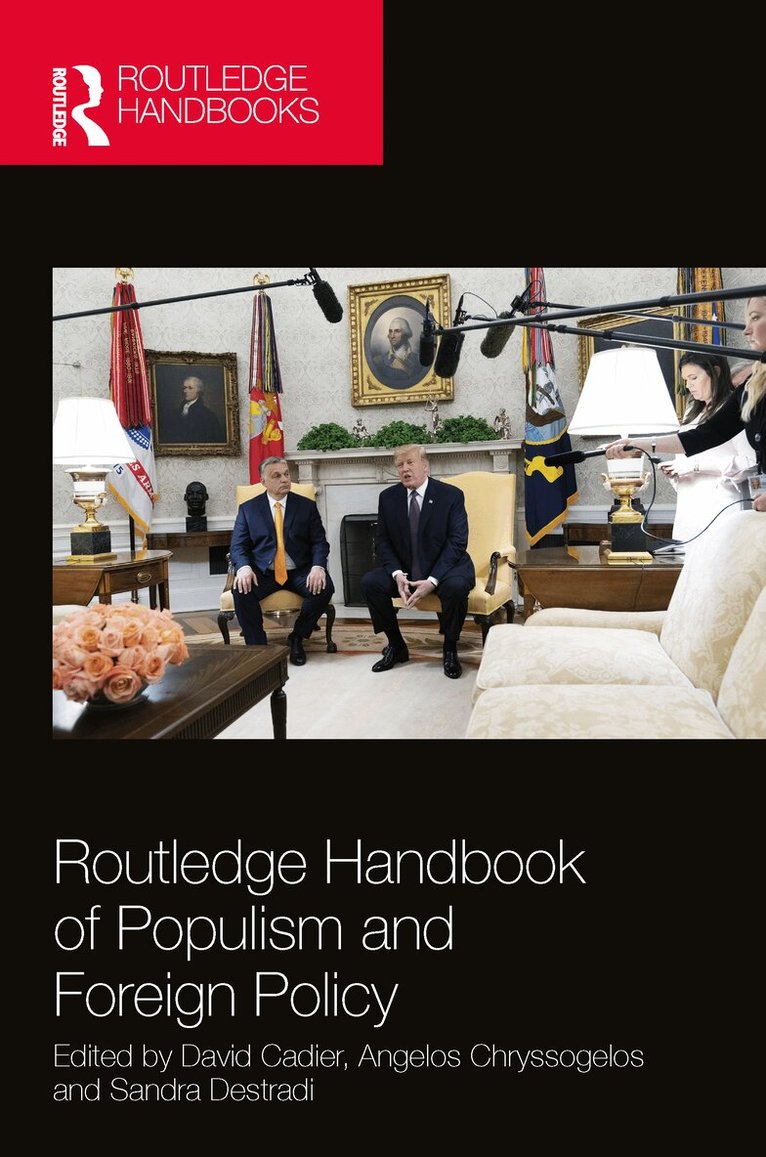
    Routledge Handbook of Populism and Foreign Policy

    AvDavid Cadier,Angelos Chryssogelos

    Inbunden, Engelska, 2025

    3 656 kr

    Beställningsvara. Skickas inom 10-15 vardagar. Fri frakt över 249 kr.

    Beskrivning

    This handbook provides a methodical, comprehensive, and unifying overview of the vibrant yet disparate scholarship on populism and foreign policy. By mapping the debates and existing findings, as well as presenting the different conceptual and theoretical lenses, the handbook provides new insights as to how, whether, and to what extent, populism influences foreign policy. Carefully selected international contributors connect their own work to others to offer a thorough, theoretically informed, and empirically tested academic treatment of the topic across a number of cases where populist actors are, or have been, in power. Divided into four parts (Concepts and Theories; Factors and Processes; Actors and Structures; Issues and Policy Areas), the diverse and comprehensive insights on the global, cross-regional, and transnational dimensions of populism will be of interest to scholars and students of international relations, political science, public policy, foreign policy, political theory, populism, and area studies. This text will also be of interest to those working from the perspectives of Sociology, Law, and History, as well as to the practitioners of international politics.

    Produktinformation

    • Utgivningsdatum:2025-06-20
    • Mått:156 x 234 x 40 mm
    • Vikt:1 140 g
    • Format:Inbunden
    • Språk:Engelska
    • Antal sidor:642
    • Förlag:Taylor & Francis Ltd
    • ISBN:9781032540184

    Utforska kategorier

    • Internationella relationer inom Samhälle och politik
    • Statsvetenskap och politisk teori inom Samhälle och politik
    • Politiska ideologier och rörelser inom Samhälle och politik

    Mer om författaren

    David Cadier is a Senior Research Fellow at the Institute for Strategic Research (IRSEM) in Paris. He is also a Visiting Professor at the College of Europe in Bruges and an Associate Researcher and Adjunct Lecturer at Sciences Po Paris. Previously, he held positions at, inter alia, the London School of Economics, SAIS Johns Hopkins University, the University of Groningen, and the Fletcher School of Law and Diplomacy.Angelos Chryssogelos is Reader in Politics and International Relations in the School of Social Sciences and Professions of London Metropolitan University. He holds a PhD from the European University Institute and in the past he has held positions at LSE, King's College London, Harvard, and the Schuman Centre of the EUI.Sandra Destradi holds the Chair of International Relations at the University of Freiburg and she is a DAAD long-term guest professor at Reichman University. She is a PI of the project 'Populism and Foreign Policy' funded by the German Research Foundation (financial assistance is gratefully acknowledged, grant DE 1918/3-1), and she leads the MSCA doctoral network 'International Dimensions and Effects of Populism' (IDEoPOP), funded by the European Union (Project 101168714).

    Innehållsförteckning

    • 1. Introduction, by David Cadier, Angelos Chryssogelos and Sandra DestradiSECTION 1: CONCEPTS AND THEORIES2. The Ideational Approach to Populism and Foreign Policy, by Sandra Destradi3. The Politico-Strategic Approach to Populism and Foreign Policy, by David Cadier4. The Discourse-Theoretic Approach to Populism and Foreign Policy, by Hakkı Taş5. The Stylistic-Performative Approach to Populism and Foreign Policy, by Théo Aiolfi6. Populism and International Relations Theories, by Angelos Chryssogelos7. How International Politics Helps Explain Domestic Politics, by Bertjan Verbeek and Andrej Zaslove SECTION 2: FACTORS AND PROCESSES8. Populism and Individual Leadership Profiles in Foreign Policy, by Klaus Brummer9. Populism, Roles and Foreign Policy, by Leslie E. Wehner10. Populist Uses of History and Foreign Policy, by Senem Aydın-Düzgit and Bahar Rumelili11. Populism and Political Violence in Foreign Policy, by Semir Dzebo and Erin K. Jenne12. Populist Security Narratives and Foreign Policy, by Georg Löfflmann13. Populism, Coalition Dynamics and Foreign Policy, by Hanna Corsini14. Populism and the Centralisation of Foreign Policy Decision-Making, by Vihang Jumle, Johannes Plagemann, Sandra Destradi, Elena Dressler, Alyssa Santiago and Ronald Schleehauf15. Populist Communication, Discursive Strategy and Foreign Policy, by Corina Lacatus and Gustav Meibauer16. Populism, Party Ideology, and Foreign Policy by Falk OstermannSECTION 3: ACTORS AND STRUCTURES17. Career Diplomats and Populist Leaders, by Kira Huju and Christian Lequesne18. Populism and International Organisations, by Kilian Spandler and Fredrik Söderbaum19. Populism and EU Foreign Policy, by Ana E. Juncos and Karolina Pomorska20. Foreign Policy Think Tanks under Populist Governments, by Monika Sus and Joanna Dyduch21. Populist Foreign Policy and International Law, by Heike Krieger22. Populism and Regionalism, by Daniel F. Wajner23. The Transnational Dimensions of Populism, by Panos Panayotu and Giorgos Katsambekis24. Diasporas and Populism in Foreign Policy, by Erdi Ozturk25. Military Thinking and Populist Foreign Policy, by Erica ResendeSECTION 4: ISSUES AND POLICY AREAS26. Populism and the Use of Force, by Fabrizio Coticchia27. Populism and International Trade, by Amy Skonieczny28. Populists, Multinational Corporations, and International Financial Institutions, by Stephan Fouquet29. Right-Wing Ethnopopulism and Migration Policy, by Diego Caballero-Vèlez and Eugenio Cusumano30. Populism, Energy Transitions, and International Politics, by Kacper Szulecki31. Populism and International Climate Policy, by Jana Kistner32. Populism and Nuclear Weapons, by Michal Onderco33. Populist Aesthetics and Security, by Bohdana Kurylo34. Radical Right Populism and Development Policy, by Christine Hackenesch35. Populism and Peacemaking, by Dana M. Landau and Lior Lehrs36. Civilisationism, Populism and Foreign Policy, by Tamas Dudlak