• Fri frakt över 249 kr
  • •
  • Snabba leveranser
  • •
  • Billiga böcker
Kundservice

Du är på sajten för privatpersoner.

Företag, bibliotek eller offentlig verksamhet?

Du handlar på classic.bokus.com, där alla dina funktioner finns intakta.
Till classic.bokus.com
Bokus logotyp. Gå till startsidan.
  • Erbjudanden
  • Nyheter
  • Student
  • Topplistor
  • Barn & ungdom
  • Bokus Play
  • E-böcker
  • Pocketböcker
  • Spel & pussel

10% rabatt på allt med kod: NYSTART10 →

Sidfot

Mina sidor

    Hjälp

    • Kundservice
    • Vanliga frågor och svar
    • Frakt och leverans
    • Retur vid ångerrätt
    • Reklamera vara
    • Betalning
    • Köpvillkor
    • Allmänna villkor
    • Information om webbplatsens tillgänglighet

    Om Bokus

    • Om oss
    • Pressrum
    • För studenter
    • För företag
    • För bibliotek och offentlig verksamhet
    • För leverantörer
    • Hållbarhet

    Populärt

    • Aktuella erbjudanden
    • Presentkort
    • Studentlitteratur
    • Nya böcker
    • Topplistor
    • Signerade böcker
    • Engelska böcker

    Inspiration

    • Boktips
    • BookTok
    • Populära bokserier
    • Barnbokskaraktärer
    • Populära författare
    Logotyp för Bokus
    Följ oss på Facebook (extern länk)Följ oss på Instagram (extern länk)Följ oss på YouTube (extern länk)Följ oss på TikTok (extern länk)
    bokus @ CookiesAnpassa cookiesIntegritetspolicyKöpvillkor
    Till Citymail hemsida (extern länk)Till Budbee hemsida (extern länk)Till Postnord hemsida (extern länk)Till Schenker hemsida (extern länk)Till Early Bird hemsida (extern länk)Till Walleys hemsida (extern länk)
    1. Samhälle och politik
    2. Samhälle och kultur
    3. Kultur och medier
    4. Referensverk och tvärvetenskap
    • Nyhet

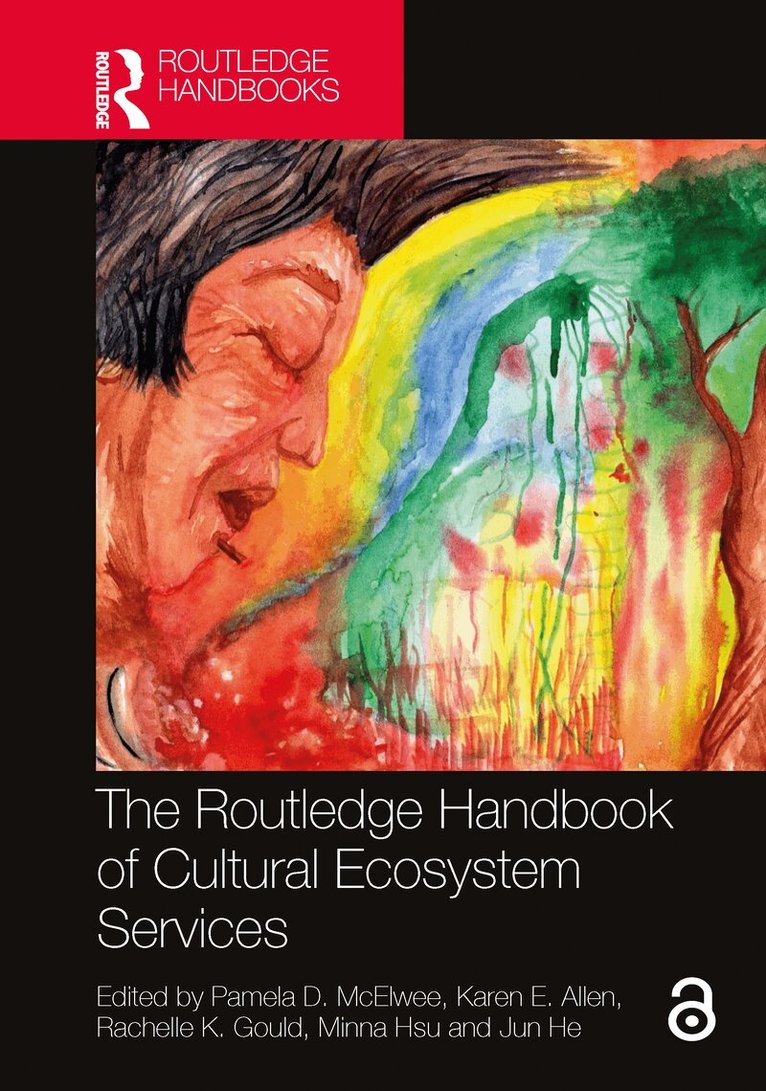
    Routledge Handbook of Cultural Ecosystem Services

    AvPamela D. McElwee,Karen E. Allen

    Häftad, Engelska, 2026

    765 kr

    Beställningsvara. Skickas inom 10-15 vardagar. Fri frakt över 249 kr.

    Beskrivning

    The Routledge Handbook of Cultural Ecosystem Services provides an overview of Cultural Ecosystem Services (CES), which are the nonmaterial aspects of benefits that people derive from nature. These diverse and multifaceted contributions can include experiences, capabilities, and identities, among others. The Handbook addresses how these CES are valued, how they reflect human-nonhuman relationships, and what roles they can play in improved human well-being, ecosystem management, and trajectories towards sustainability.This Handbook presents a wide array of perspectives on the roles CES can play in understanding relationships to nature, and on how those relationships might translate into policy. The Handbook includes philosophical approaches to CES, typologies and classifications of types of CES, and case studies of places, people, policies and projects engaging CES. Across seven distinctive Parts, the chapters deliver a number of important practical lessons on how to understand, measure, and value CES, and use examples and applications from around the world, including how CES apply across different biomes. The Handbook also includes a selection of compelling artworks that represent CES in different cultural contexts. The 91 authors represent 19 different countries, providing a rich range of experiences, including a strong focus on the Global South.This book can serve as a comprehensive guide to researchers who are new to CES and wish to understand more about the field, and as a set of go-to instructions for experienced CES researchers. It can also inform policymakers who wish to better incorporate CES into their work.The Open Access version of this book, available at http://www.taylorfrancis.com, has been made available under a Creative Commons Attribution-Non Commercial-No Derivatives (CC BY-NC-ND) 4.0 license

    Produktinformation

    • Utgivningsdatum:2026-08-27
    • Mått:174 x 246 x 26 mm
    • Vikt:940 g
    • Format:Häftad
    • Språk:Engelska
    • Antal sidor:474
    • Förlag:Taylor & Francis Ltd
    • ISBN:9781032540474

    Utforska kategorier

    • Referensverk och tvärvetenskap inom Samhälle och politik
    • Geografi inom Naturvetenskap och teknik
    • Miljövetenskap och miljöpolitik inom Naturvetenskap och teknik

    Mer om författaren

    Pamela D. McElwee is trained as an anthropologist and forester and is a Professor of Human Ecology at Rutgers University. Her work focuses on human dimensions of environmental change related to biodiversity and climate. She has served key roles in science-policy assessments, including the Intergovernmental Science-Policy Platform for Biodiversity and Ecosystem Services (IPBES), Intergovernmental Panel on Climate Change (IPCC), and US National Climate Assessment.Karen E. Allen is a cultural anthropologist who works in conservation and sustainability science. Her research focuses on the sustainability of social-ecological systems and the interaction between environmental policy and human decision-making. She is an Associate Professor at Furman University.Rachelle K. Gould is an interdisciplinary scholar whose work involves social science, the humanities, and ecology. She is an Associate Professor at the University of Vermont. Her research explores the relationship between people and ecosystems and focuses on (1) environmental values, including Cultural Ecosystem Services and relational values; (2) lifelong and life-wide environmental learning and its relationship to behavior; and (3) how issues of equity, inclusion, and justice permeate environmental issues.Minna Hsu is a human geographer whose work focuses on Indigenous peoples' rights and knowledges in natural resource and disaster management. She is the co-lead of the IUCN Cultural Practices and Ecosystem Management Thematic Group (Commission on Ecosystem Management).Jun He is a Professor of human ecology at the School of Ethnology and Sociology, Yunnan University, China. His research interests lie in global value chains, Indigenous knowledge, non-timber forest products, agroforestry and forest governance.

    Recensioner i media

    "Cultural ecosystem services are the glue that binds people and nature together. Charting its way through an important, if often diffusing emerging, field of knowledge, this authoritative handbook will be an essential guide for researchers and practitioners concerned with the cultural dimensions of natural resource management."Professor Rob Fish, Imperial College London"The Handbook of Cultural Ecosystem Services is an essential tool to illuminate the vital, yet often overlooked, intangible benefits humans gain from nature. By providing a global perspective and diverse examples, it sets the foundation for future research while offering guidance for integrating culture into environmental policy and practice."Victoria Reyes-García, ICREA Research Professor at the Institute of Environmental Science and Technology, Universitat Autònoma de Barcelona (ICTA-UAB)“How do we do conservation differently, to pursue well-being of people and nature together? This rich volume presents a multitude of approaches, tools and perspectives addressing cultural dimensions and meaningful reciprocal human-nature relations as a key way forward. An important resource to guide research, policy and practice.”Maria Tengö, Professor, Stockholm Resilience Centre, Stockholm University, and the Nature College Special Chair in Human-Nature Relationships in the Anthropocene at Wageningen University"Extractive, profit-based, relationships between people and nature support our current civilizational crisis. This book offers a refreshing focus on the deeply rooted and very diverse non-material benefits to people from nature across the world. It provides a roadmap to better weave individuals, communities and non-humans through reciprocal and just relations."Patricia Balvanera, Researcher at the Institute of Research in Ecosystems of the Universidad Nacional Autónoma de México, and Professor of Biology and Human Well-being

    Innehållsförteckning

    • Introduction Part 1 Approaching and defining CES Part 2 Understanding categories of CES and their importance Part 3 Place, identity and CES Part 4 CES across ecologies Part 5 Methods and valuation for CES Part 6 CES in management and policy Part 7 New directions for CES