• Fri frakt över 249 kr
  • •
  • Snabba leveranser
  • •
  • Billiga böcker
Kundservice

Du är på sajten för privatpersoner.

Företag, bibliotek eller offentlig verksamhet?

Du handlar på classic.bokus.com, där alla dina funktioner finns intakta.
Till classic.bokus.com
Bokus logotyp. Gå till startsidan.
  • Erbjudanden
  • Nyheter
  • Student
  • Topplistor
  • Barn & ungdom
  • Bokus Play
  • E-böcker
  • Pocketböcker
  • Spel & pussel

10% rabatt på allt med kod: NYSTART10 →

Sidfot

Mina sidor

    Hjälp

    • Kundservice
    • Vanliga frågor och svar
    • Frakt och leverans
    • Retur vid ångerrätt
    • Reklamera vara
    • Betalning
    • Köpvillkor
    • Allmänna villkor
    • Information om webbplatsens tillgänglighet

    Om Bokus

    • Om oss
    • Pressrum
    • För studenter
    • För företag
    • För bibliotek och offentlig verksamhet
    • För leverantörer
    • Hållbarhet

    Populärt

    • Aktuella erbjudanden
    • Presentkort
    • Studentlitteratur
    • Nya böcker
    • Topplistor
    • Signerade böcker
    • Engelska böcker

    Inspiration

    • Boktips
    • BookTok
    • Populära bokserier
    • Barnbokskaraktärer
    • Populära författare
    Logotyp för Bokus
    Följ oss på Facebook (extern länk)Följ oss på Instagram (extern länk)Följ oss på YouTube (extern länk)Följ oss på TikTok (extern länk)
    bokus @ CookiesAnpassa cookiesIntegritetspolicyKöpvillkor
    Till Citymail hemsida (extern länk)Till Budbee hemsida (extern länk)Till Postnord hemsida (extern länk)Till Schenker hemsida (extern länk)Till Early Bird hemsida (extern länk)Till Walleys hemsida (extern länk)
    1. Juridik
    2. Internationell rätt
    3. Folkrätt

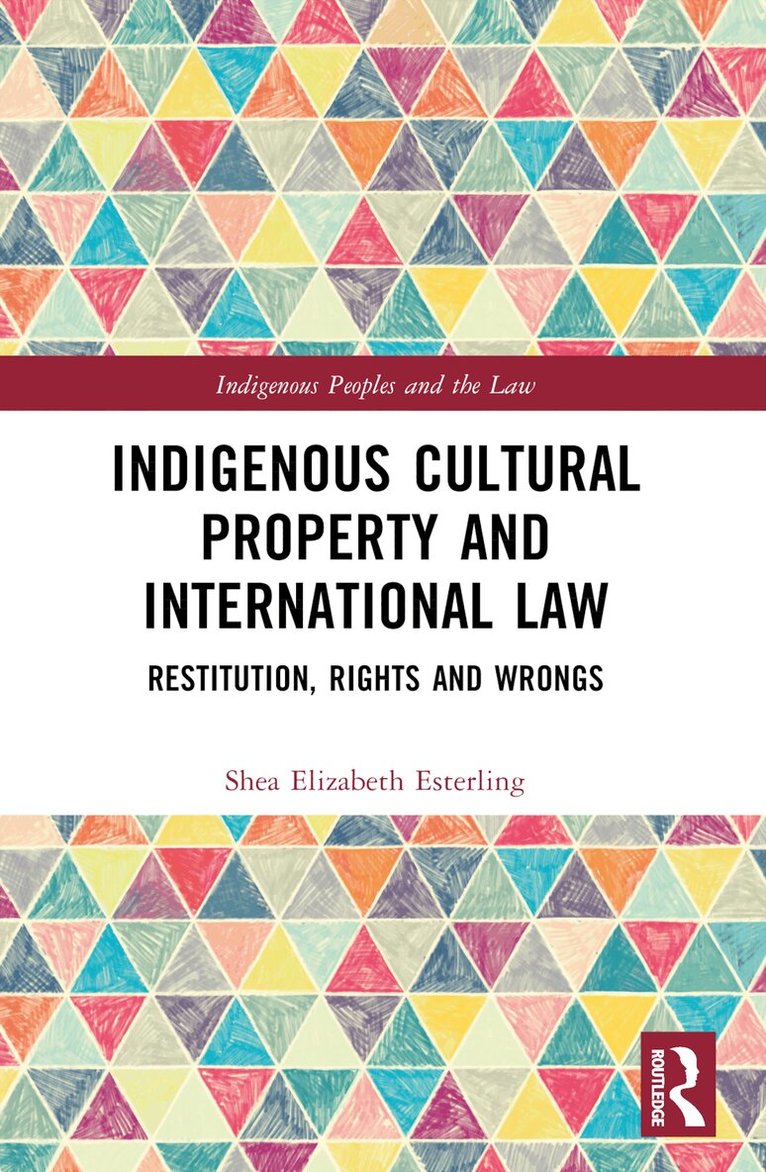
    Indigenous Cultural Property and International Law

    Restitution, Rights and Wrongs

    AvShea Elizabeth Esterling

    Häftad, Engelska, 2025

    Del i serien Indigenous Peoples and the Law

    574 kr

    Beställningsvara. Skickas inom 10-15 vardagar. Fri frakt över 249 kr.

    Fler format och utgåvor

    Inbunden

    2 227 kr

    E-bok

    679 kr

    E-bok

    679 kr

    Beskrivning

    Examining the restitution of cultural property to Indigenous Peoples in human rights law, this book offers a detailed analysis of the opportunities and constraints of international law as a tool of resistance and social transformation for marginalized groups.In accordance with an increasing insistence on respect for diverse cultures, and through their own international mobilization, Indigenous Peoples have participated in the construction of a distinct human rights framework. Significant academic inquiry has focused on the substantive gains made by Indigenous Peoples in this context, along with its impact on a body of law that had previously denied Indigenous Peoples a basis for claims to their own cultural materials and practices. Accordingly, this book acknowledges that Indigenous Peoples, as non-state actors, have generated greater substantive and procedural legitimacy in human rights law making. Offering normative insights into the participation of non-state actors in international law making, however, it also demonstrates that, despite their significant role in constructing the legal framework of human rights in the 21st century, the participation of Indigenous Peoples continues to be structurally limited.With its interdisciplinary approach to the field, this book will appeal to scholars and students in the fields of law, politics, anthropology and indigenous studies.

    Produktinformation

    • Utgivningsdatum:2025-04-14
    • Mått:156 x 234 x 15 mm
    • Vikt:420 g
    • Format:Häftad
    • Språk:Engelska
    • Serie:Indigenous Peoples and the Law
    • Antal sidor:252
    • Förlag:Taylor & Francis Ltd
    • ISBN:9781032540832

    Utforska kategorier

    • Folkrätt inom Juridik
    • Rättssystem inom Juridik

    Mer om författaren

    Shea Elizabeth Esterling is Senior Lecturer in the Faculty of Law at the University of Canterbury in Christchurch, New Zealand; a Fellow of the Higher Education Academy; and Co-Chair of the American Society of International Law Rights of Indigenous Peoples Interest Group.

    Innehållsförteckning

    • Acknowledgments xi1 Introductions 1On Indigenous Cultural Property and Restitution 1On the Repatriation Debate 3On Aims and Arguments 4On Location 8On Method 9On Organization 112 A Textual Analysis: Article 11 of the United Nations Declaration on the Rights of Indigenous Peoples 18Introduction 18I. Situating Indigenous Peoples and Claims for Cultural Property: A Brief History of Indigenous Rights as Human Rights 21II. The UN Declaration on the Rights of Indigenous Peoples and Indigenous Cultural Heritage 27A Distinctive Identity, a Distinctive Space: The UN Declaration on the Rights of Indigenous Peoples 27The Long and Winding Road to the UNDRIP: A Soft Law Success 28A Sui Generis Scheme: UNDRIP and Indigenous Cultural Heritage 33A Tale of Terminology: Cultural Heritage Versus Cultural Property 35III. A Textual Analysis: Article 11, Indigenous Cultural Property, Redress and the UNDRIP 40Article 11: A Cultural Right in Cultural Integrity 40Article 11: An Application 44IV. The International Legal Framework for the Protection of Cultural Property 54An Indigenous View: The UNESCO Convention 1970 56An Indigenous View: The UNIDROIT Convention 1995 60Conclusions 643 A Purposive Analysis: Article 11 of the United Nations Declaration on the Rights of Indigenous Peoples 73Introduction 73I. One Step Forward, One Step Back: A Sui Generis Right Gained, a Sui Generis Right Lost 74A Shadow of a Draft: Article 11 and Its Retrogression 74Right to Restitution: A Drafting History 75II. A Sui Generis Right Lost: Human Rights and the Restitution of Cultural Property 82Article 27: A Cultural Right 83Article 27: Limits 86Article 1: The Right to Self-Determination 89A Minimalist Approach: The Approach of States to Self-Determination 91A Minimalist Approach and the Application of Self- Determination to Indigenous Peoples: The Beneficiary Debate 91A Minimalist Approach and the Modality of Self- Determination Available to Indigenous Peoples: External and Internal Self-Determination 93A Minimalist Approach: Self-Determination Within the UNDRIP 95A Maximalist Approach: The Approach of Indigenous Peoples to Self-Determination 107Conclusions 1164 A Contextual Analysis: Article 11 of the United Nations Declaration on the Rights of Indigenous Peoples 122Introduction 122I. The Disruption of Property Rights, Article 11 and the Restitution of Cultural Property 123Western and Indigenous Conceptions of Property Rights 123II. Collective Rights, Article 11 and the Restitution of Cultural Property 132ICCPR Article 27 and Collective Rights 133The UNDRIP and Collective Rights 136III. Sovereignty, Article 11 and the Restitution of Cultural Property 140Sovereignty 140Article 11 and Sovereignty: Cultural Property and Its Redress 142Voluntary Restitution of Cultural Property 148IV. One Step Forward, Two Steps Back: Article 11 and the Disempowerment of Cultural Rights and Temporal Uncertainty 151Decoupling Restitution and Cultural Integrity: Disempowering Cultural Rights 152Decoupling Restitution and Cultural Integrity: Temporal Uncertainty 155Non-retroactivity 156Legal Status and the Temporal Scope of the Redress of Cultural Property Under International Law 159Article 11 and Temporal Scope 161Conclusions: Unintended Consequences and Indigenous Participation in International Law Making 1705 Discursive Limits: Article 11 of the United Nations Declaration on the Rights of Indigenous Peoples and Human Rights Law 180Introduction 180I. Essentialism as Categorization and Human Rights: Indigenous Identity 182Essentialism as Categorization: Indigenous Identity and Restitution 185Essentialism as Categorization: Indigenous Identity and the Restitution of Cultural Property 189II. Essentialism as Categorization and Human Rights: Indigenous Claims 192Essentialism as Categorization: Indigenous Claims and the Restitution of Cultural Property 195III. Essentialism as Reification and Human Rights: Unstrategic and Strategic Approaches 198Essentialism as Reification and Cultural Property: An Unstrategic Approach 199Essentialism as Reification and Human Rights: Fixing Identity and Culture 201Essentialism as Reification and the Restitution of Cultural Property: A Strategic Approach 204IV. Conclusion: Downsides, Unintended Consequences and the Human Rights Discourse 2156 Some Conclusions 227Conclusion 245Index 249