• Fri frakt över 249 kr
  • •
  • Snabba leveranser
  • •
  • Billiga böcker
Kundservice

Du är på sajten för privatpersoner.

Företag, bibliotek eller offentlig verksamhet?

Du handlar på classic.bokus.com, där alla dina funktioner finns intakta.
Till classic.bokus.com
Bokus logotyp. Gå till startsidan.
  • Erbjudanden
  • Nyheter
  • Student
  • Topplistor
  • Barn & ungdom
  • Bokus Play
  • E-böcker
  • Pocketböcker
  • Spel & pussel

10% rabatt på allt med kod: NYSTART10 →

Sidfot

Mina sidor

    Hjälp

    • Kundservice
    • Vanliga frågor och svar
    • Frakt och leverans
    • Retur vid ångerrätt
    • Reklamera vara
    • Betalning
    • Köpvillkor
    • Allmänna villkor
    • Information om webbplatsens tillgänglighet

    Om Bokus

    • Om oss
    • Pressrum
    • För studenter
    • För företag
    • För bibliotek och offentlig verksamhet
    • För leverantörer
    • Hållbarhet

    Populärt

    • Aktuella erbjudanden
    • Presentkort
    • Studentlitteratur
    • Nya böcker
    • Topplistor
    • Signerade böcker
    • Engelska böcker

    Inspiration

    • Boktips
    • BookTok
    • Populära bokserier
    • Barnbokskaraktärer
    • Populära författare
    Logotyp för Bokus
    Följ oss på Facebook (extern länk)Följ oss på Instagram (extern länk)Följ oss på YouTube (extern länk)Följ oss på TikTok (extern länk)
    bokus @ CookiesAnpassa cookiesIntegritetspolicyKöpvillkor
    Till Citymail hemsida (extern länk)Till Budbee hemsida (extern länk)Till Postnord hemsida (extern länk)Till Schenker hemsida (extern länk)Till Early Bird hemsida (extern länk)Till Walleys hemsida (extern länk)
    1. Historia och arkeologi
    2. Historia
    3. Allmän historia och världshistoria

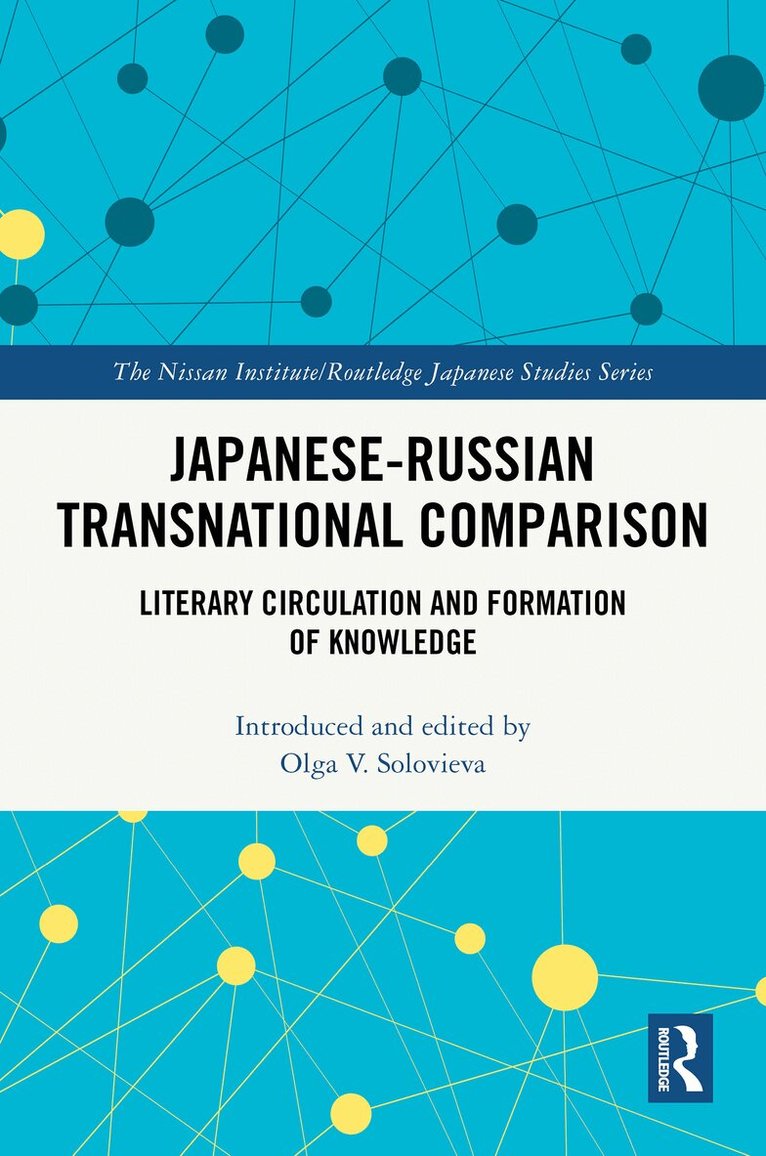
    Japanese-Russian Transnational Comparison

    Literary Circulation and Formation of Knowledge

    AvOlga V. Solovieva

    Inbunden, Engelska, 2026

    Del i serien Nissan Institute/Routledge Japanese Studies

    2 493 kr

    Beställningsvara. Skickas inom 10-15 vardagar. Fri frakt över 249 kr.

    Beskrivning

    This book examines the transnational circulation of knowledge between Russia and Japan from the early Meiji era to the present day, reconfiguring the East-West paradigm both in terms of socio-geographical divides and cultural and political tensions within both cultures. Featuring chapters from the fields of literature, history, philosophy, film, and social and political thought, the case studies give interdisciplinary examples of the ways in which Russian-Japanese intellectual relations offer cross-cultural interconnections and emphasize the global circulation of ideas while undermining reductive national constructs. By switching the perspective on the cultural history from the grand narratives of modernization and Westernization to that of individual and local case studies of agency, engagement, and creativity on the ground, the book uncovers a much more diverse, fluid, and complex landscape of intellectual history, rich in alternative contexts for understanding the past and embracing the future. Revealing not only the historical points of transfer of ideas, but also the textual and disciplinary forms of this transfer, this book will appeal to students and scholars of the culture, literature, society, and history of both Japan and Russia.

    Produktinformation

    • Utgivningsdatum:2026-05-06
    • Mått:156 x 234 x 14 mm
    • Vikt:570 g
    • Format:Inbunden
    • Språk:Engelska
    • Serie:Nissan Institute/Routledge Japanese Studies
    • Antal sidor:204
    • Förlag:Taylor & Francis Ltd
    • ISBN:9781032547220

    Utforska kategorier

    • Allmän historia och världshistoria inom Historia och arkeologi
    • Asiens historia inom Historia och arkeologi
    • Internationella relationer inom Samhälle och politik

    Mer om författaren

    Olga V. Solovieva is Researcher in Comparative and Slavonic Literatures at the Center of Excellence—Interacting Minds, Societies, Environments at the Nicolaus Copernicus University in Toruń, Poland.

    Recensioner i media

    “Japanese-Russian Transnational Comparison provides important new perspectives on linkages between Japan and Russia through a welcome focus on the complex circuits of circulation that inspire new forms of creativity and provide new ways of understanding literature, philosophy, and a range of additional fields. Rightly arguing for the interconnections between Japan and Russia to be perceived as a crucial link in global cultural history, Solovieva's new volume is a crucial addition to the fields of comparative and world literature.”Karen L. Thornber, Harvard University, USA“Comparative and transcultural readings are often caught within staid frameworks resulting in uninspiring literary-cultural pay-offs. This volume, however, brilliantly navigates through cartographic reason into the realms of metageography, metesis and border bashing laminarity where the reading lines opened between Russia and Japan are curvy, cracked and plastic. Urging a critical pause around the rationale of the comparative and the plasticity of the transcultural, this book makes us line the interpretive dots in ways that are unexpected and produce a ‘literary’ whose aesthetic-political affordances and molecularity are difficult to ignore.”Ranjan Ghosh, University of North Bengal, India“The collection of essays gathered together in Japanese-Russian Transnational Comparison challenge long-held assumptions and habits of thinking around comparative approaches. Texts become "relay points"; translations become a "coupling between social subsystems"; and national literary traditions become dynamic "links" in complex circuits of material and discursive circulation. Overall, the volume forces scholars to rethink the comparative analysis of culture through the lens of media and communication in ways that emphasize geographical contingency and the looping, non-linear paths by which texts and ideas circulate and hold together.”Hoyt Long, The University of Chicago, USA"A major contribution to comparative literary studies, this volume demonstrates how translations between Japanese and Russian writings emerge from complex global crossings of culture, history, and imagination. Its methodological innovation lies in showing how each text is a network of links between a present in one setting, a reframed past in another, and a new horizon of thought in a third."Prasenjit Duara, Duke University, USA"Olga Solovieva has compiled a groundbreaking collection of essays that significantly advances the field. The nine essays included here are often colored by ominous historical events and contexts, from Yellow Peril discourse to the massacre of Koreans by the Japanese in Sakhalin. Yet the book frames these events as "co-texts" which resonate with the texts themselves and generate a dynamic, mutual permeation— thereby moving the discourse beyond the conventional center–periphery paradigm. This book offers a ray of light in our difficult age of division and rupture." Mitsuyoshi Numano, The University of Tokyo, Japan

    Innehållsförteckning

    • Introduction. Transnational Comparison and Epistemology of Circulation Part I: Retracing Multiplicities 1. “like the arc of the Northern Lights”: Japan in Russia’s Asian Constellations 2. From Commune to Co-operation: Global Circuits and the Heiminsha Translation of The Conquest of Bread 3. Wests: The Logogenic Travels of Inoue Yasushi’s Writings on the Silk Road Part II: (A)Social Translations 4. Translating Madness: Psychiatry, Literature, and the Emergence of the “Modern Person” in Post-Russo-Japanese War Japan 5. I Saw a Pale Horse: Hayashi Fumiko, Boris Savinkov, and the Abjection of Revolution 6.Lenin’s Letter, the Japanese Writer, and the Soviet Ambassador: A Re-Reading of Tenkō Short Story “The House in the Village” by Nakano Shigeharu Part III: Rethinking Alliances 7. “Each Unhappy in Its Own Way”: Afterlives of Tolstoy’s Resurrection in Asian Drama and Film 8. “To Leave Contradictions as They Are”: Reconfiguring the Tolstoyan Network of Tanabe Hajime’s Philosophy as Metanoetics 9. The Three Trees at Midzuho: Konstantin Gaponenko, Tolstoyan Humanism, and Russian-Japanese-Korean Triangulation in Tragedy of Midzuho Village