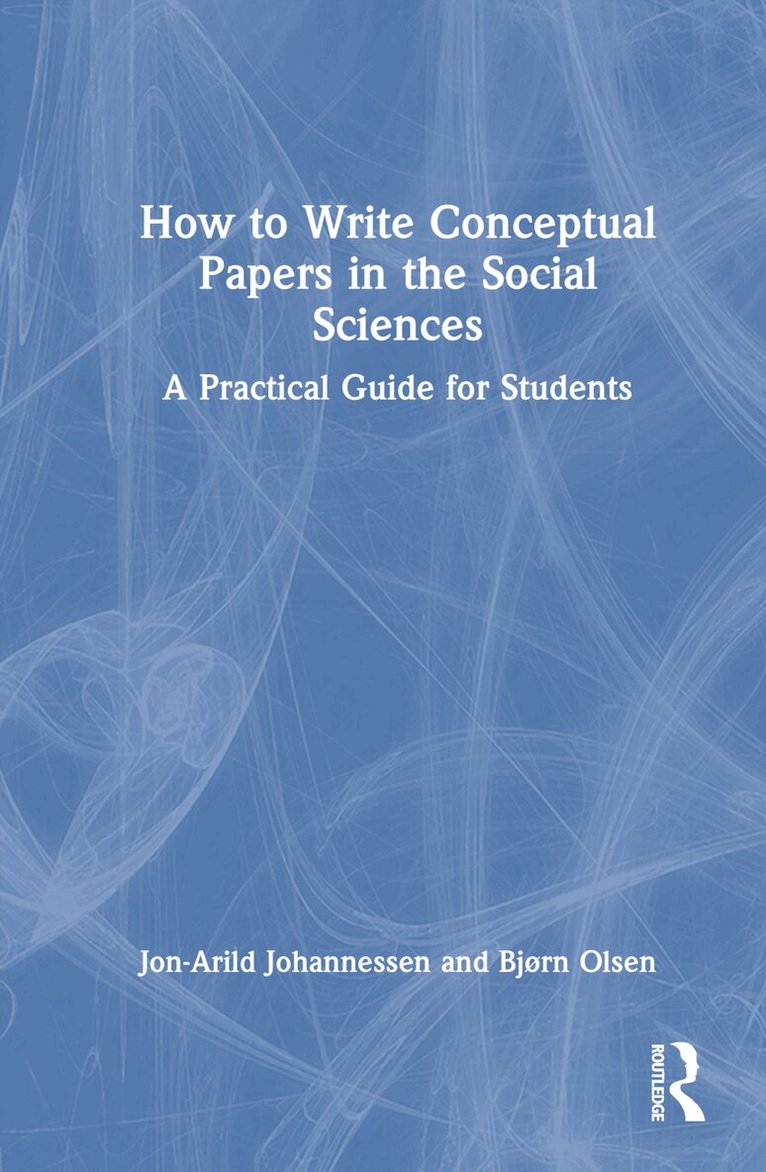
This book is a practical guide on how to write conceptual papers and use conceptual generalization as a research methodology. Divided into two parts, the book first focuses on the scientific foundation for conceptual generalization, to identify what is a conceptual model and how conceptual models can be developed. Part two focuses on how to write a winning conceptual thesis, covering conceptual generalisation and empirical generalisation, and discusses research problems and questions, and how to analyse them.The authors cover different conceptual and analytical models to offer students a multitude of tools to visualize, interpret and uncover relationships and patterns. For example, they explore the thought experiment, analytical models, empirical causal models, analytical forms and data mining models, and outline a strategy for developing conceptual models to assist with students who wish to design their own conceptual paper. Students gain a clear understanding of the driving forces in the research process, how to define a research problem, how to analysis the problem and develop research strategies. Moving from concepts to hypotheses, the book also covers the main types of errors that may be encountered as students learn about understanding the development of models and how to develop a theory.Also including a checklist for students, and a list of definitions and concepts, this is the ideal resource for advanced undergraduate and postgraduate students, and researchers, in the social sciences.
Jon-Arild Johannessen is Professor in Leadership, at Kristiania University College, Norway. He has previously held professor roles at Syd-Danske University, Denmark, The Arctic University, Norway, Bodø Graduate School of Business, Norway, and Norwegian School of Management (BI). He has written more than 200 international papers on innovation, knowledge management and leadership and is a prolific author, with over 30 books under his belt. Professor Johannessen has received a number of international awards for his research.Bjørn Olsen is Professor in Leadership at Nord University Business School. He also holds a professor position at Kristiania University college. He has previously been the Dean at Nord University Business School, and the President of Nord University. His research interest is on innovation, entrepreneurship, knowledge management and leadership. He has received international awards for his research.
Recensioner i media
Select Guide Rating
Innehållsförteckning
Preface Contents List of figures Part I. CONCEPTUAL GENERALIZATION Chapter One: Conceptual Generalisations 1.1. What is a conceptual model? 1.2. How can we develop a conceptual model? 1.3. A typology and strategy for the development of conceptual models 1.4. A strategy for the development of a conceptual model Concluding comments Part II: HOW TO WRITE A WINNING CONCEPTUAL THESIS Chapter 2. General considerations 2.1. Introduction2.2. Driving forces in the research process 2.3. Knowledge development Concluding comments Exercises Chapter 3. Research problems and questions 3.1. Introduction 3.2. Thorough preparation is half the solution 3.3. Problems 3.4. Problem-system Concluding comments Exercises Chapter 4. Analysis of the research problem 4.1. Introduction 4.2. The start of the process of asking questions 4.3. Problem relationships 4.4. Problem solutions Concluding comments Exercises Chapter 5. Our mental tools 5.1. Introduction 5.2. Constructs 5.3. Use of constructs in research Concluding comments Exercises Chapter 6. Suggestions for developing research strategies 6.1. Introduction 6.2. The first step in a research strategy 6.3. What is a scientific method? 6.4. The different approaches to research Concluding comments Exercises Chapter 7. The main types of errors 7.1. Introduction 7.2. Problem formulation 7.3. Models 7.4. Analysis 7.5. Synthesis 7.6. Implementation 7.7. Evaluation Concluding comments Exercises Chapter 8. From concepts to hypotheses 8.1. Introduction 8.2. The purpose of concepts and hypotheses 8.3. Mental constructs 8.4. Hypothesis Concluding comments Exercises Chapter 9 Types of hypotheses 9.1. Introduction 9.2. Descriptive and explanatory hypotheses Concluding comments Exercises Chapter 10. Systematization 10.1. Classification 10.2. Typologization 10.3. Classification Concluding comments Exercises Chapter 11. Simplification 11.1. Introduction 11.2. Phenomenon Concluding comments Exercises Chapter 12. Causality 12.1. Introduction 12.2. Cause and affect 12.3. Historical causal processes 12.4. Functional causal processes 12.5. Cybernetic causal processes 12.6. Pattern-based processes Concluding comments Exercise Chapter 13. Interpretation 13.1. Introduction 13.2. The interpretative process Concluding comments Exercises Chapter 14. Uncovering patterns 14.1. Introduction 14.2. Typology of patterns 14.3. Uncovering patterns Concluding comments Exercises Chapter 15. Understanding and explaining 15.1. Introduction 15.2. Describe, understand, explain 15.3. From data to knowledge Exercises Chapter 16. Development of models 16.1. Introduction 16.2. The purpose of developing models 16.3. Model types Concluding comments Exercises Chapter 17. Theory development 17.1. Introduction 17.2. Developing theories Concluding comments Exercises Chapter 18. Reflections Chapter 19: Checklist Chapter 20. Definitions of terms and concepts
Bertil Christensson, Simon Athlin, Per Björkman, Sara Cajander, Carl-Johan Fraenkel, Vanda Friman, Mia Furebring, Anna Färnert, Magnus Gisslén, Lars Hagberg, Håkan Hanberger, Anders F. Johansson, Fredrik Kahn, Adam Linder, Åsa Nilsdotter-Augustinsson, Björn Olsen, Magnus Rasmussen, Marie Studahl, Jonas Sundén-Cullberg, Bo Söderquist, Johan Westin, Per Åkesson
Annelie Brauner, Birgitta Castor, Kerstin Falk, Klas Kärre, Åsa Sjöling, Jan Albert, Tobias Allander, Annika Allard, Staffan Arvidson, Sven Bergström, Tomas Bergström, Sverker Bernander, Ola Blennow, Jonas Blomberg, Gordana Bogdanovic, Kristina Broliden, Maria Brytting, Tina Dalianis, Marie-Louise Danielsson-Tham, Joakim Dillner, Lena Dillner, Robert Dyrdak, Fredrik Elgh, Lars Engstrand, Ingemar Ernberg, Hans Fredlund, Maria Fällman, Christian Giske, Marta Granström, Lena Grillner, Marie Hagbom, Anna-Lena Hammarin, Lennart Hammarström, Berit Hammas, Birgitta Henriques Normark, Peter Horal, Petter Höglund, Thomas Jaenson, Kari Johansen, Karl-Erik Johansson, Karin Jung, Bertil Kaijser, Sara Karlsson Söbirk, Erik Kihlström, Lena Klingspor, Teresa Lagergård, Johan Lennerstrand, Ilona Lewensohn-Fuchs, Annika Linde, Magnus Lindh, Åsa Ljungh, Inger Ljungström, Åke Lundkvist, Birgitta Lytsy, Lars Magnius, Per Marits, Maria Masucci, Per Montan, Roland Möllby, Kenneth Nilsson, Carl Erik Nord, Heléne Norder, Johan Nordgren, Per Olcén, Björn Olsen, Björn Petrini, Karin Pettersson, Hilpi Rautelin, Kristian Riesbeck, Maria Rotzén Östlund, Gustaf Rydell, Charlotta Rydgård, Agneta Samuelson, Claës Schalén, Thomas Schön, Edvard Smith, Bo Svenungsson, Maria Söderlund-Venermo, Wilhelm Tham, Monica Thelestam, Erik Torell, Ulf Törnebladh, Magnus Unemo, Göran Wadell, Torkel Wadström, Mats Wahlgren, Britta Wahren, Andrej Weintraub, Anders Widell, Bengt Wretlind, Zhibing Yun, Lars Öhrmalm
Karl Ekdahl, Magnus Gisslén, Taha Alexandersson, Peter Almerson, Emmi Andersson, Sören Andersson, Martin Angelin, Veronica Arthurson, Olov Aspevall, Malin Bengnér, Andreas Bråve, Anneli Carlander, Ann-Sofi Duberg, Annika Elmgart, Lars Engstrand, Kathy Falkenstein-Hagander, Per Hagstam, Katarina Hedin, Kari Johansen, Anders F. Johansson, Jerker Jonsson, Jan Krut, Owe Källman, Marie Köhler, Lisa Labbé Sandelin, Lina Lilja, Fredrik Liljeros, Ann Lindberg, Mats Lindblad, Magnus Lindh, Laila Noppa, Jonas Näslund, Henrik Olinder, Björn Olsen, Erik Sturegård, Karl Ståhl, Martin Sundqvist, Åsa Szekely Björndal, Thomas Tängdén, Malin Veje, Thomas Wahlberg, Katarina Widgren
This book is a practical guide on how to write conceptual papers and use conceptual generalization as a research methodology. Divided into two parts, the book first focuses on the scientific foundation for conceptual generalization, to identify what is a conceptual model and how conceptual models can be developed. Part two focuses on how to write a winning conceptual thesis, covering conceptual generalisation and empirical generalisation, and discusses research problems and questions, and how to analyse them.The authors cover different conceptual and analytical models to offer students a multitude of tools to visualize, interpret and uncover relationships and patterns. For example, they explore the thought experiment, analytical models, empirical causal models, analytical forms and data mining models, and outline a strategy for developing conceptual models to assist with students who wish to design their own conceptual paper. Students gain a clear understanding of the driving forces in the research process, how to define a research problem, how to analysis the problem and develop research strategies. Moving from concepts to hypotheses, the book also covers the main types of errors that may be encountered as students learn about understanding the development of models and how to develop a theory.Also including a checklist for students, and a list of definitions and concepts, this is the ideal resource for advanced undergraduate and postgraduate students, and researchers, in the social sciences.
Jon-Arild Johannessen is Professor in Leadership, at Kristiania University College, Norway. He has previously held professor roles at Syd-Danske University, Denmark, The Arctic University, Norway, Bodø Graduate School of Business, Norway, and Norwegian School of Management (BI). He has written more than 200 international papers on innovation, knowledge management and leadership and is a prolific author, with over 30 books under his belt. Professor Johannessen has received a number of international awards for his research.Bjørn Olsen is Professor in Leadership at Nord University Business School. He also holds a professor position at Kristiania University college. He has previously been the Dean at Nord University Business School, and the President of Nord University. His research interest is on innovation, entrepreneurship, knowledge management and leadership. He has received international awards for his research.
Recensioner i media
Select Guide Rating
Innehållsförteckning
Preface Contents List of figures Part I. CONCEPTUAL GENERALIZATION Chapter One: Conceptual Generalisations 1.1. What is a conceptual model? 1.2. How can we develop a conceptual model? 1.3. A typology and strategy for the development of conceptual models 1.4. A strategy for the development of a conceptual model Concluding comments Part II: HOW TO WRITE A WINNING CONCEPTUAL THESIS Chapter 2. General considerations 2.1. Introduction2.2. Driving forces in the research process 2.3. Knowledge development Concluding comments Exercises Chapter 3. Research problems and questions 3.1. Introduction 3.2. Thorough preparation is half the solution 3.3. Problems 3.4. Problem-system Concluding comments Exercises Chapter 4. Analysis of the research problem 4.1. Introduction 4.2. The start of the process of asking questions 4.3. Problem relationships 4.4. Problem solutions Concluding comments Exercises Chapter 5. Our mental tools 5.1. Introduction 5.2. Constructs 5.3. Use of constructs in research Concluding comments Exercises Chapter 6. Suggestions for developing research strategies 6.1. Introduction 6.2. The first step in a research strategy 6.3. What is a scientific method? 6.4. The different approaches to research Concluding comments Exercises Chapter 7. The main types of errors 7.1. Introduction 7.2. Problem formulation 7.3. Models 7.4. Analysis 7.5. Synthesis 7.6. Implementation 7.7. Evaluation Concluding comments Exercises Chapter 8. From concepts to hypotheses 8.1. Introduction 8.2. The purpose of concepts and hypotheses 8.3. Mental constructs 8.4. Hypothesis Concluding comments Exercises Chapter 9 Types of hypotheses 9.1. Introduction 9.2. Descriptive and explanatory hypotheses Concluding comments Exercises Chapter 10. Systematization 10.1. Classification 10.2. Typologization 10.3. Classification Concluding comments Exercises Chapter 11. Simplification 11.1. Introduction 11.2. Phenomenon Concluding comments Exercises Chapter 12. Causality 12.1. Introduction 12.2. Cause and affect 12.3. Historical causal processes 12.4. Functional causal processes 12.5. Cybernetic causal processes 12.6. Pattern-based processes Concluding comments Exercise Chapter 13. Interpretation 13.1. Introduction 13.2. The interpretative process Concluding comments Exercises Chapter 14. Uncovering patterns 14.1. Introduction 14.2. Typology of patterns 14.3. Uncovering patterns Concluding comments Exercises Chapter 15. Understanding and explaining 15.1. Introduction 15.2. Describe, understand, explain 15.3. From data to knowledge Exercises Chapter 16. Development of models 16.1. Introduction 16.2. The purpose of developing models 16.3. Model types Concluding comments Exercises Chapter 17. Theory development 17.1. Introduction 17.2. Developing theories Concluding comments Exercises Chapter 18. Reflections Chapter 19: Checklist Chapter 20. Definitions of terms and concepts
Bertil Christensson, Simon Athlin, Per Björkman, Sara Cajander, Carl-Johan Fraenkel, Vanda Friman, Mia Furebring, Anna Färnert, Magnus Gisslén, Lars Hagberg, Håkan Hanberger, Anders F. Johansson, Fredrik Kahn, Adam Linder, Åsa Nilsdotter-Augustinsson, Björn Olsen, Magnus Rasmussen, Marie Studahl, Jonas Sundén-Cullberg, Bo Söderquist, Johan Westin, Per Åkesson
Annelie Brauner, Birgitta Castor, Kerstin Falk, Klas Kärre, Åsa Sjöling, Jan Albert, Tobias Allander, Annika Allard, Staffan Arvidson, Sven Bergström, Tomas Bergström, Sverker Bernander, Ola Blennow, Jonas Blomberg, Gordana Bogdanovic, Kristina Broliden, Maria Brytting, Tina Dalianis, Marie-Louise Danielsson-Tham, Joakim Dillner, Lena Dillner, Robert Dyrdak, Fredrik Elgh, Lars Engstrand, Ingemar Ernberg, Hans Fredlund, Maria Fällman, Christian Giske, Marta Granström, Lena Grillner, Marie Hagbom, Anna-Lena Hammarin, Lennart Hammarström, Berit Hammas, Birgitta Henriques Normark, Peter Horal, Petter Höglund, Thomas Jaenson, Kari Johansen, Karl-Erik Johansson, Karin Jung, Bertil Kaijser, Sara Karlsson Söbirk, Erik Kihlström, Lena Klingspor, Teresa Lagergård, Johan Lennerstrand, Ilona Lewensohn-Fuchs, Annika Linde, Magnus Lindh, Åsa Ljungh, Inger Ljungström, Åke Lundkvist, Birgitta Lytsy, Lars Magnius, Per Marits, Maria Masucci, Per Montan, Roland Möllby, Kenneth Nilsson, Carl Erik Nord, Heléne Norder, Johan Nordgren, Per Olcén, Björn Olsen, Björn Petrini, Karin Pettersson, Hilpi Rautelin, Kristian Riesbeck, Maria Rotzén Östlund, Gustaf Rydell, Charlotta Rydgård, Agneta Samuelson, Claës Schalén, Thomas Schön, Edvard Smith, Bo Svenungsson, Maria Söderlund-Venermo, Wilhelm Tham, Monica Thelestam, Erik Torell, Ulf Törnebladh, Magnus Unemo, Göran Wadell, Torkel Wadström, Mats Wahlgren, Britta Wahren, Andrej Weintraub, Anders Widell, Bengt Wretlind, Zhibing Yun, Lars Öhrmalm
Karl Ekdahl, Magnus Gisslén, Taha Alexandersson, Peter Almerson, Emmi Andersson, Sören Andersson, Martin Angelin, Veronica Arthurson, Olov Aspevall, Malin Bengnér, Andreas Bråve, Anneli Carlander, Ann-Sofi Duberg, Annika Elmgart, Lars Engstrand, Kathy Falkenstein-Hagander, Per Hagstam, Katarina Hedin, Kari Johansen, Anders F. Johansson, Jerker Jonsson, Jan Krut, Owe Källman, Marie Köhler, Lisa Labbé Sandelin, Lina Lilja, Fredrik Liljeros, Ann Lindberg, Mats Lindblad, Magnus Lindh, Laila Noppa, Jonas Näslund, Henrik Olinder, Björn Olsen, Erik Sturegård, Karl Ståhl, Martin Sundqvist, Åsa Szekely Björndal, Thomas Tängdén, Malin Veje, Thomas Wahlberg, Katarina Widgren
This book is a practical guide on how to write conceptual papers and use conceptual generalization as a research methodology. Divided into two parts, the book first focuses on the scientific foundation for conceptual generalization, to identify what is a conceptual model and how conceptual models can be developed. Part two focuses on how to write a winning conceptual thesis, covering conceptual generalisation and empirical generalisation, and discusses research problems and questions, and how to analyse them.The authors cover different conceptual and analytical models to offer students a multitude of tools to visualize, interpret and uncover relationships and patterns. For example, they explore the thought experiment, analytical models, empirical causal models, analytical forms and data mining models, and outline a strategy for developing conceptual models to assist with students who wish to design their own conceptual paper. Students gain a clear understanding of the driving forces in the research process, how to define a research problem, how to analysis the problem and develop research strategies. Moving from concepts to hypotheses, the book also covers the main types of errors that may be encountered as students learn about understanding the development of models and how to develop a theory.Also including a checklist for students, and a list of definitions and concepts, this is the ideal resource for advanced undergraduate and postgraduate students, and researchers, in the social sciences.
Jon-Arild Johannessen is Professor in Leadership, at Kristiania University College, Norway. He has previously held professor roles at Syd-Danske University, Denmark, The Arctic University, Norway, Bodø Graduate School of Business, Norway, and Norwegian School of Management (BI). He has written more than 200 international papers on innovation, knowledge management and leadership and is a prolific author, with over 30 books under his belt. Professor Johannessen has received a number of international awards for his research.Bjørn Olsen is Professor in Leadership at Nord University Business School. He also holds a professor position at Kristiania University college. He has previously been the Dean at Nord University Business School, and the President of Nord University. His research interest is on innovation, entrepreneurship, knowledge management and leadership. He has received international awards for his research.
Recensioner i media
Select Guide Rating
Innehållsförteckning
Preface Contents List of figures Part I. CONCEPTUAL GENERALIZATION Chapter One: Conceptual Generalisations 1.1. What is a conceptual model? 1.2. How can we develop a conceptual model? 1.3. A typology and strategy for the development of conceptual models 1.4. A strategy for the development of a conceptual model Concluding comments Part II: HOW TO WRITE A WINNING CONCEPTUAL THESIS Chapter 2. General considerations 2.1. Introduction2.2. Driving forces in the research process 2.3. Knowledge development Concluding comments Exercises Chapter 3. Research problems and questions 3.1. Introduction 3.2. Thorough preparation is half the solution 3.3. Problems 3.4. Problem-system Concluding comments Exercises Chapter 4. Analysis of the research problem 4.1. Introduction 4.2. The start of the process of asking questions 4.3. Problem relationships 4.4. Problem solutions Concluding comments Exercises Chapter 5. Our mental tools 5.1. Introduction 5.2. Constructs 5.3. Use of constructs in research Concluding comments Exercises Chapter 6. Suggestions for developing research strategies 6.1. Introduction 6.2. The first step in a research strategy 6.3. What is a scientific method? 6.4. The different approaches to research Concluding comments Exercises Chapter 7. The main types of errors 7.1. Introduction 7.2. Problem formulation 7.3. Models 7.4. Analysis 7.5. Synthesis 7.6. Implementation 7.7. Evaluation Concluding comments Exercises Chapter 8. From concepts to hypotheses 8.1. Introduction 8.2. The purpose of concepts and hypotheses 8.3. Mental constructs 8.4. Hypothesis Concluding comments Exercises Chapter 9 Types of hypotheses 9.1. Introduction 9.2. Descriptive and explanatory hypotheses Concluding comments Exercises Chapter 10. Systematization 10.1. Classification 10.2. Typologization 10.3. Classification Concluding comments Exercises Chapter 11. Simplification 11.1. Introduction 11.2. Phenomenon Concluding comments Exercises Chapter 12. Causality 12.1. Introduction 12.2. Cause and affect 12.3. Historical causal processes 12.4. Functional causal processes 12.5. Cybernetic causal processes 12.6. Pattern-based processes Concluding comments Exercise Chapter 13. Interpretation 13.1. Introduction 13.2. The interpretative process Concluding comments Exercises Chapter 14. Uncovering patterns 14.1. Introduction 14.2. Typology of patterns 14.3. Uncovering patterns Concluding comments Exercises Chapter 15. Understanding and explaining 15.1. Introduction 15.2. Describe, understand, explain 15.3. From data to knowledge Exercises Chapter 16. Development of models 16.1. Introduction 16.2. The purpose of developing models 16.3. Model types Concluding comments Exercises Chapter 17. Theory development 17.1. Introduction 17.2. Developing theories Concluding comments Exercises Chapter 18. Reflections Chapter 19: Checklist Chapter 20. Definitions of terms and concepts
Bertil Christensson, Simon Athlin, Per Björkman, Sara Cajander, Carl-Johan Fraenkel, Vanda Friman, Mia Furebring, Anna Färnert, Magnus Gisslén, Lars Hagberg, Håkan Hanberger, Anders F. Johansson, Fredrik Kahn, Adam Linder, Åsa Nilsdotter-Augustinsson, Björn Olsen, Magnus Rasmussen, Marie Studahl, Jonas Sundén-Cullberg, Bo Söderquist, Johan Westin, Per Åkesson
Annelie Brauner, Birgitta Castor, Kerstin Falk, Klas Kärre, Åsa Sjöling, Jan Albert, Tobias Allander, Annika Allard, Staffan Arvidson, Sven Bergström, Tomas Bergström, Sverker Bernander, Ola Blennow, Jonas Blomberg, Gordana Bogdanovic, Kristina Broliden, Maria Brytting, Tina Dalianis, Marie-Louise Danielsson-Tham, Joakim Dillner, Lena Dillner, Robert Dyrdak, Fredrik Elgh, Lars Engstrand, Ingemar Ernberg, Hans Fredlund, Maria Fällman, Christian Giske, Marta Granström, Lena Grillner, Marie Hagbom, Anna-Lena Hammarin, Lennart Hammarström, Berit Hammas, Birgitta Henriques Normark, Peter Horal, Petter Höglund, Thomas Jaenson, Kari Johansen, Karl-Erik Johansson, Karin Jung, Bertil Kaijser, Sara Karlsson Söbirk, Erik Kihlström, Lena Klingspor, Teresa Lagergård, Johan Lennerstrand, Ilona Lewensohn-Fuchs, Annika Linde, Magnus Lindh, Åsa Ljungh, Inger Ljungström, Åke Lundkvist, Birgitta Lytsy, Lars Magnius, Per Marits, Maria Masucci, Per Montan, Roland Möllby, Kenneth Nilsson, Carl Erik Nord, Heléne Norder, Johan Nordgren, Per Olcén, Björn Olsen, Björn Petrini, Karin Pettersson, Hilpi Rautelin, Kristian Riesbeck, Maria Rotzén Östlund, Gustaf Rydell, Charlotta Rydgård, Agneta Samuelson, Claës Schalén, Thomas Schön, Edvard Smith, Bo Svenungsson, Maria Söderlund-Venermo, Wilhelm Tham, Monica Thelestam, Erik Torell, Ulf Törnebladh, Magnus Unemo, Göran Wadell, Torkel Wadström, Mats Wahlgren, Britta Wahren, Andrej Weintraub, Anders Widell, Bengt Wretlind, Zhibing Yun, Lars Öhrmalm
Karl Ekdahl, Magnus Gisslén, Taha Alexandersson, Peter Almerson, Emmi Andersson, Sören Andersson, Martin Angelin, Veronica Arthurson, Olov Aspevall, Malin Bengnér, Andreas Bråve, Anneli Carlander, Ann-Sofi Duberg, Annika Elmgart, Lars Engstrand, Kathy Falkenstein-Hagander, Per Hagstam, Katarina Hedin, Kari Johansen, Anders F. Johansson, Jerker Jonsson, Jan Krut, Owe Källman, Marie Köhler, Lisa Labbé Sandelin, Lina Lilja, Fredrik Liljeros, Ann Lindberg, Mats Lindblad, Magnus Lindh, Laila Noppa, Jonas Näslund, Henrik Olinder, Björn Olsen, Erik Sturegård, Karl Ståhl, Martin Sundqvist, Åsa Szekely Björndal, Thomas Tängdén, Malin Veje, Thomas Wahlberg, Katarina Widgren