• Fri frakt över 249 kr
  • •
  • Snabba leveranser
  • •
  • Billiga böcker
Kundservice

Du är på sajten för privatpersoner.

Företag, bibliotek eller offentlig verksamhet?

Du handlar på classic.bokus.com, där alla dina funktioner finns intakta.
Till classic.bokus.com
Bokus logotyp. Gå till startsidan.
  • Erbjudanden
  • Nyheter
  • Student
  • Topplistor
  • Barn & ungdom
  • Bokus Play
  • E-böcker
  • Pocketböcker
  • Spel & pussel

10% rabatt på allt med kod: NYSTART10 →

Sidfot

Mina sidor

    Hjälp

    • Kundservice
    • Vanliga frågor och svar
    • Frakt och leverans
    • Retur vid ångerrätt
    • Reklamera vara
    • Betalning
    • Köpvillkor
    • Allmänna villkor
    • Information om webbplatsens tillgänglighet

    Om Bokus

    • Om oss
    • Pressrum
    • För studenter
    • För företag
    • För bibliotek och offentlig verksamhet
    • För leverantörer
    • Hållbarhet

    Populärt

    • Aktuella erbjudanden
    • Presentkort
    • Studentlitteratur
    • Nya böcker
    • Topplistor
    • Signerade böcker
    • Engelska böcker

    Inspiration

    • Boktips
    • BookTok
    • Populära bokserier
    • Barnbokskaraktärer
    • Populära författare
    Logotyp för Bokus
    Följ oss på Facebook (extern länk)Följ oss på Instagram (extern länk)Följ oss på YouTube (extern länk)Följ oss på TikTok (extern länk)
    bokus @ CookiesAnpassa cookiesIntegritetspolicyKöpvillkor
    Till Citymail hemsida (extern länk)Till Budbee hemsida (extern länk)Till Postnord hemsida (extern länk)Till Schenker hemsida (extern länk)Till Early Bird hemsida (extern länk)Till Walleys hemsida (extern länk)
    1. Skönlitteratur
    2. Litteraturvetenskap
    3. Litteraturvetenskap

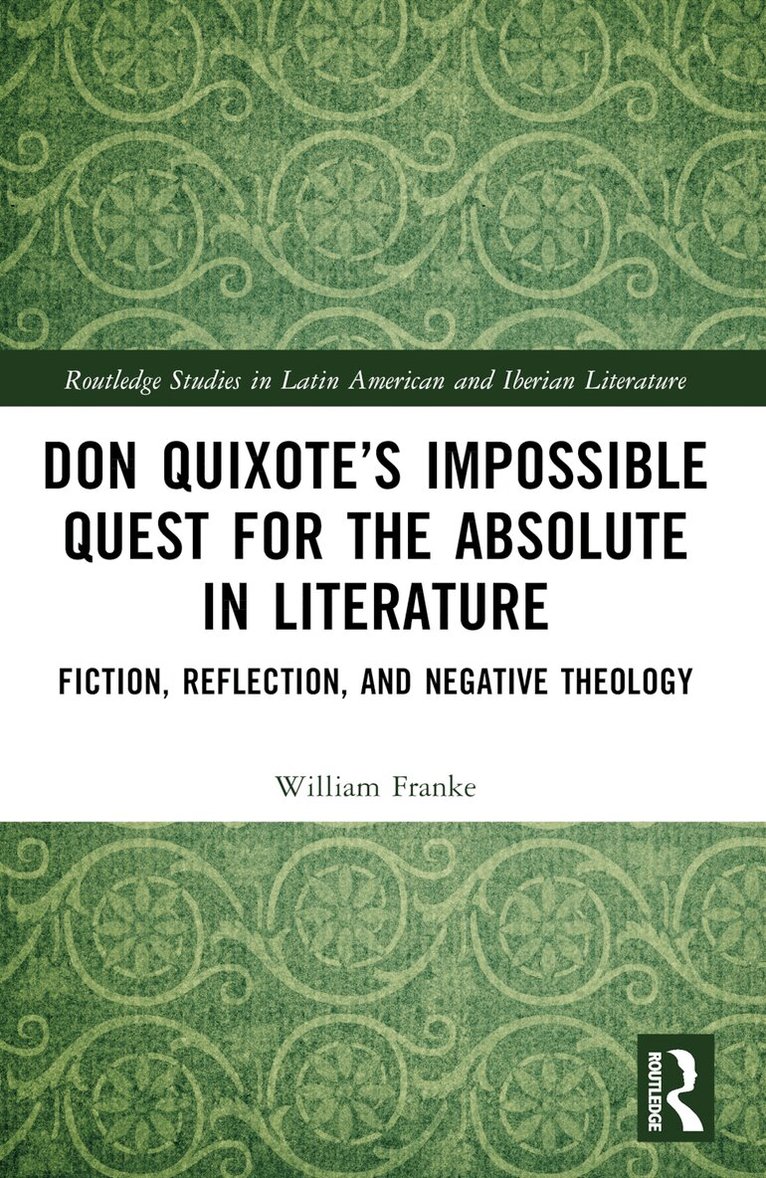
    Don Quixote’s Impossible Quest for the Absolute in Literature

    Fiction, Reflection, and Negative Theology

    AvWilliam Franke

    Häftad, Engelska, 2026

    Del i serien Routledge Studies in Latin American and Iberian Literature

    734 kr

    Beställningsvara. Skickas inom 10-15 vardagar. Fri frakt över 249 kr.

    Fler format och utgåvor

    Inbunden

    2 784 kr

    E-bok

    926 kr

    E-bok

    890 kr

    Beskrivning

    This book offers a reading particularly of Part II of Don Quixote, a reading that is embedded in a philosophical reflection on the revelation of religious truth in and through literature. Part II of Don Quixote is the far richer part for its meta-literary reflection on the novel itself as a genre and on life as such seen through the lens of self-reflection. The author has treated the phenomenon of modern self-reflexivity as originally theological in nature in previous publications (notably Dante’s Paradiso and the Theological Origins of Modern Thought: Toward a Speculative Philosophy of Self-Reflection, Routledge, 2021). The present endeavor expands this overall intellectual project, extending it into detailed consideration of what is recognizably another nodal great work inaugurating unprecedented forms of self-reflection in the early modern period. Reading the founding texts of literary and cultural tradition in this negative-theological key proves crucial to allowing them to release the full force of their religious vision in the present age, despite its sometimes obstinate secularity. This reading absorbs and reconciles the religious and secular readings of Miguel de Unamuno and José Ortega y Gasset, two of Spain’s outstanding philosophical luminaries. Both thinkers based their entire philosophies and their analyses of the Spanish national character and destiny on their interpretations of the Quixote. Negative theology deploys critical reason that critiques the limits of reason itself and opens toward an unfathomable (un)ground of All. Such speculative interpretation performs a synthesis of the secularizing and sacralizing tendencies that are both sublimely operative in the text of the Quixote. It thereby enables the work to emerge in the fully parodic and paradoxical vitality that other interpretations, governed by one paradigm or the other, access only partially. Rather than falling into one camp or the other, the proposed approach combines and resources both heritages, sacred and secular, in their deepest synergisms. Spanish baroque mysticism and contemporary post-secular thought are made to converge in highlighting the blessed, even sacred, donation that literature like Don Quixote preserves and transmits as our most precious and saving cultural heritage.

    Produktinformation

    • Utgivningsdatum:2026-01-29
    • Mått:152 x 229 x 14 mm
    • Vikt:470 g
    • Format:Häftad
    • Språk:Engelska
    • Serie:Routledge Studies in Latin American and Iberian Literature
    • Antal sidor:240
    • Förlag:Taylor & Francis Ltd
    • ISBN:9781032688992

    Utforska kategorier

    • Litteraturvetenskap inom Skönlitteratur
    • Litteraturteori inom Skönlitteratur
    • Religion: allmänt inom Filosofi och religion

    Mer om författaren

    William Franke is Professor of Comparative Literature at Vanderbilt University. He is currently Francesco de Dombrowski Professor in Residence at the Harvard University Center for Renaissance Studies in Florence (Villa I Tatti) and Senior Fellow of the International Institute for Hermeneutics. He has been Research Fellow of the Alexander von Humboldt-Stiftung, Professor of Philosophy at the University of Macao, Visiting Professor of Philosophy at the University of Navarra, and Fulbright Distinguished Chair in Intercultural Theology and the Study of Religions at the University of Salzburg. His books include On What Cannot Be Said (2007); Poetry and Apocalypse (2009); Dante and the Sense of Transgression (2013); A Philosophy of the Unsayable (2014); The Revelation of Imagination (2015); Secular Scriptures (2016); A Theology of Literature (2018); The Universality of What is Not (2020); The Divine Vision of Dante’s Paradiso (2021); The Vita Nuova and the New Testament (2021); Dantologies (2024); and numerous others.

    Recensioner i media

    "This is one of the very best, most interesting studies of Cervantes’ Don Quixote that I have read in some time. . . . I consistently found myself engaged by the argument, fascinated by the detailed analyses, and impressed by the depth of thought in evidence in this work. It’s clear that Franke really “gets” the complexity and the importance of Don Quixote, and he does a superb job communicating this to the reader. . . .In a scholarly landscape that is littered with studies of Don Quixote that often fail to do justice to Cervantes’ text, Franke’s study stands out for the way in which it truly captures the profundity of the work."-Anthony J. Cascardi, Sidney and Margaret Distinguished Professor of Comparative Literature, University of California, BerkeleyA celebrated scholar of Dante and of the discipline known as apophatic theology or negative theology, William Franke in Don Quixote’s Impossible Quest for the Absolute in Literature offers us a tour-de force interpretation of how Cervantes searches for God’s revelation of truth in theologically diverse apophatic discourses. Franke’s exegetical reflections converse with Ortega’s, Unamuno’s, and Zambrano’s respective meditations on Cervantes’s masterpiece, allowing the reader to get a taste of the parodic laughter in Don Quixote, a mode of discourse that speaks (or rather un-speaks) of the impossible quest for the transcendent and the divine. Franke’s is a complex and excellent book that sheds insight upon Don Quixote’s experience of the divine around him.-Antonio Cortijo Ocaña, Professor, University of California, Santa BarbaraWilliam Franke’s Don Quixote’s Impossible Quest for the Absolute in Literature: Fiction, Reflection, and Negative Theology could hardly be a more ambitious project, and I believe that the results are brilliant. Professor Franke has analyzed Don Quixote using his unique and wide-ranging background in literature, culture, theology, and philosophy, not to mention his familiarity with the meta- offspring of Cervantes’s work. I find the framing of the theses and arguments to be superb. The critic lays the foundations for his particular readings, upon which readers can reflect and debate.-Edward H. Friedman, Gertrude Conaway Vanderbilt Professor in the Humanities, Vanderbilt University, Tennessee

    Innehållsförteckning

    • List of FiguresAcknowledgmentsPrologue Concerning Apophatic Theology in Literary Representation and ReflectionChapter 1 The Revelation of Laughter: Cervantes’s Comic Christian MuseThe Power of Laughter—The Wisdom of FollyA Negative Theological Reading of Don QuixoteFool for Christ as Universal SageDon Quixote’s Contemporaneity and UniversalityThe Holy Fool as Christian Saint and CrusaderUnamuno and Ortega: Dialectic of the Religious and the Secular Chapter 2 Self-reflective Dynamics of Revelation in LiteratureA. Self-subversive Mirroring Between and Among the ProtagonistsThe Knight of Mirrors and of the White Moon as Self-reflection of Don QuixoteDon Quixote’s Ideal Reflected in Sancho—and InverselySelf-reflexivity as Self-fulfilling IdealBecoming a Book and Reading One’s LifeB. Self-reflection and Undermining the Authority of the AuthorSelf-reflective Questioning of AuthorshipCervantes’s Self-representations in the ProloguesAuthorship and OriginalitySelf-reflexivity in the Narrative Structure of FictionFictionalization of Author by Self-reflection—Kafka and BorgesThe Dialectic of Self-reflection and Negative TheologyChapter 3 Negative Theology of the NovelThe Novel as Breaking Down the Separation of Styles—Auerbach Recognition Scenes: Epiphanies and TheophaniesThe Novel as Subjective Reflective Medium and Genre Reflecting Concrete RealityThe Novel as Subjectively Lived ExperienceThe Novel as a New and Comprehensive GenreDialectics of WholenessThe In-breaking of External Reality Into FictionMutual Contamination of History and Fiction and Their Exposure to ExternalityMaese Pedro’s Puppet Show and Unamuno’s Move Through Fiction to RealityOrtega on Literary Genre: From Epic Myth to Novelistic Formal RealityNovelistic Creation of Formal Reality—Ortega and Maese Pedro’s Puppet TheatreFiction and Realization of the IdealChapter 4 Visionary Experience in the Cave of Montesinos as Revelation via ParodyThe Vision of Montesinos, or the Part of Fiction in the Construction of Prophetic RevelationThe Question of Truth Raised by the Vision in the CaveArtifice and the Limits of the Control of the AuthorThe Reality that Our Fictions BecomeThe Ontological Argument for Dulcinea’s ExistenceReal Costs of One’s Fictive InventionsRepetitions of Visionary Revelation following MontesinosSancho’s Perversion of Visionary Experience—ClavileñoVisionary Revelation After the Cave of Montesinos—Its Translation Into the EverydayChapter 5 Dialectic of Religious Truth and Its Secular SimulationReligious and Anti-religious Interpretations of the Quixote: Religion Versus SecularityVelázquez’s Las Meninas: Self-reflexivity and the OtherCamacho’s Wedding as Theatrical Artifice and Its Sacramental TransfigurationBaroque Aesthetics of Contrast, the Grotesque, and Theatricalization of the WorldFeminine Beauty as Ideal and as SimulationTransvestism, Love of Artifice, and the TranshumanFormal Dimension of Reality—Names as Revelation—AntonomasiaArchetypal Image and Primal Naming—Spitzer’s Linguistic PerspectivismThe Epistolary Novel and the Scriptural IdealDialectic of Self-reflective Desengaño and Disinterested DedicationChapter 6 A Political Novel: Representation of an Idealized World Versus Contemporary RealityThe Baroque Age: Aesthetics of the Ideal, Realism, and the UnrepresentableBarataria as Anti-utopia of a Perfectly Artificial StateKnowing One’s Limits and Becoming Oneself: Sancho in “Hell”The Contemporary Expulsion Drama and the Apotheosis of FictionThe Realistic Political Novel as an Overture to ModernityBarcelona and the New MaterialismChapter 7 The Passion of Sancho Panza and the Death of Don QuixoteThe Wise Fool—Like Master Like Servant: Sancho’s GovernanceSancho’s Assuming the Lead Position in the DuoVisionary Revisitations—Sancho in the Role of the Christ FigureAltisidora’s Invention of a Visionary RevelationDon Quixote’s Death and Bequest—The Heroism of the Common Person?The Christian Death of Alonso Quijano—and Sancho’s Passion to LiveChapter 8 The Metaphysics of FictionThe Force of FictionReal Tragedy in Fiction—Carl SchmittAmbiguity of Fictive Truth in Epic Tradition and Its Modern ParodyWhat Makes a Book of Poetic Literature Great—or Revelatory?The Integration of Fiction into Reality and Vice Versa—Vargas LlosaSelf-reflection at the Juncture of Fiction and Ultimate RealityThe Apophatic in Literature—An Aesthetic Dimension of the RealChapter 9 Philosophies of QuixotismUnamuno’s Quixotesque Turning of Philosophy into ReligionOrtega’s Cervantesque Philosophy of Desengaño as a Theory of GenresUnamuno on Quixotism as the True Philosophy and Religion of the Spanish PeopleUnamuno’s Staging of the Battle Between Reason and Faith—Reason’s Self-underminingThe Novel as Philosophy, Don Quixote as TragicomedyTowards Ortega’s Philosophy of Relations as a Type of Secular RevelationMaria Zambrano’s Mediation of Two Philosophical MastersA Parting ReflectionIndex