• Fri frakt över 249 kr
  • •
  • Snabba leveranser
  • •
  • Billiga böcker
Kundservice

Du är på sajten för privatpersoner.

Företag, bibliotek eller offentlig verksamhet?

Du handlar på classic.bokus.com, där alla dina funktioner finns intakta.
Till classic.bokus.com
Bokus logotyp. Gå till startsidan.
  • Erbjudanden
  • Nyheter
  • Student
  • Topplistor
  • Barn & ungdom
  • Bokus Play
  • E-böcker
  • Pocketböcker
  • Spel & pussel

Må bättre, för mindre! Upp till 50% rabatt på hälsoböcker

Sidfot

Mina sidor

    Hjälp

    • Kundservice
    • Vanliga frågor och svar
    • Frakt och leverans
    • Retur vid ångerrätt
    • Reklamera vara
    • Betalning
    • Köpvillkor
    • Allmänna villkor
    • Information om webbplatsens tillgänglighet

    Om Bokus

    • Om oss
    • Pressrum
    • För studenter
    • För företag
    • För bibliotek och offentlig verksamhet
    • För leverantörer
    • Hållbarhet

    Populärt

    • Aktuella erbjudanden
    • Presentkort
    • Studentlitteratur
    • Nya böcker
    • Topplistor
    • Signerade böcker
    • Engelska böcker

    Inspiration

    • Boktips
    • BookTok
    • Populära bokserier
    • Barnbokskaraktärer
    • Populära författare
    Logotyp för Bokus
    Följ oss på Facebook (extern länk)Följ oss på Instagram (extern länk)Följ oss på YouTube (extern länk)Följ oss på TikTok (extern länk)
    bokus @ CookiesAnpassa cookiesIntegritetspolicyKöpvillkor
    Till Citymail hemsida (extern länk)Till Budbee hemsida (extern länk)Till Postnord hemsida (extern länk)Till Schenker hemsida (extern länk)Till Early Bird hemsida (extern länk)Till Walleys hemsida (extern länk)
    1. Samhälle och politik
    2. Politik och statsskick
    3. Internationella relationer

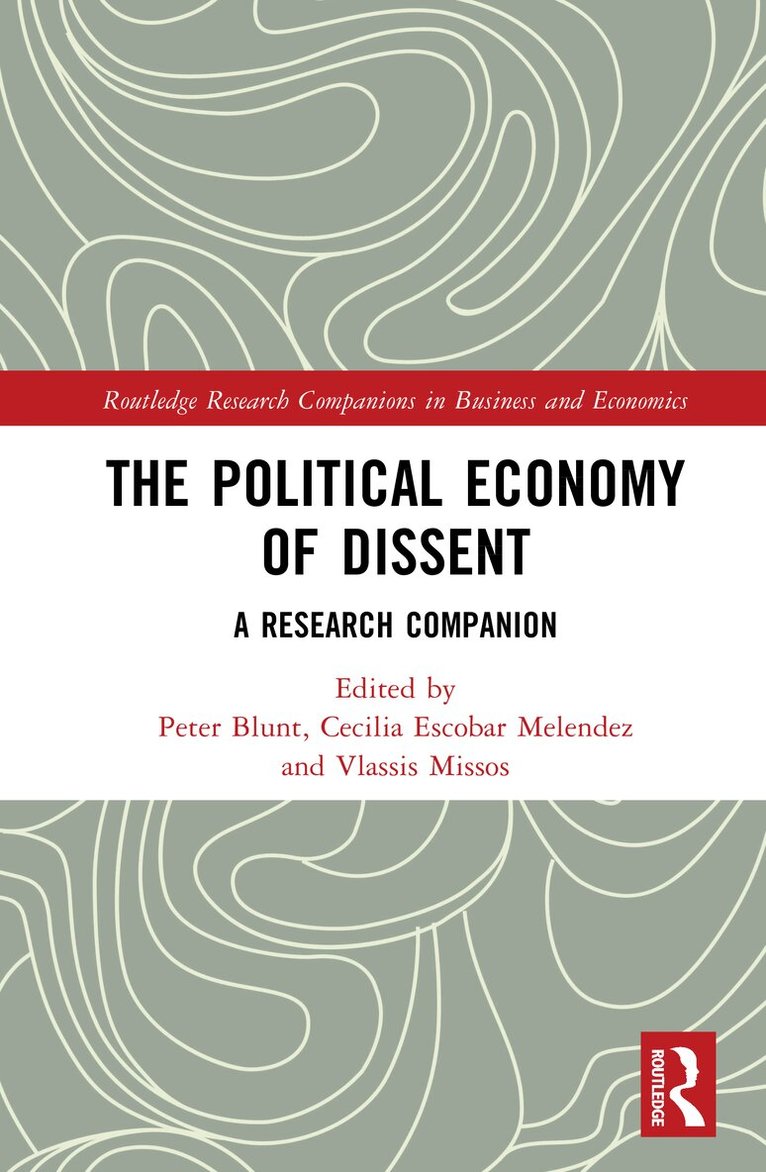
    Political Economy of Dissent

    A Research Companion

    AvPeter Blunt,Cecilia Escobar

    Inbunden, Engelska, 2025

    Del i serien Routledge Research Companions in Business and Economics

    2 421 kr

    Beställningsvara. Skickas inom 10-15 vardagar. Fri frakt över 249 kr.

    Beskrivning

    In 2020 Noam Chomsky asserted that the time to panic about the existential threats posed by nuclear war, global warming, and the stifling of informed debate in supposedly open and democratic societies was upon us, and that it was the duty of concerned citizens to act accordingly. Hastened by the lingering aftermath of the 2008 financial crisis, the COVID-19 pandemic, the proxy war in Ukraine, the decline of US economic hegemony, and increasing hostility between the US and China, he concluded in early 2023 that unless the US could be persuaded to cooperate with its declared adversaries and capitalism could be overthrown or ‘defanged’, there was little hope for survival. The authors of this book argue that achieving these ends will depend greatly on effective individual and collective worldwide dissent.The book analyses and exemplifies dissent in the main domains of institutionalised capitalist control and the manufacture of uninformed consent, namely: political economy; education; the media and IT; work and trade unions; the commons and communities; and culture. And thereby gives voice and hope to the downtrodden and marginalised, including indigenous peoples and those of the global south. It provides an uplifting counter to the otherwise seemingly overwhelming expression of uninformed consent, one that will inspire by example and be an antidote to the fear and defeatism instilled by capitalist intransigence, indoctrination, and control.The book is addressed to students, scholars and researchers primarily, but its breadth of coverage, authenticity and plain writing style will appeal to activists, community organisers, and concerned citizens, both in industrialised countries and the global south.

    Produktinformation

    • Utgivningsdatum:2025-10-22
    • Mått:156 x 234 x 27 mm
    • Vikt:400 g
    • Format:Inbunden
    • Språk:Engelska
    • Serie:Routledge Research Companions in Business and Economics
    • Antal sidor:458
    • Förlag:Taylor & Francis Ltd
    • ISBN:9781032699783

    Utforska kategorier

    • Internationella relationer inom Samhälle och politik
    • Nationalekonomi inom Ekonomi och Ledarskap
    • Politisk aktivism inom Samhälle och politik

    Mer om författaren

    Peter Blunt is Honorary Professor, School of Business, University of New South Wales (Canberra), Australia. Before then, he had held a senior position with the World Bank in Jakarta, Indonesia, and tenured full professorships of management in universities in Australia (Charles Darwin University), Norway (University of Nordland), and the UK (Cardiff University).Cecilia Escobar has worked as a lecturer and researcher for the Department of Economics of the Central American University, El Salvador, and as an independent researcher and consultant. She holds a PhD and an MPhil in Economics and a BA in Archaeology, History, and Literature of Ancient Greece from the University of Athens, a Master in Economic Development from the Carlos III University of Madrid, and a BA in Economics from the Central American University.Vlassis Missos is Research Fellow at the Centre of Planning and Economic Research in Athens, Greece, and a staff member in the Department of Economics at the University of Athens. He has served as a consultant to the General Secretariat of Fiscal Policy at the Greek Ministry of Finance and as a short-term consultant to the Government of Samoa on a development assistance project funded by the Australian Government.

    Recensioner i media

    Impassioned lucidity against the plunder of the planet and the wrecking of our lives at work shines from every page as the contributors deliver the daily doses of optimism of the will and of the intellect essential for our confronting global catastrophes and when grappling with get-out-of-bed concerns. Here are the contexts for why ‘The News Item’ has always been fake.—Humphrey McQueen, author of The Essence of Capitalism.If we are to have any hope of overcoming the most fundamental crises of our time, we need a deep understanding of their causes. The essays in this vital volume provide the exact kind of powerful social and economic analysis that is urgently needed. The editors have compiled a rich range of voices who make the world intelligible and therefore give us the clarity we need to undertake effective activism.—Nathan J. Robinson, Editor in Chief, Current Affairs.If there was ever a time to analyse the politics of dissent, now is surely it. In doing just that, this collection of essays brings to bear on the major issues involved some of the best minds in the business of international relations such as Chomsky, Sachs, and Varoufakis, long-standing stalwarts of the Left such as Brenner, Grossman, Loshitzky, and Purser; and voices from the Global South that are all too often unheard or ignored. It is written in plain English, which should make it accessible to a wide audience, which it richly deserves.—Dr. Bala Yusuf Yunusa, Senior Technical Adviser and Head of Policy and Strategy Unit, Sustainable Development Goals, Office of the Senior Special Assistant to the President of Nigeria.As an African scholar, I commend The Political Economy of Dissent: A Research Companion for its bold and incisive analysis of the systemic inequalities that define our world. This book illuminates the entangled crises of climate change, imperialism, and economic exploitation, issues that resonate deeply with the lived realities of the African continent. By weaving perspectives from marginalised voices alongside renowned critics like Chomsky and Varoufakis, the editors craft a compelling narrative that challenges entrenched global power dynamics. The essays confront the historic and ongoing predation of the Global South, a stark reminder of how Africa remains at the epicentre of resource extraction and economic exploitation. The discussions on climate vulnerability, extractivism, and the persistent consequences of colonialism underscore the urgent need for systemic transformation. Particularly relevant are the insights into grassroots resistance and the role of indigenous knowledge systems, which align with Africa’s resilience and rich traditions of community-driven activism. This volume is not just a critique but a clarion call for justice, equity, and systemic change. It equips readers with the analytical tools to reimagine governance and global solidarity, making it an indispensable resource for those committed to a just future for all, especially those in the Global South.—Justice N. Bawole, Professor of Public Administration and Management; Dean of the University of Ghana Business School, Accra, Ghana.These essays invite us to contemplate the root cause of the global climate crisis and the volatile state of international relations – unbridled capitalism. The authors present eclectic, stimulating perspectives on issues ranging from the north-south divide and climate change to the terrifying threat of nuclear conflict. The compilation is a sobering, but necessary read. A clarion call for action before it is too late.—Hon. Steve Bracks AC, former Premier of the State of Victoria, Australia (1999-2007); current Chancelor of Victoria University.For centuries, Africa has been on the receiving end of Western ‘largesse’. First it was slavery, then settler-colonialism. More recently it has been the hydra-headed incarnation of late-stage capitalism – neoliberalism – which has continued to feast on Africa’s natural resources. All too often it has been ably aided and abetted by coopted local elites who create and perpetuate the failed state conditions that are conducive to such exploitation. However, the underdevelopment and misery caused by these traditional forms of extractivism may well be overshadowed by the catastrophic effects of climate change, which is also made largely by the industrialised rich countries of the West; and by the increasing tensions between the US-led imperium and its declared principal adversaries, Russia and China, which could result in nuclear war. Africa is a ‘taker’ in all of these respects. Among other things, this book helps to show how and why and where the responsibilities lie; how the rule of international law is ignored by the mighty; how the walls are closing in on civil liberties in the supposed bastions of liberal democracy; and what other forms of destruction and infringement on our lives and livelihoods a seemingly unyielding capitalism has in store. As the book makes clear, the prospects are not good for the Global South. The essays that comprise this book deserve a wide readership.—Dr. Theogene Rudasingwa, Former Secretary General of the ruling party of Rwanda; Ambassador to the US; Chief of Staff, Office of the President of Rwanda; and now a prominent opposition leader.

    Innehållsförteckning

    • Introduction -Peter Blunt, Cecilia Escobar, and Vlassis Missos Part 1: International Relations 1. Savage Capitalism: From Climate Change to Bank Failures to War -David Barsamian and Noam Chomsky 2. The New Geopolitics -Jeffrey D. Sachs 3. Dealing with Despair about Global Catastrophe: Agents of Change or ‘Sack of Potatoes’? -Peter Blunt 4. The West’s Reckoning? -Michael Brenner 5. Is there, and Can there be, Method to Trump’s Madness? Peter Blunt 6. Ukraine, Palestine, Latin America and the Caribbean: The US-China Rivalry and Dissent in a Multipolar World -Oliver Villar 7. The Aetiology of the 2011 Syrian Crisis: Why the Social Base of the Baath State Rebelled -Marwan Kabalan 8. A North American’s Reflections on Post-WWII Governance in Germany -Victor Grossman Part 2: Imperialism, Accountability, and ‘Development’ 9. Gaza and the Zionist Settler Colonial Politics of Genocide -Yosefa Loshitzky 10. The United States and Accountability for Extra-Territorial Human Rights Violations -Gerald Gahima 11. Undersea Internet Cables and Satellite Communication Networks (SATCOM): The New ‘Great Game’ for the Imperialist Superstructure of the 21st Century -Oliver Villar 12. Deep-Sea Mining and Geopolitics in the Pacific -Pascale Hatcher and Peter Blunt 13. The Search for Climate Justice in Africa -Kola Ibrahim 14. The Market Panacea: The Co-option of Gender Equality Discourse as Part of Neoliberal Development -Selver B. Sahin and Stepan Verkhovets 15. False Realities: Media Opacity in the Age of the Customised Experience -Vangelis Chirmpilidis 16. Julian Assange and the US Imperium: Targeting the Information Insurgency -Binoy Kampmark Part 3: Work and Trade Unions 17. Against Managerialism -Ronald Purser 18. Precarious Labour: The Case of Filipina Domestic Migrant Workers -Susan Reyes Kurdli 19. Social Movements in Argentina: From One Crisis (2001) to Another (2023) -Mariano Féliz 20. Building and Sustaining Alliances as a Crucial Strategy for Platform Resistance and Unionisation: The Cases of efood and Wolt in Greece -Alexandros Minotakis Part 4: Culture 21. Popular Culture, Terror Capitalism, and Orientalism -Hizer Mir 22. Whatever it Takes – Australia’s Ruthless Quest for Sovereignty in the Timor Sea -Kim McGrath 23. ‘Where Are you Really From?’: The Politics of ‘Pink’ in ‘Down Under’ Capitalism -Peter Blunt 24. Postcolonialism and Elite-Centric Ways of Explaining the Past -Borja Legarra Herrero 25. Explaining the Erasure of Gaza -Caroline Sandes Part 5: Education 26. Shaking the Superflux: Why Shakespeare Should be Compulsory Reading for Economists -Yanis Varoufakis 27. Notes on an Afrocentric Educational Alternative to Human Capital Theory in Africa -Aminu Mamman and Jianing Song 28. Academic Job Placement in Post-Communist Studies: Politics and Meritocracy -Ivan Katchanovski 29. Whom Does the State Serve? The Role of the State in Capitalism -Cecilia Escobar