• Fri frakt över 249 kr
  • •
  • Snabba leveranser
  • •
  • Billiga böcker
Kundservice

Du är på sajten för privatpersoner.

Företag, bibliotek eller offentlig verksamhet?

Du handlar på classic.bokus.com, där alla dina funktioner finns intakta.
Till classic.bokus.com
Bokus logotyp. Gå till startsidan.
  • Erbjudanden
  • Nyheter
  • Student
  • Topplistor
  • Barn & ungdom
  • Bokus Play
  • E-böcker
  • Pocketböcker
  • Spel & pussel

10% studentrabatt med kod TERM26

Sidfot

Mina sidor

    Hjälp

    • Kundservice
    • Vanliga frågor och svar
    • Frakt och leverans
    • Retur vid ångerrätt
    • Reklamera vara
    • Betalning
    • Köpvillkor
    • Allmänna villkor
    • Information om webbplatsens tillgänglighet

    Om Bokus

    • Om oss
    • Pressrum
    • För studenter
    • För företag
    • För bibliotek och offentlig verksamhet
    • För leverantörer
    • Hållbarhet

    Populärt

    • Aktuella erbjudanden
    • Presentkort
    • Studentlitteratur
    • Nya böcker
    • Topplistor
    • Signerade böcker
    • Engelska böcker

    Inspiration

    • Boktips
    • BookTok
    • Populära bokserier
    • Barnbokskaraktärer
    • Populära författare
    Logotyp för Bokus
    Följ oss på Facebook (extern länk)Följ oss på Instagram (extern länk)Följ oss på YouTube (extern länk)Följ oss på TikTok (extern länk)
    bokus @ CookiesAnpassa cookiesIntegritetspolicyKöpvillkor
    Till Citymail hemsida (extern länk)Till Budbee hemsida (extern länk)Till Postnord hemsida (extern länk)Till Schenker hemsida (extern länk)Till Early Bird hemsida (extern länk)Till Walleys hemsida (extern länk)
    1. Naturvetenskap och teknik
    2. Matematik och naturvetenskap
    3. Kemi

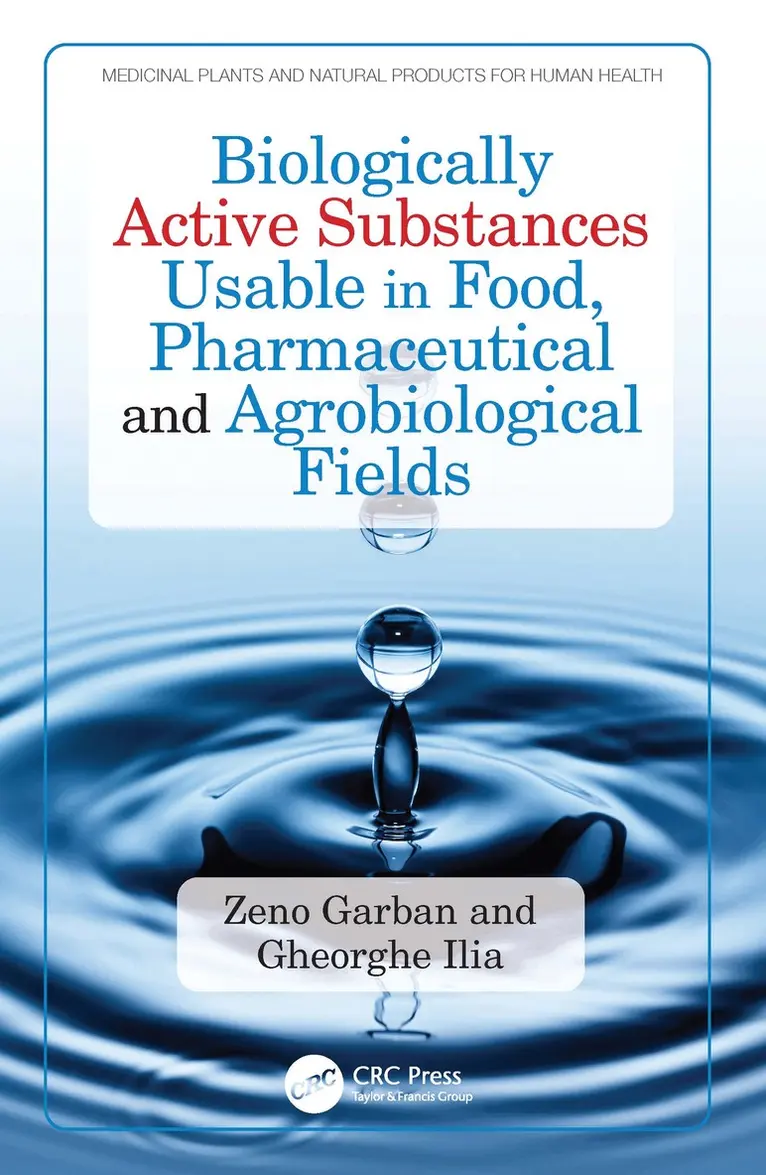
    Biologically Active Substances Usable in Food, Pharmaceutical and Agrobiological Fields

    AvZeno Garban,Gheorghe Ilia

    Häftad, Engelska, 2025

    Del i serien Medicinal Plants and Natural Products for Human Health

    938 kr

    Beställningsvara. Skickas inom 10-15 vardagar. Fri frakt över 249 kr.

    Fler format och utgåvor

    Inbunden

    2 660 kr

    Beskrivning

    This concise text on biologically active substances of the food, pharmaceutical and agricultural industries presents data on natural compounds of vegetable and animal origin. Various nutrients in food, phytochemicals and zoochemicals are discussed, including their uses for prophylactic, metaphylactic and therapeutic purposes in personalized medicine. Along with these compounds, prebiotics isolated by biotechnological methods from plant tissues are reviewed, with the aim of obtaining compounds with an oligoglucide structure. Metabolism of nutrients and the biodegradation of xenobiotics are hot topics and access routes into the human body for the various biologically active substances are covered.Features:Biologically active substances and related chemistry, biochemistry and agrochemistry data are rigorously discussedData regarding natural compounds of vegetable origin detected from plants present in the spontaneous flora and plants obtained in agricultural crops (medicinal plants, aromatic plants and more) are presentedDiscusses the natural compounds of animal origin detected in the organisms of some terrestrial and aquatic animalsCovers prebiotics isolated by technological and biotechnological methods from plant tissues, with the aim of obtaining compounds with oligoglucide structureBroad audience including all those in biochemistry, the food and pharmaceutical industries and agricultural fields

    Produktinformation

    • Utgivningsdatum:2025-08-29
    • Mått:156 x 234 x 15 mm
    • Vikt:440 g
    • Format:Häftad
    • Språk:Engelska
    • Serie:Medicinal Plants and Natural Products for Human Health
    • Antal sidor:258
    • Förlag:Taylor & Francis Ltd
    • ISBN:9781032702513

    Utforska kategorier

    • Kemi inom Naturvetenskap och teknik
    • Biokemi inom Naturvetenskap och teknik
    • Agronomi och lantbruk inom Naturvetenskap och teknik

    Mer om författaren

    Zeno Garban – Ph.D., consulting professor of Biochemistry and Molecular biology, senior researcher, currently corresponding member of the Romanian Academy. He is member of some national and international scientific associations as well as of the editorial boards of some journals.His educational background includes engineering studies at the University of “Life Sciences” Timişoara - Faculty of Agronomy, followed by the graduation of chemistry studies at the “Babeş-Bolyai” University Cluj-Napoca - Faculty of Chemistry. Afterwards, he defended his doctoral thesis and obtained the Ph.D. degree in chemistry (biochemistry).Prof. Garban has an impressive research activity encompassing a broad spectrum of domains starting with comparative animal physiology (focusing on blood circulation – lactopoiesis, electrophoretic studies); neuroendocrine interrelationships in animal vasectomy: ethanol in teratology (on animal models) etc. He conducted studies in biochemistry and molecular biology, on specific interactions of DNA with various substances (metal ions, cytostatic drugs - in vitro and in vivo); the metabolization of nutrients and biotransformation of chemical xenobiotics of nutritional and pharmaceutical interest; the role of chemical xenobiotics in nutrition and pathobiochemistry. Professor Garban was doctoral advisor in the domain of chemistry (biochemistry) at the Polytechnic University of Timisoara.His scientific activity was focused on the domains of food science, approaching the complex problems of metallomics and proteomics. The interdisciplinary character has been put into evidence both in the published articles and in books and treatises.These achievements resulted in an intense publishing activity with over 380 scientific papers in the country and abroad, 32 books (28 as single author); chapters in books published by Pergamon Press-Oxford (1984), Libbey-London (1997), Wiley-VCH-Weinheim (2004). His most important works are represented by the books: «Biochemistry: Comprehensive Treatise» - four volumes, published in five editions (in Romanian); «Molecular biology: Concepts, methods, appplications» (in Romanian) – awarded with the “Traian Savulescu” Prize of the Romanian Academy; «Quo vadis food xenobiochemistry» - three editions (the last one in English).Professor Garban initiated and organized the International symposium “Metal Elements in Environment, Medicine and Biology” and was co-editor of the published 10 proceedings tomes. His scientific activity in the last few years included the biologically active substances of nutritional and pharmaceutical interest.Formerly, as full professor, has also been involved in university teaching at the Faculty of Food Products Technology of the University of Life Sciences Timişoara. He held courses in biochemistry, molecular biology, nutrition and food xenobiochemistry.Dr. Eng. Gheorghe Ilia graduated “Polytechnica” University Timisoara as chemical engineer, and earned PhD in chemistry at the same university. Senior Researcher at “Coriolan Dragulescu” Institute of Chemistry Timisoara part of Romanian Academy and Professor at West University Timisoara, Chemistry Doctoral School as PhD coordinator. He published more than 315 papers in per reviewed journals, 11 books and 17 chapter books in domestic and abroad publishing houses. Fields of expertise: phosphorus-containing polymers obtained by polycondensation or radical polymerization and their use in biomedical applications, as flame retardants, or as solid polymer electrolytes for electrochemical devices (Li polymer batteries or fuel cells); organic–inorganic hybrids based on phosphorus derivatives using sol-gel method or by grafting on inorganic supports with potential applications in catalysis; MOF’s based on phosphorus derivatives; green synthesis of phosphorus compounds; biological active substances especially plant growth bioregulators. Associate Editor-Current Green Chemistry; Editorial board member– Current Catalysis.

    Innehållsförteckning

    • 1. BIOLOGICALLY ACTIVE SUBSTANCES: CONCEPTUAL AND APPLICATIVE ASPECTSZeno Garban, Gheorghe Ilia1.1. Introduction1.2. Characteristics of the chemical composition of the living organisms1.2.1. Basic concepts1.2.2. Bioconstituents, nutrients and chemical xenobiotics1.3. Metabolisation of nutrients1.3.1. Basic concepts1.3.2. Phases and metabolization pathways1.4. Biotransformation of chemical xenobiotics1.4.1. Basic concepts1.4.2. Phases and pathways of biotransformation1.5. Metabolsation and biotransformation: Similitudes and discrepancies1.6. Apparata and systems1.7. Admission of biologically active substances in the body1.7.1. Basic concepts1.7.2. Gastrointestinal route1.7.3. Pulmonary route1.7.4. Cutaneous route1.8. Barriers in biochemistry1.8.1. Tissue barriers of the body1.8.2. Membrane barriers of cells1.9. Biomarkers in the investigation of biologically active substances1.9.1. Types of biomarkers1.9.2. Applications of biomarkers1.10. Biologically active substances in ethnobiology - overviewReferences2. NATURAL COMPOUNDS OF PLANT ORIGINZeno Garban2.1. Introduction2.2. Chemical composition and natural distribution2.3. Classification and nomenclature2.4. Phytochemicals classes 2.4.1. Introductory exposure2.4.2. Organic acids2.4.3. Alkaloids2.4.4. Phytoncides2.4.5. Heterosides2.4.6. Natural pigments2.4.7. Tannins2.4.8. Essential oilsReferences3. NATURAL COMPOUNDS OF ANIMAL ORIGINZeno Garban3.1. Introduction3.2. Chemical composition and natural distribution3.3. Zoochemicals present in various food groups3.3.1. Zoochemicals from milk and dairy products3.3.2. Zoochemicals from meat and viscera3.3.3. Zoochemicals from eggs3.3.4. Zoochemicals from bee products3.4. Zoochemicals present in animal tissuesReferences4. PREBIOTICSZeno Garban4.1. Introduction4.2. Chemical composition and natural distribution4.3. Classification and nomenclature4.4. Prebiotics vs probiotics4.5. Prebiotics and nutrition4.6. Groups of prebiotic compounds4.7. Prebiotics in foods and pharmaceutic products4.8. Obtainment of prebiotic compounds - generalitiesReferences5. PLANT GROWTH BIOREGULATORSGheorghe Ilia5.1. Introduction5.2. Chemical composition and natural distribution5.3. Brief history5.4. Classes of chemical compounds5.4.1. Auxins5.4.2. Gibberellins5.4.3. Cytokinins5.4.4. Ethylene5.4.5. Abscisic acid5.4.6. Other compound as bioregulators5.4.7. Natural and synthetized inhibiting substances5.5. Bioregulators in food chemistry and nutrition5.6. Growth regulators in agrobiology5.6.1. General characteristics5.6.2. Comparative effectsReferences6. AD LIMINA INTERRELATIONS: ORGANISM-BIOLOGICALLY ACTIVE SUBSTANCESGheorghe Ilia, Zeno Garban 6.1. Introduction6.2. Bioavailability6.2.1. Basic concepts6.2.2. Interdisciplinary characteristics6.2.3. Conditioning of bioavailability6.2.4. The relationship ligands-receptors and bioavailability6.2.5. Bioavailability and biologically active substances6.3. Chronobiochemistry6.3.1. Basic concepts6.3.2. Biorhythm conditioning6.3.3. Periodicity of biorhythm6.3.4. Biorhythm types and parameters6.3.5. Autonomy and synchronization of biorhythms6.3.6. Chronobiochemistry and phenology in the plant and animal kingdoms6.4. Traceability of food and pharmaceutical products6.4.1. Basic concepts6.4.2. Traceability types6.4.3. Systems of products identification6.4.4. Traceability of biologically active substancesReferences