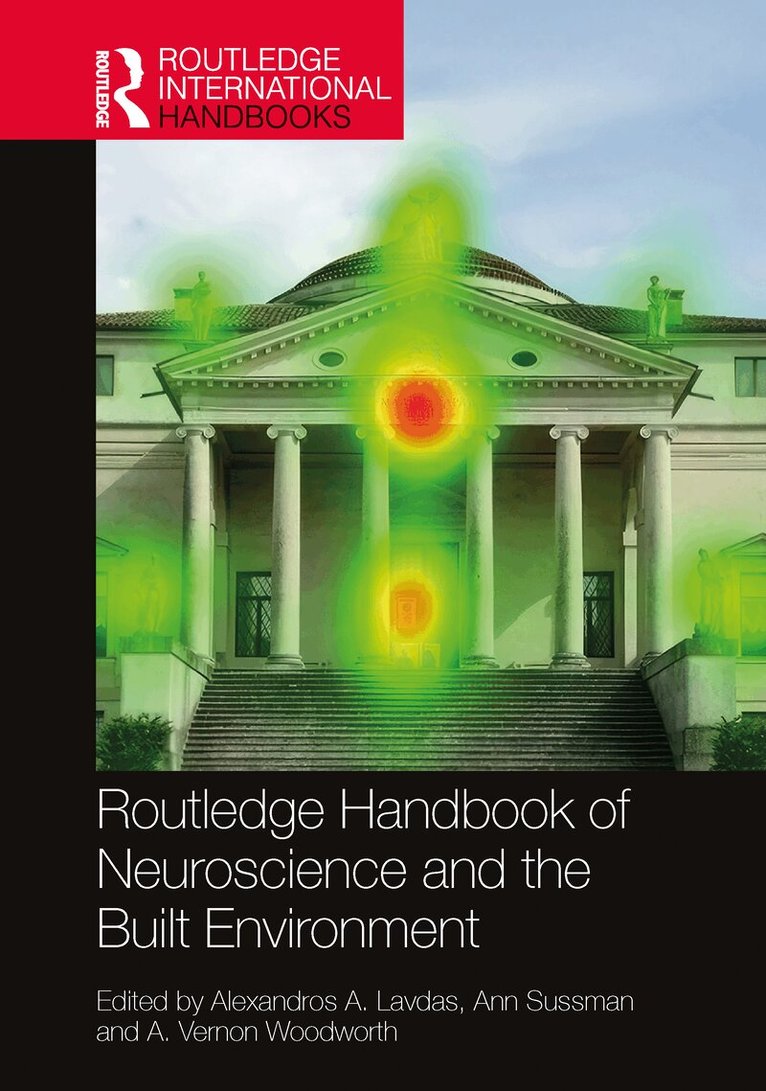
Routledge Handbook of Neuroscience and the Built Environment
A. Vernon Woodworth, Ann Sussman, Alexandros A. Lavdas
950 kr
Du är på sajten för privatpersoner.
AvAlexandros A. Lavdas,Ann Sussman
Del i serien Routledge International Handbooks
3 847 kr
Beställningsvara. Skickas inom 10-15 vardagar. Fri frakt över 249 kr.
Alexandros A. Lavdas is a tenured Senior Researcher Neuroscientist at Eurac Research, Bolzano, Italy, an Assistant Professor and Head of Psychology at Webster University, Athens Campus, Greece, and a member of the Board of Directors at the Human Architecture and Planning Institute, Concord, MA, USA. He holds an MSc and PhD from University College London. He has worked extensively in nervous system development and regeneration, and in more recent years, he has been especially interested in examining elements of visually organized complexity, such as those found in nature and pre-modern architecture, and exploring the psychophysiological correlates of exposure to environments incorporating such patterns.Ann Sussman, an architect, author, researcher, and teacher, is passionate about understanding how buildings impact us. She serves as President of the Human Architecture + Planning Institute (theHapi.org), a nonprofit devoted to improving the design of the built environment through education and research. Her book Cognitive Architecture: Designing for How We Respond to the Built Environment (Routledge, 2015, 2021) won the 2016 Place Research Award from the Environmental Design Research Association (EDRA). She has taught a course on human perception of architecture, Buildings, Biology + the Brain, at the Boston Architectural College (BAC) since 2018.A. Vernon Woodworth is a registered architect and member of the Faculty at the Boston Architectural College with a BA in Urban Design from the New College in Sarasota, FLA, a Master of Theological Studies from the Harvard Divinity School, and a Diploma in Analytical Psychology from the C.G. Jung Institute Boston. He co-edited a volume of essays titled Programming for Health and Wellbeing in Architecture. His design firm Urban Determination, LLC focuses on small-scale residential and commercial projects in the Mattapan neighborhood of Boston.
“The Handbook of Neuroscience and the Built Environment is a pioneering exploration of how architecture and design influence our brains, emotions, and well-being. By integrating neuroscience with the built environment, this essential volume offers profound insights into creating spaces that enhance health, creativity, and human flourishing through intentional, science-based design.”- Stephen Porges, PhD, University of North Carolina, School of Medicine"This wide-ranging and comprehensive Handbook will be of serious interest to anyone concerned with the built environment. In six parts, spanning human evolution to neurodiversity, contributions cover everything from aesthetics and proportion to context, wellbeing and AI. These essays demonstrate how the investigation of brain sciences and architecture can extend beyond the strictly performative and quantitative, something many of us have been hoping for since the phrase "Neuroscience for Architecture" was first coined."- Kurt C. Hunker, FAIA, Past President, Academy of Neuroscience for Architecture (ANFA)"The Handbook of Neuroscience and the Built Environment fills a crucial gap in the literature, bridging design and cognitive science. This essential handbook highlights how the built environment shapes human cognition, emotion, and behavior. It offers invaluable insights for architects and designers, helping them create spaces that enhance well-being. A must-have for understanding spatial stimuli and their profound impact on human interaction and health."Maria Christofi, Postdoctoral Researcher, Tufts University
A. Vernon Woodworth, Ann Sussman, Alexandros A. Lavdas
950 kr
A. Vernon Woodworth, Ann Sussman, Alexandros A. Lavdas
960 kr
Du är på sajten för privatpersoner.
AvAlexandros A. Lavdas,Ann Sussman
Del i serien Routledge International Handbooks
3 847 kr
Beställningsvara. Skickas inom 10-15 vardagar. Fri frakt över 249 kr.
Alexandros A. Lavdas is a tenured Senior Researcher Neuroscientist at Eurac Research, Bolzano, Italy, an Assistant Professor and Head of Psychology at Webster University, Athens Campus, Greece, and a member of the Board of Directors at the Human Architecture and Planning Institute, Concord, MA, USA. He holds an MSc and PhD from University College London. He has worked extensively in nervous system development and regeneration, and in more recent years, he has been especially interested in examining elements of visually organized complexity, such as those found in nature and pre-modern architecture, and exploring the psychophysiological correlates of exposure to environments incorporating such patterns.Ann Sussman, an architect, author, researcher, and teacher, is passionate about understanding how buildings impact us. She serves as President of the Human Architecture + Planning Institute (theHapi.org), a nonprofit devoted to improving the design of the built environment through education and research. Her book Cognitive Architecture: Designing for How We Respond to the Built Environment (Routledge, 2015, 2021) won the 2016 Place Research Award from the Environmental Design Research Association (EDRA). She has taught a course on human perception of architecture, Buildings, Biology + the Brain, at the Boston Architectural College (BAC) since 2018.A. Vernon Woodworth is a registered architect and member of the Faculty at the Boston Architectural College with a BA in Urban Design from the New College in Sarasota, FLA, a Master of Theological Studies from the Harvard Divinity School, and a Diploma in Analytical Psychology from the C.G. Jung Institute Boston. He co-edited a volume of essays titled Programming for Health and Wellbeing in Architecture. His design firm Urban Determination, LLC focuses on small-scale residential and commercial projects in the Mattapan neighborhood of Boston.
“The Handbook of Neuroscience and the Built Environment is a pioneering exploration of how architecture and design influence our brains, emotions, and well-being. By integrating neuroscience with the built environment, this essential volume offers profound insights into creating spaces that enhance health, creativity, and human flourishing through intentional, science-based design.”- Stephen Porges, PhD, University of North Carolina, School of Medicine"This wide-ranging and comprehensive Handbook will be of serious interest to anyone concerned with the built environment. In six parts, spanning human evolution to neurodiversity, contributions cover everything from aesthetics and proportion to context, wellbeing and AI. These essays demonstrate how the investigation of brain sciences and architecture can extend beyond the strictly performative and quantitative, something many of us have been hoping for since the phrase "Neuroscience for Architecture" was first coined."- Kurt C. Hunker, FAIA, Past President, Academy of Neuroscience for Architecture (ANFA)"The Handbook of Neuroscience and the Built Environment fills a crucial gap in the literature, bridging design and cognitive science. This essential handbook highlights how the built environment shapes human cognition, emotion, and behavior. It offers invaluable insights for architects and designers, helping them create spaces that enhance well-being. A must-have for understanding spatial stimuli and their profound impact on human interaction and health."Maria Christofi, Postdoctoral Researcher, Tufts University
A. Vernon Woodworth, Ann Sussman, Alexandros A. Lavdas
950 kr
A. Vernon Woodworth, Ann Sussman, Alexandros A. Lavdas
960 kr