• Fri frakt över 249 kr
  • •
  • Snabba leveranser
  • •
  • Billiga böcker
Kundservice

Du är på sajten för privatpersoner.

Företag, bibliotek eller offentlig verksamhet?

Du handlar på classic.bokus.com, där alla dina funktioner finns intakta.
Till classic.bokus.com
Bokus logotyp. Gå till startsidan.
  • Erbjudanden
  • Nyheter
  • Student
  • Topplistor
  • Barn & ungdom
  • Bokus Play
  • E-böcker
  • Pocketböcker
  • Spel & pussel

10% rabatt på allt med kod: NYSTART10 →

Sidfot

Mina sidor

    Hjälp

    • Kundservice
    • Vanliga frågor och svar
    • Frakt och leverans
    • Retur vid ångerrätt
    • Reklamera vara
    • Betalning
    • Köpvillkor
    • Allmänna villkor
    • Information om webbplatsens tillgänglighet

    Om Bokus

    • Om oss
    • Pressrum
    • För studenter
    • För företag
    • För bibliotek och offentlig verksamhet
    • För leverantörer
    • Hållbarhet

    Populärt

    • Aktuella erbjudanden
    • Presentkort
    • Studentlitteratur
    • Nya böcker
    • Topplistor
    • Signerade böcker
    • Engelska böcker

    Inspiration

    • Boktips
    • BookTok
    • Populära bokserier
    • Barnbokskaraktärer
    • Populära författare
    Logotyp för Bokus
    Följ oss på Facebook (extern länk)Följ oss på Instagram (extern länk)Följ oss på YouTube (extern länk)Följ oss på TikTok (extern länk)
    bokus @ CookiesAnpassa cookiesIntegritetspolicyKöpvillkor
    Till Citymail hemsida (extern länk)Till Budbee hemsida (extern länk)Till Postnord hemsida (extern länk)Till Schenker hemsida (extern länk)Till Early Bird hemsida (extern länk)Till Walleys hemsida (extern länk)
    1. Ekonomi och Ledarskap
    2. Nationalekonomi
    3. Mikroekonomi

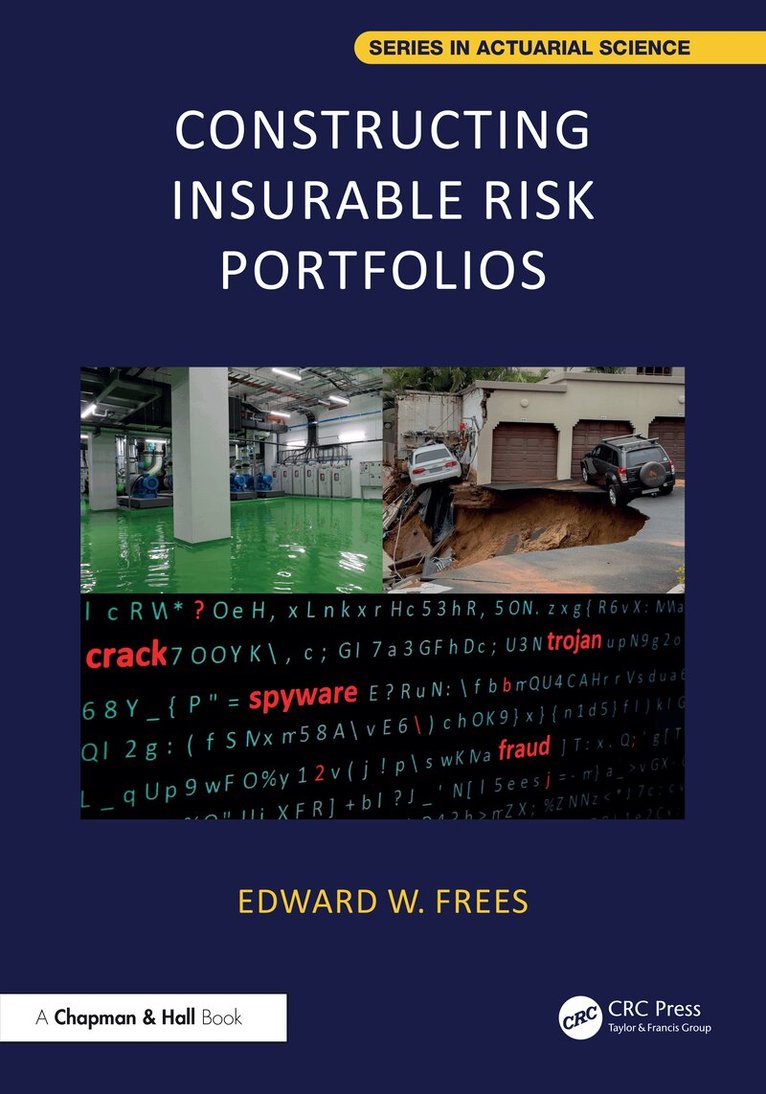
    Constructing Insurable Risk Portfolios

    AvEdward W. Frees

    Inbunden, Engelska, 2025

    Del i serien Chapman & Hall/CRC Series in Actuarial Science

    1 763 kr

    Beställningsvara. Skickas inom 10-15 vardagar. Fri frakt över 249 kr.

    Fler format och utgåvor

    E-bok

    2 096 kr

    E-bok

    2 096 kr

    Beskrivning

    Constructing Insurable Risk Portfolios offers a data-driven approach to devising risk retention programs that safeguard firms from a multitude of risks. Because firms face many risks, including fire damage to their buildings, liability from management misconduct, and external threats like cyberattacks, this book treats these potential liabilities as a "portfolio." Drawing inspiration from Markowitz portfolio theory, the text leverages techniques from probability, statistics, and optimization to build algorithms that construct optimal risk insurable portfolios under budget constraints.FeaturesThrough engaging case studies and supporting statistical (R) code, readers will learn how to build optimal insurable risk portfolios.This book illustrates a frontier that depicts the trade-off between the uncertainty of a portfolio and the cost of risk transfer. This visual representation, mirroring familiar Markowitz investment tools, enables informed decision-making and easy adoption by risk advisors.This book lays the mathematical groundwork for constructing optimal insurable risk portfolios in an effective and aesthetically pleasing manner.For those interested in the detailed mathematical aspects of insurable risk portfolio optimization, comprehensive proofs and derivations are available in an online supplement.This book equips students, academics, and practitioners with quantitative tools to analyze real-world risk portfolios. Additionally, it empowers financial analysts to provide data-driven insights that enhance their advisory roles for risk managers.

    Produktinformation

    • Utgivningsdatum:2025-04-08
    • Mått:178 x 254 x 26 mm
    • Vikt:800 g
    • Format:Inbunden
    • Språk:Engelska
    • Serie:Chapman & Hall/CRC Series in Actuarial Science
    • Antal sidor:310
    • Förlag:Taylor & Francis Ltd
    • ISBN:9781032745046

    Utforska kategorier

    • Mikroekonomi inom Ekonomi och Ledarskap
    • Matematisk statistik inom Naturvetenskap och teknik
    • Tillämpad matematik inom Naturvetenskap och teknik

    Mer om författaren

    Edward W. Frees is an emeritus professor affiliated with the University of Wisconsin-Madison where he served as the Hickman Larson Chair of Actuarial Science. Until recently, he enjoyed a fractional research appointment with the Australian National University. He received his PhD in mathematical statistics from the University of North Carolina at Chapel Hill. He works at the intersection of data science and actuarial studies; he is a fellow of the American Statistical Association and was a fellow of the Society of Actuaries (SOA) (the only fellow of both organizations).Prof. Frees has provided extensive service to the profession, including serving as the founding chairperson of the SOA Education and Research Section, member of the SOA Board of Directors, trustee of the Actuarial Foundation, editor of the North American Actuarial Journal, and actuarial representative to the Social Security Advisory Board’s Technical Panel on Methods and Assumptions. He has written three books, edited a two-volume series on predictive modeling applications in actuarial science, and is editing an online, open source book, Loss Data Analytics.Regarding his research, Prof. Frees has published extensively and won several awards for his work. He has won the Society of Actuaries’ Annual Prize for the best paper published by the Society, the SOA’s Ed Lew Award for research in modeling, the Casualty Actuarial Society’s Hachmeister award, and the Halmstad Prize for best paper published in the actuarial literature (four times).

    Innehållsförteckning

    • 1. Introduction. 2. Risk Retention Functions. 3. Balancing Retained Risk and Risk Transfer Cost. 4. Transferring Multiple Risks including Reinsurance. 5. Excess of Loss for Two Risks. 6. Managing Portfolios of Insurable Risks. 7. Simulating Multivariate Risks. 8. Risk Retention Case Studies. 9. Stress Testing, Sensitivity, and Robustness. 10. Sensitivity and Data Uncertainty. 11. Risk Retention Conditions. 12. The Role of Dependence in Managing Insurable Risks.