• Fri frakt över 249 kr
  • •
  • Snabba leveranser
  • •
  • Billiga böcker
Kundservice

Du är på sajten för privatpersoner.

Företag, bibliotek eller offentlig verksamhet?

Du handlar på classic.bokus.com, där alla dina funktioner finns intakta.
Till classic.bokus.com
Bokus logotyp. Gå till startsidan.
  • Erbjudanden
  • Nyheter
  • Student
  • Topplistor
  • Barn & ungdom
  • Bokus Play
  • E-böcker
  • Pocketböcker
  • Spel & pussel

10% rabatt på allt med kod NYSTART10 →

Sidfot

Mina sidor

    Hjälp

    • Kundservice
    • Vanliga frågor och svar
    • Frakt och leverans
    • Retur vid ångerrätt
    • Reklamera vara
    • Betalning
    • Köpvillkor
    • Allmänna villkor
    • Information om webbplatsens tillgänglighet

    Om Bokus

    • Om oss
    • Pressrum
    • För studenter
    • För företag
    • För bibliotek och offentlig verksamhet
    • För leverantörer
    • Hållbarhet

    Populärt

    • Aktuella erbjudanden
    • Presentkort
    • Studentlitteratur
    • Nya böcker
    • Topplistor
    • Signerade böcker
    • Engelska böcker

    Inspiration

    • Boktips
    • BookTok
    • Populära bokserier
    • Barnbokskaraktärer
    • Populära författare
    Logotyp för Bokus
    Följ oss på Facebook (extern länk)Följ oss på Instagram (extern länk)Följ oss på YouTube (extern länk)Följ oss på TikTok (extern länk)
    bokus @ CookiesAnpassa cookiesIntegritetspolicyKöpvillkor
    Till Citymail hemsida (extern länk)Till Budbee hemsida (extern länk)Till Postnord hemsida (extern länk)Till Schenker hemsida (extern länk)Till Early Bird hemsida (extern länk)Till Walleys hemsida (extern länk)
    1. Data och IT
    2. Systemvetenskap och AI

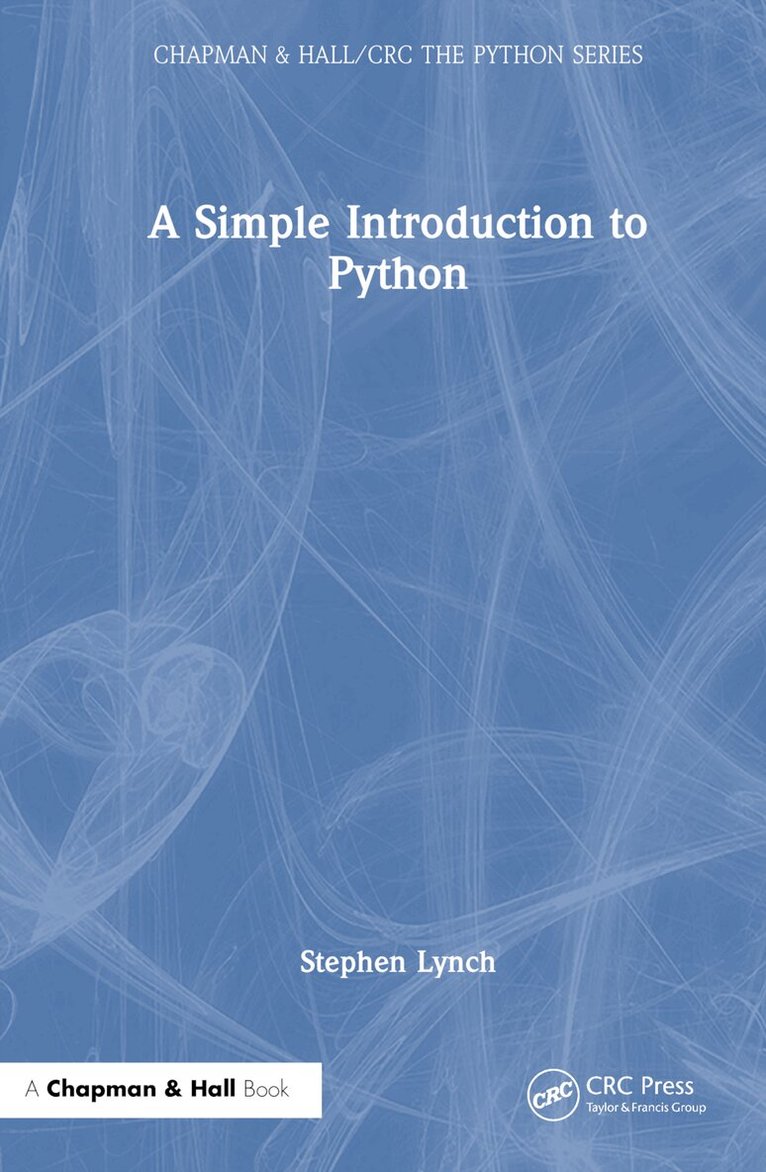
    Simple Introduction to Python

    AvStephen Lynch

    Inbunden, Engelska, 2024

    Del i serien Chapman & Hall/CRC The Python Series

    1 468 kr

    Beställningsvara. Skickas inom 10-15 vardagar. Fri frakt över 249 kr.

    Fler format och utgåvor

    Häftad

    414 kr

    E-bok

    501 kr

    E-bok

    501 kr

    Beskrivning

    A Simple Introduction to Python is aimed at pre-university students and complete novices to programming. The whole book has been created using Jupyter notebooks. After introducing Python as a powerful calculator, simple programming constructs are covered, and the NumPy, MatPlotLib and SymPy modules (libraries) are introduced. Python is then used for Mathematics, Cryptography, Artificial Intelligence, Data Science and Object Oriented Programming.The reader is shown how to program using the integrated development environments: Python IDLE, Spyder, Jupyter notebooks, and through cloud computing with Google Colab.Features:No prior experience in programming is required.Demonstrates how to format Jupyter notebooks for publication on the Web.Full solutions to exercises are available as a Jupyter notebook on the Web.All Jupyter notebook solution files can be downloaded through GitHub.GitHub Repository of Data Files and a Jupyter Solution notebook: https://github.com/proflynch/A-Simple-Introduction-to-PythonJupyter Solution notebook web page: https://drstephenlynch.github.io/webpages/A-Simple-Introduction-to-Python-Solutions.html

    Produktinformation

    • Utgivningsdatum:2024-06-11
    • Mått:156 x 234 x 11 mm
    • Vikt:360 g
    • Format:Inbunden
    • Språk:Engelska
    • Serie:Chapman & Hall/CRC The Python Series
    • Antal sidor:92
    • Förlag:Taylor & Francis Ltd
    • ISBN:9781032751672

    Utforska kategorier

    • Systemvetenskap och AI inom Data och IT
    • Programvaruutveckling inom Data och IT
    • Tillämpad matematik inom Naturvetenskap och teknik

    Mer om författaren

    In 2022, Stephen Lynch was named a National Teaching Fellow, which celebrates and recognizes individuals who have made an outstanding impact on student outcomes and teaching in higher education. He won the award for his work in programming in STEM subjects, research feeding into teaching, and widening participation (using experiential and object-based learning). Although educated as a pure mathematician, Stephen’s many interests now include applied mathematics, cell biology, electrical engineering, computing, neural networks, nonlinear optics and binary oscillator computing, which he co-invented with a colleague. He has authored 2 international patents for inventions, 8 books, 4 book chapters, over 45 journal articles, and a few conference proceedings. Stephen is a Fellow of the Institute of Mathematics and Its Applications (FIMA) and a Senior Fellow of the Higher Education Academy (SFHEA). He is currently a Reader with MMU and was an Associate Lecturer with the Open University from 2008 to 2012. In 2010, Stephen volunteered as a STEM Ambassador, in 2012, he was awarded MMU Public Engagement Champion status, and in 2014, he became a Speaker for Schools. He runs national workshops on "Python for A-Level Mathematics and Beyond," and international workshops on "Python for Scientific Computing and TensorFlow for Artificial Intelligence." He has run workshops in China, Malaysia, Singapore, Saudi Arabia and the USA.

    Innehållsförteckning

    • 1. Python as a Powerful Calculator. 1.1. BODMAS. 1.2. Fractions: Symbolic Computation. 1.3. Powers (Exponentiation) and Roots. 1.4. The Math Library (Module) Chapter. 2. Simple Programming With Python. 2.1. Lists, Tuples, Sets and Dictionaries. 2.2. Defining Functions (Programming). 2.3. For and While Loops. 2.4. Conditional Statements, If, Elif, Else. 3. The Turtle Library. 3.1. The Cantor Set Fractal. 3.2. The Koch Snowflake. 3.3. A Bifurcating Tree. 3.4. The Sierpinski Triangle. 4. NumPy and MatPlotLib. 4.1. Numerical Python (Numpy). 4.2. MatPlotLib. 4.3. Scatter Plots. 4.4. Surface Plots. 5. Google Colab, SymPy and GitHub. 5.1. Google Colab. 5.2. Formatting Notebooks. 5.3. Symbolic Python (Sympy). 5.4. GitHub. 6. Python for Mathematics. 6.1. Basic Algebra. 6.2. Solving Equations. 6.3. Functions (Mathematics). 6.4. Differentiation and Integration (Calculus). 7. Introduction to Cryptography. 7.1. The Caesar Cipher. 7.2. The XOR Cipher. 7.3. The Rivest-Shamir-Adleman (RSA) Cryptosystem. 7.4. Simple RSA Algorithm Example. 8. An Introduction to Artificial Intelligence. 8.1. Artificial Neural Networks. 8.2. The And/Or and XOR Gate Anns. 8.3. The Backpropagation Algorithm. 8.4. Boston Housing Data. 9. An Introduction to Data Science. 9.1. Introduction to Pandas. 9.2. Load, Clean and Preprocess the Data. 9.3. Exploring the Data. 9.4. Violin, Scatter and Hexagonal Bin Plots. 10. An Introduction to Object Oriented Programming. 10.1. Classes and Objects. 10.2. Encapsulation. 10.3. Inheritance. 10.4. Polymorphism.