• Fri frakt över 249 kr
  • •
  • Snabba leveranser
  • •
  • Billiga böcker
Kundservice

Du är på sajten för privatpersoner.

Företag, bibliotek eller offentlig verksamhet?

Du handlar på classic.bokus.com, där alla dina funktioner finns intakta.
Till classic.bokus.com
Bokus logotyp. Gå till startsidan.
  • Erbjudanden
  • Nyheter
  • Student
  • Topplistor
  • Barn & ungdom
  • Bokus Play
  • E-böcker
  • Pocketböcker
  • Spel & pussel

10% rabatt på allt med kod: NYSTART10 →

Sidfot

Mina sidor

    Hjälp

    • Kundservice
    • Vanliga frågor och svar
    • Frakt och leverans
    • Retur vid ångerrätt
    • Reklamera vara
    • Betalning
    • Köpvillkor
    • Allmänna villkor
    • Information om webbplatsens tillgänglighet

    Om Bokus

    • Om oss
    • Pressrum
    • För studenter
    • För företag
    • För bibliotek och offentlig verksamhet
    • För leverantörer
    • Hållbarhet

    Populärt

    • Aktuella erbjudanden
    • Presentkort
    • Studentlitteratur
    • Nya böcker
    • Topplistor
    • Signerade böcker
    • Engelska böcker

    Inspiration

    • Boktips
    • BookTok
    • Populära bokserier
    • Barnbokskaraktärer
    • Populära författare
    Logotyp för Bokus
    Följ oss på Facebook (extern länk)Följ oss på Instagram (extern länk)Följ oss på YouTube (extern länk)Följ oss på TikTok (extern länk)
    bokus @ CookiesAnpassa cookiesIntegritetspolicyKöpvillkor
    Till Citymail hemsida (extern länk)Till Budbee hemsida (extern länk)Till Postnord hemsida (extern länk)Till Schenker hemsida (extern länk)Till Early Bird hemsida (extern länk)Till Walleys hemsida (extern länk)
    1. Psykologi och pedagogik
    2. Psykologi
    3. Socialpsykologi och gruppsykologi

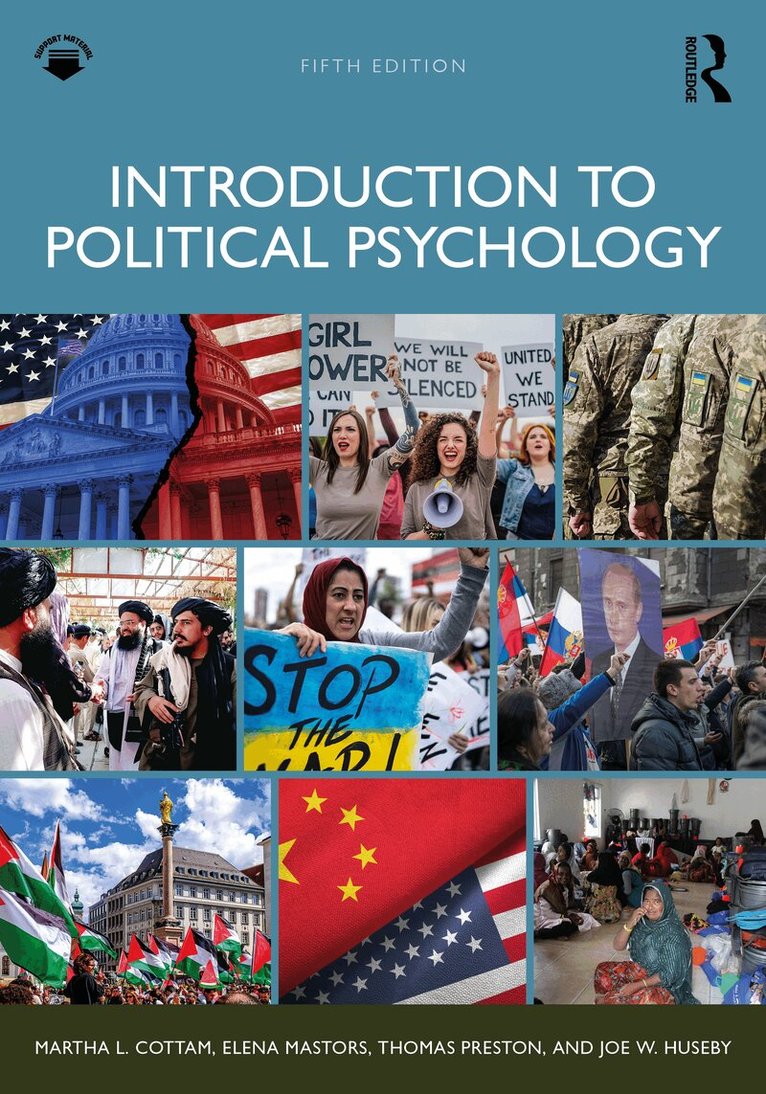
    Introduction to Political Psychology

    AvMartha L. Cottam,Elena Mastors

    Häftad, Engelska, 2025

    1 084 kr

    Beställningsvara. Skickas inom 10-15 vardagar. Fri frakt över 249 kr.

    Fler format och utgåvor

    Häftad

    1 087 kr

    Inbunden

    2 053 kr

    Beskrivning

    This fifth edition of Introduction to Political Psychology explores the many psychological patterns that influence individual political behavior. The authors introduce readers to a broad range of theories, concepts, and case studies of political activity, arguing that individuals are driven or motivated to act in accordance with personality characteristics, values, beliefs, and attachments to groups. The book explains many aspects of political behavior—whether seemingly pathological actions or normal decision-making practices, which sometimes work optimally, and sometimes fail.Thoroughly updated throughout, the book examines patterns of political behavior in areas including leadership, group behavior, voting, race, nationalism, terrorism, and war. This edition features:Detailed coverage of political polarization, and the psychology behind it;Up-to-date topics and case studies focused on the 2024 US election, the war in Ukraine, and the Israel–Palestine conflict, as well as social movements such as climate change activism, Black Lives Matter, and #MeToo;A robust suite of timesaving support material.Accessibly written and comprehensive in scope, it is an essential companion for all graduate and upper-level undergraduate students of psychology, political science, and political psychology. It will also be of interest to those in the policy-making community, especially those looking to learn more about the extent to which perceptions, personality, and group dynamics affect the policy-making arena.

    Produktinformation

    • Utgivningsdatum:2025-09-16
    • Mått:178 x 254 x 37 mm
    • Vikt:1 100 g
    • Format:Häftad
    • Språk:Engelska
    • Antal sidor:588
    • Upplaga:5
    • Förlag:Taylor & Francis Ltd
    • ISBN:9781032783765

    Utforska kategorier

    • Socialpsykologi och gruppsykologi inom Psykologi och pedagogik
    • Politik och statsskick inom Samhälle och politik

    Mer om författaren

    Martha L. Cottam is Professor Emeritus of Political Science in the School of Politics, Philosophy, and Public Affairs at Washington State University, USA. She specializes in political psychology, international politics, and intercommunal conflict. She has published books and articles on US foreign policy, decision-making, nationalism, and Latin American politics. She received her Ph.D. from UCLA.Elena Mastors is a lecturer at Johns Hopkins University, USA. She was an academic administrator for over a decade and also served as an associate professor in the National Decision Making Department of the Naval War College. She has held various senior intelligence and policy positions in the Department of Defense. She specializes in the political psychology of violence.Thomas Preston is Professor of Political Science in the School of Politics, Philosophy, and Public Affairs at Washington State University, USA. He specializes in political psychology, leadership analysis, and international politics. He has written numerous books and articles on presidential leadership, weapons of mass destruction, and American foreign policy. He received his Ph.D. from The Ohio State University.Joe W. Huseby is a Political Science faculty at Spokane Colleges, USA, where he teaches classes on global poverty, climate change, democracy, and polarization. He has conducted field research for non-profit organizations and the US government in Africa, the Middle East, and Central America, and has worked on human rights and environmental causes in those regions. He earned his Ph.D. from Washington State University.

    Recensioner i media

    "In this new edition of their classic textbook, Cottam, Mastors, Preston and Huseby provide a comprehensive introduction to political psychology, a field which they correctly note is exploding in popularity. Many of our contemporary problems, the authors skillfully show, have their roots in the psychology of political action. Indispensable to beginner and advanced students alike, this is an essential text with a fresh new polish."Dr Stephen Dyson, Professor of Political Science, University of Connecticut, US"This magisterial text belongs on the shelf of every international relations scholar and political scientist. Its breadth is truly extraordinary, and the authorial team are leading experts in the field of political psychology. Whether one is interested in the personalities of world leaders or the pathologies of groups and coalitions or the dynamics of ethnic conflict, nationalism, and terror, this book overviews both foundational and cutting-edge research, complemented by numerous in-depth case studies. In sum, this volume serves not only as an introduction to the field for newcomers, including students, but as an invaluable companion and reference for scholars and practitioners."Dr Valerie M. Hudson, University Distinguished Professor, Texas A&M University, US"This book provides students with an eye-opening and intriguing introduction to how individuals participate in and influence politics—from voters to leaders. It describes a wide range of topics regarding how psychological processes help to shape politics from one’s identity to level of participation, from leadership to engaging in collaboration, from how the media works to terrorism. As well as describing theories and research, it also provides case studies to illustrate how the psychological processes actually work. This book brings political psychology alive for the reader!"Margaret G. Hermann, Cramer Professor of Global Affairs Emerita, Syracuse University

    Innehållsförteckning

    • 1. Political Psychology: Introduction and Overview 2. Personality and Politics 3. Cognition, Social Identity, Emotions, and Attitudes in Political Psychology 4. The Political Psychology of Groups 5. The Study of Political Leaders 6. The Political Psychology of Mass Politics: How Do People Decide Who to Vote For? 7. The Political Psychology of the Media in Politics 8. The Political Psychology of Race 9. From Ethnic Conflict to Genocide 10. The Political Psychology of Nationalism 11. The Political Psychology of Social Movements 12. The Political Psychology of Terrorism 13. The Political Psychology of International Security and Conflict 14. Conflict Resolution and Reconciliation