• Fri frakt över 249 kr
  • •
  • Snabba leveranser
  • •
  • Billiga böcker
Kundservice

Du är på sajten för privatpersoner.

Företag, bibliotek eller offentlig verksamhet?

Du handlar på classic.bokus.com, där alla dina funktioner finns intakta.
Till classic.bokus.com
Bokus logotyp. Gå till startsidan.
  • Erbjudanden
  • Nyheter
  • Student
  • Topplistor
  • Barn & ungdom
  • Bokus Play
  • E-böcker
  • Pocketböcker
  • Spel & pussel

10% rabatt på allt med kod: NYSTART10 →

Sidfot

Mina sidor

    Hjälp

    • Kundservice
    • Vanliga frågor och svar
    • Frakt och leverans
    • Retur vid ångerrätt
    • Reklamera vara
    • Betalning
    • Köpvillkor
    • Allmänna villkor
    • Information om webbplatsens tillgänglighet

    Om Bokus

    • Om oss
    • Pressrum
    • För studenter
    • För företag
    • För bibliotek och offentlig verksamhet
    • För leverantörer
    • Hållbarhet

    Populärt

    • Aktuella erbjudanden
    • Presentkort
    • Studentlitteratur
    • Nya böcker
    • Topplistor
    • Signerade böcker
    • Engelska böcker

    Inspiration

    • Boktips
    • BookTok
    • Populära bokserier
    • Barnbokskaraktärer
    • Populära författare
    Logotyp för Bokus
    Följ oss på Facebook (extern länk)Följ oss på Instagram (extern länk)Följ oss på YouTube (extern länk)Följ oss på TikTok (extern länk)
    bokus @ CookiesAnpassa cookiesIntegritetspolicyKöpvillkor
    Till Citymail hemsida (extern länk)Till Budbee hemsida (extern länk)Till Postnord hemsida (extern länk)Till Schenker hemsida (extern länk)Till Early Bird hemsida (extern länk)Till Walleys hemsida (extern länk)
    1. Psykologi och pedagogik
    2. Psykologi
    3. Arbetspsykologi

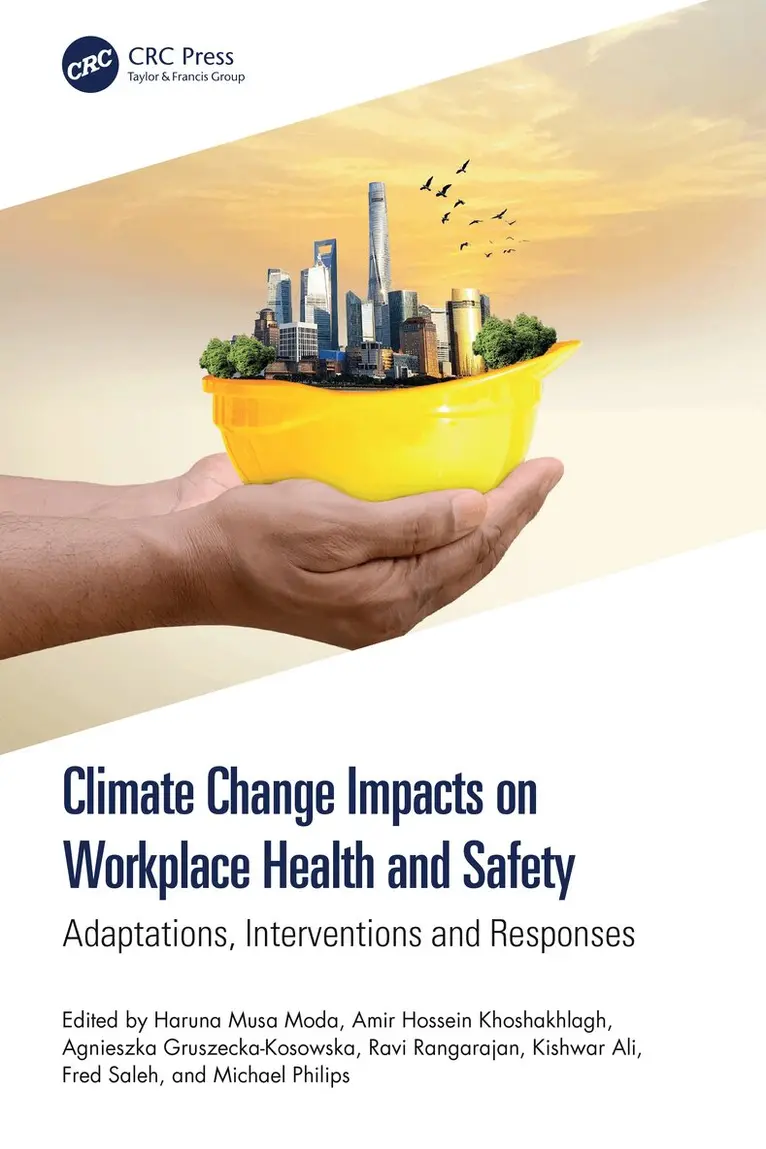
    Climate Change Impacts on Workplace Health and Safety

    Adaptations, Interventions and Responses

    AvHaruna Musa Moda,Amir Hossein Khoshakhlagh

    Inbunden, Engelska, 2025

    1 761 kr

    Beställningsvara. Skickas inom 10-15 vardagar. Fri frakt över 249 kr.

    Beskrivning

    Climate change has become the primary serious human and environmental threat of the 21st century and, with associated variability, it presents enormous potential to affect workers' safety and health. This book delivers vital information regarding climate change adaptation measures and workplace health and safety interventions across diverse sectors.This edited book delivers relevant information for specialists and academics to compare good practices across different sectors to help improve workplace safety and health as climate change factors continue to impact indoor and outdoor workplaces. In addition, it highlights the impact of extreme heat exposure and risk of climate-related chronic diseases, which could impact productivity, occupational safety adherence and wellbeing of workers. It also covers the impact of reduced work capacity due to climate change variability on the jobs undertaken. Comprehensive, up-to-date and including the latest references and cutting-edge case studies, this book reveals to the reader how to adapt accordingly for the impacts of climate change and to understand what the key issues are likely to be.Climate Change Impacts on Workplace Health and Safety: Adaptations, Interventions and Responses is a sobering but essential read for academics, researchers and professionals in health, safety, and environment (HSE) roles, occupational health engineering and environmental health specialists. Its appeal will extend to climate change scientists, epidemiologists and business and management professionals.

    Produktinformation

    • Utgivningsdatum:2025-10-31
    • Mått:156 x 234 x 26 mm
    • Vikt:890 g
    • Format:Inbunden
    • Språk:Engelska
    • Antal sidor:374
    • Förlag:Taylor & Francis Ltd
    • ISBN:9781032814162

    Utforska kategorier

    • Arbetspsykologi inom Psykologi och pedagogik
    • Arbetsmarknaden inom Ekonomi och Ledarskap
    • Miljövetenskap och miljöpolitik inom Naturvetenskap och teknik

    Mer om författaren

    Haruna Musa Moda is Associate Professor and Department Head of Environmental Health and Safety at the University of Doha for Science and Technology, Doha, Qatar. Dr. Moda is actively engaged in research, consultancy, and knowledge transfer projects in the UK, West Africa, and Middle East in occupational safety and health, climate change adaption, and safety response among outdoor workers, e-waste management, and workers’ safety behaviour. Dr. Moda is a chartered member of the Institution of Occupational Safety and Health (IOSH) and Fellow of the Higher Education Academy and belongs to several professional bodies, including Workplace Health Without Borders (WHWB), Higher Education Academy, Association of Industrial Hygiene, Nigeria, and Environmental Health Registration Council of Nigeria.Amir Hossein Khoshakhlagh is Assistant Professor at the Department of Occupational Health Engineering and Head of International Affairs at Kashan University of Medical Sciences and Health Services, Kashan, Iran and serves as chair of the Health, Safety and Environment (HSE) bureau. Dr. Khoshakhlagh’s research interest is in the aspect of chemical agents’ exposure at workplaces and Occupational Toxicology. Aside from his research, Dr. Khoshakhlagh is involved in the design of ventilation systems for several industries in Iran. To date, Dr. Khoshakhlagh has authored six books. Agnieszka Gruszecka-Kosowska is Associate Professor at the AGH University of Krakow, Poland, where she is the leader of the Health and Environmental Risk Analysis Team (HERAT). Dr. Gruszecka-Kosowska was a fellow at the European Food Risk Assessment (EU-FORA) Fellowship Programme, Cycle 2021-2022, University of Granada (INYTA-CIBM). She was a Guest Scientist at the Helmholtz Centre for Environmental Research UFZ, Leipzig, Germany, under the fellowship of the German Federal Environmental Foundation DBU. She has authored and coauthored over 50 scientific publications, over 20 conference proceedings, and 3 books on the topics of environmental pollution, human and environmental risk assessment, and environmental epidemiology. Ravi Rangarajan is Assistant Professor in the College of Health Sciences at the University of Doha for Science and Technology, Doha, Qatar. He completed his doctorate in philosophy in Interdisciplinary Earth System Science and Climate Change at the Indian Institute of Science, Bangalore, India, specializing in mass spectrometry and environmental chemistry and is a recipient of the Council of Industrial and Scientific Research Fellowship from the government of India for his Ph.D. dissertation work. Subsequently, he obtained his post-doctoral research experience from the National Taiwan University, Taiwan (R.O.C.), and was a research professor in Environmental and Public Health at St. John’ s Academy of Health Sciences, India. He is an established environmental health and safety specialist with research interests in climate change, environmental management and its implications, health and wellbeing, occupational health safety, and toxicology.Kishwar Ali is Assistant Professor at the University of Doha for Science and Technology, Qatar. His principal research focus is comprehensive climate change analysis, with a special emphasis on Qatar’s dry ecosystem. Dr. Ali and his international collaborators are working on cutting-edge research that involves predictive modelling of ethnomedicinally valuable plant species endemic to their research area. Dr. Ali makes substantial contributions to plant sciences and environmental studies through his leadership and dedication. Fred Saleh is Associate Dean at the College of Health Sciences at the University of Doha for Science and Technology, Qatar. With a research focus on the biomarkers of DNA damage following environmental exposure, his work has significantly contributed to our understanding of the link between environmental factors and health outcomes. Dr. Saleh’s ongoing research and dedication to his field underscore his commitment to improving health outcomes by studying environmental impacts. His work continues to inspire students and colleagues alike, making him a respected figure in the field of environmental health.Michael Phillips is Director of Applied Research, Innovation and Economic Development at the University of Doha for Science and Technology, Qatar. He is also the UNESCO Chair on Technical and Vocational Education and Training (TVET) and Sustainable Development, the QAPCO Professional Chair in Vocational Education, and the coordinator of the UNESCO-UNEVOC Center. He has served as an Adjunct Professor in Canada, Iceland, and Malaysia. He is a Director and Trustee of the US Coastal Education and Research Foundation (CERF) Inc., where his role includes Regional Vice-President for the Middle East. He has created interdisciplinary clusters to achieve applied research, business, and commercialization goals, and has integrated TVET into new models of Work Based Learning and Enterprise Education.

    Innehållsförteckning

    • PART I: Health and Safety in the Face of Climate ChangeChapter 1 Climate Actions for Workplace Safety and Health Intervention in Construction IndustryFaris Omer, Rasha Ali Abdelrahim, Lekha Kozhiparambath, Ahmed Elidrisy, and Haruna Musa ModaChapter 2 Navigating Climate Change Impact: Resilience and Adaptation Strategies for Construction Project Delivery in Emerging EconomiesBello Mahmud Zailani, Muhammad Aliyu Yamusa, Mu’awiya Abubakar, Joy Maina, and Yahaya Makarfi IbrahimChapter 3 Review of Climate Change Impact on Workplace Health and Safety in the Global Manufacturing IndustryDevathanthrige Janaka Chamara Harshana Senadeera, Abu Sadat Muhammad Sayem, Walter Leal Filho, Grace Farhat, and Haruna Musa ModaChapter 4 Impacts of Climate Change on Workplace Health and Safety in Nigeria: A Systematic Review of Adaptations, Interventions, and ResponsesAnthony Kola‑OlusanyaChapter 5 Impacts of Climate Change on Workers’ Health and SafetyKassu Jilcha Sileyew PART II: Climate Impact and Well-BeingChapter 6 Climate Change Impacts on Crops, Future Challenges, and Mitigating Strategies: An Era of Food SecurityPeter Ameh AdegedeChapter 7 ynergistic Impacts of Climate Change and Pesticide Exposure on the Health of Farm WorkersJohn Gushit and Idoko Ogbe Chapter 8 Atrazine Exposure in the Age of Climate Change: Uncovering the Risks and Exploring Sustainable SolutionsLauritta Chinazaekpere Ndufeiya‑KumasPART III: Climate Change and Community ResilienceChapter 9 Climate Change and Viral Proliferation: Implications for Global Health and Well-BeingEsra Büşra Işık, Ebru Sarsılmaz, and Asif M. KhanChapter 10 Nourishing Resilience and Adaptation: Addressing the Impact of Climate Change on Maternal and Child Health in the WorkplaceSamuel Atta Tonyemevor, Mary Amoako, Charles Martyn‑Dickens, and Leonard AmekudziChapter 11 Impact of Climate Change and Extreme Weather Conditions on the Commitment of Allied Health Professionals Towards Adopting a Healthy LifestyleAlbara Alomari, Alham Abuatiq, Jamila Albajaly, Yasin M. Yasin, Ayat Kadhi, Mahmoud Nadar, Arlene Masaba, Fahima Yusuf, X Joanne Jaramillo, Asma Alamgir, and Shannan MacNevinChapter 12 Application of Circular Economy Principles to Promote Sustainable Well-being in Qatar: A Literature ReviewJuliet Gladies Jayasuria, Kurobuza Tukamushaba Eddy, and Dan MusinguziPART IV: Climate Change Adaptation and Community ResilienceChapter 13 Nature-based Solutions (NbS) for Managing Ecological and Environmental Challenges: A Viable Option for African CountriesPeter Ameh Adegede Chapter 14 Heatwaves Over Indian Subcontinent: Assessing Prevalence and Adaptive Implications for Health and SafetyPrasanna K and Ravi RangarajanChapter 15 Community Resilience and Rapid Response to Health Challenges Occasioned by Environmental and Climate Change DisastersChinenye Mercy Nwankwo, Natal Ayiga, and Ifeyinwa Joy NwakoChapter 16 Health and Safety Adaptation and Resilience Strategies for Management of Climate Change-driven Extreme Hydrological Events in Coastal South Asian RegionsAbdulla Ansari, Ravi Rangarajan, and Prasanna K Chapter 17 Climate Change Effects and Adaptability Strategies on Occupational Health and Safety Among Workers in Africa: A Literature ReviewDaniel Obioma Thomas PART V: Climate Change Literacy and SafetyChapter 18 Climate Change Impact on Worker’s Health: Mitigation Measures and the Need for Education to Build Climate-Resilient WorkforceNorr Hassan, Ashraf Chamseddine, Jafar Momani, and Hind Soubhi Chapter 19 Climate Change Impacts on the Health and Safety of the University Community in the GCC Countries: Adaptations and ResponsesFaseeha Waheed, Naji Akber, Zayyanu Muhammed, Ayesha Agha Shah, and Ismaila Rimi Abubakar Chapter 20 Climate Mitigation and Healthy Work Environment Through Workplace Greening: Lessons from Nigeria University CampusesAdetunji Kehind, Samson Olarewaju, and Binta Moustapha Chapter 21 Navigating the Climate Crisis through Case Studies: The Importance of Integrating Environmental Health Literacy with Sustainable Healthcare Leadership Jennifer Egbunike, Steve Moore, Julie Davies, and Olu Moradeyo