• Fri frakt över 249 kr
  • •
  • Snabba leveranser
  • •
  • Billiga böcker
Kundservice

Du är på sajten för privatpersoner.

Företag, bibliotek eller offentlig verksamhet?

Du handlar på classic.bokus.com, där alla dina funktioner finns intakta.
Till classic.bokus.com
Bokus logotyp. Gå till startsidan.
  • Erbjudanden
  • Nyheter
  • Student
  • Topplistor
  • Barn & ungdom
  • Bokus Play
  • E-böcker
  • Pocketböcker
  • Spel & pussel

10% studentrabatt med kod TERM26

Sidfot

Mina sidor

    Hjälp

    • Kundservice
    • Vanliga frågor och svar
    • Frakt och leverans
    • Retur vid ångerrätt
    • Reklamera vara
    • Betalning
    • Köpvillkor
    • Allmänna villkor
    • Information om webbplatsens tillgänglighet

    Om Bokus

    • Om oss
    • Pressrum
    • För studenter
    • För företag
    • För bibliotek och offentlig verksamhet
    • För leverantörer
    • Hållbarhet

    Populärt

    • Aktuella erbjudanden
    • Presentkort
    • Studentlitteratur
    • Nya böcker
    • Topplistor
    • Signerade böcker
    • Engelska böcker

    Inspiration

    • Boktips
    • BookTok
    • Populära bokserier
    • Barnbokskaraktärer
    • Populära författare
    Logotyp för Bokus
    Följ oss på Facebook (extern länk)Följ oss på Instagram (extern länk)Följ oss på YouTube (extern länk)Följ oss på TikTok (extern länk)
    bokus @ CookiesAnpassa cookiesIntegritetspolicyKöpvillkor
    Till Citymail hemsida (extern länk)Till Budbee hemsida (extern länk)Till Postnord hemsida (extern länk)Till Schenker hemsida (extern länk)Till Early Bird hemsida (extern länk)Till Walleys hemsida (extern länk)
    1. Juridik
    2. Rättsvetenskap
    3. Juristyrken

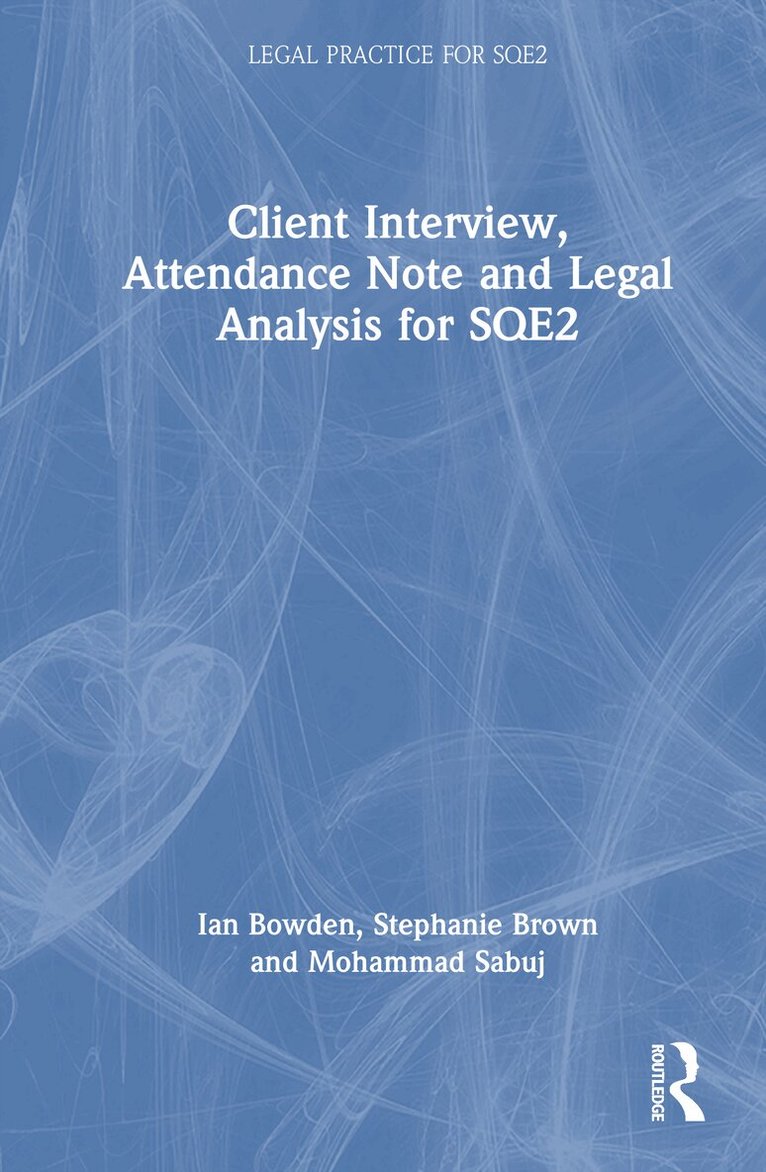
    Client Interview, Attendance Note and Legal Analysis for SQE2

    AvIan Bowden,Stephanie Brown

    Inbunden, Engelska, 2025

    Del i serien Skills of Legal Practice Series for SQE2

    2 239 kr

    Beställningsvara. Skickas inom 10-15 vardagar. Fri frakt över 249 kr.

    Fler format och utgåvor

    Häftad

    578 kr

    Beskrivning

    Client Interview, Attendance Note and Legal Analysis for SQE2 is the latest title in a new series of books aimed at those preparing for SQE2, providing a comprehensive overview of everything you need to successfully pass the SQE2 advocacy assessment.This book explains the key principles of oral communication, interview technique, and legal analysis in a clear, concise, and easy-to-understand style. The use of practical examples, from the practice areas set out by the SRA assessment specification, allows such key principles to be effectively introduced and illustrated. The book demonstrates the importance of the three key tenets of listening, questioning, and advising, with a view to ensuring that a matter can be analysed effectively, and effective and appropriate decisions can be made. The book provides a clear and structured approach, with opportunities to apply the relevant principles to the law. Chapters include summaries, key practice cases, practice tips, and exercises to reinforce learning and understanding.Written by an author team with extensive experience in teaching and practice, this unique book will be essential reading for any candidate wishing to be fully prepared for their SQE2 assessment.

    Produktinformation

    • Utgivningsdatum:2025-06-27
    • Mått:156 x 234 x 17 mm
    • Vikt:590 g
    • Format:Inbunden
    • Språk:Engelska
    • Serie:Skills of Legal Practice Series for SQE2
    • Antal sidor:214
    • Förlag:Taylor & Francis Ltd
    • ISBN:9781032856315

    Utforska kategorier

    • Juristyrken inom Juridik
    • Juridisk kompetens och praktik inom Juridik
    • Författningsrätt och förvaltningsrätt inom Juridik

    Mer om författaren

    Ian Bowden is a practising solicitor advocate and the LLM SQE Programme Manager at Liverpool John Moores University. He is the author of Essential Constitutional and Administrative Law for SQE1 and Essential Legal System and Legal Services for SQE1.Stephanie Brown is a solicitor with many years of experience in legal practice and is a legal trainer in a leading Manchester law firm.Mohammad Sabuj is Barrister-at-Law (Lincoln’s Inn) and Senior Lecturer in Law, University of Greenwich.

    Innehållsförteckning

    • Table of cases xvTable of statutes xviiIntroduction xix1 Oral Communication Skills – An Introduction 11.1 Statement of Solicitor Competence 11.2 The Importance of Oral Communication to the Legal Professional 21.3 Combining Oral and Written Communication Skills 31.4 A Student-Centred Approach to Skills Development 41.5 Finding Your Legal Voice 51.6 The Heart of Communication – The Recipient 61.7 Clarity and Structure 71.8 Two-Way Communication 81.8.1 Active Listening 81.8.2 Passive Listening 91.9 Leading the Narrative 91.9.1 Open Questions 91.9.2 Closed Questions 101.10 Non-Verbal Communication for the Legal Professional 101.10.1 Appearance 101.10.2 Body Language 111.11 The Pervasive Nature of Ethics 11In Summary 12Key Practice Case 13Practice Tips 15Practice Risks 15Exercise A 15Exercise B 16Self-Reflection Checklist 172 Creating the Right Atmosphere 192.1 Introduction 192.2 An Overview of the Regulatory Framework 212.2.1 The Legal Services Board 212.2.2 The Law Society 212.2.3 The Solicitors Regulation Authority (SRA) 222.2.4 The Solicitors Disciplinary Tribunal (SDT) 242.2.5 The Legal Ombudsman for England and Wales (LeO) 252.3 Principles of Legal Interviewing 262.3.1 What Is the Initial Client Interview? 272.3.2 Is Eff ective Interviewing an Aptitude or a Skill? 282.3.3 Why Is Interviewing Important? 282.3.4 Why Is the Initial Client Interview So Important? 292.3.5 The Aims and Objectives of the Initial Client Interview 302.3.6 What Skills and Competencies Are Needed? 312.3.7 The Structure of the Initial Client Interview 312.3.8 A Client-Centred Approach to Interviewing 332.3.9 A Client-Centred Approach in SQE2 332.4 Controlling the Interview Environment 342.4.1 Where Should the Initial Client Interview Take Place? 352.4.2 Ethical Considerations at the Planning Stage of theInterview 362.4.2.1 The Equality Act 2010 362.4.2.2 SRA Principles and Codes of Conduct(CCS and CCF) 362.4.2.3 Areas of Concern in Practice 392.4.3 Planning for the Arrival of the Client 412.4.4 Preparing the Interview Room 422.4.4.1 Minimum Expectations for an Interview Room 422.4.4.2 Seating and Table Arrangements 422.4.5 Preparing Yourself for the Interview 432.4.5.1 How Should You Dress for the Interview? 442.5 Barriers to Eff ective Communication 442.5.1 The Interview Room and Surrounding Areas 462.5.2 Culture Gaps and Inter-Cultural Barriers 472.5.3 The Interviewer 482.5.4 The Client 502.6 Client Bridges 502.7 Building Rapport 512.7.1 What Is ‘Rapport’? 522.7.2 The Importance of Building Rapport 522.7.3 How Do You Build Rapport? 522.7.4 How Do You Rebuild Rapport? 552.8 Balancing Empathy 562.9 Equality in Language – The Pitfalls of Sounding Like a Lawyer 57In Summary 60Key Practice Case 61Practice Tips 62Practice Risks 63Exercise A 63Exercise B 64Self-Refl ection Checklist 65References 653 Listening Skills 673.1 Introduction 673.2 Listening Skills in SQE2 683.3 Listening or Hearing? 683.4 Listening and Non-Verbal Communication 693.4.1 Auditory Messages – Paralanguage (Prosody) 703.4.2 Visual Messages – Body Language 703.4.3 Visual Messages – Appearance 723.5 The Lost Art of Listening 723.6 The Essentials of Professional Listening 733.7 Passive Listening 743.7.1 Start With an Open Question 743.7.2 Silence Is Golden 743.7.3 Rescuing a Client From Silence 753.8 Active Listening 753.8.1 Demonstrating Active Listening by Responding Non-Verbally 763.8.2 Demonstrating Active Listening by Responding Verbally 763.9 Note-Taking 78In Summary 78Key Practice Case – A complaint to the Legal Ombudsman(Anonymised) 79Practice Tips 80Practice Risks 80Exercise A – Practise Passive and Active Listening 80Exercise B – Refl ect on Your Listening Skills 81Self-Refl ection Checklist 81References 824 Questioning Skills 834.1 Introduction 834.2 Questioning in the Interview 844.3 Questioning Skills in SQE2 844.4 The Foundations of Legal Questioning 854.5 Question Aims 864.6 Asking the Right Questions – Preparation and Response 864.7 Types of Questions 874.8 The First Question 874.9 Open Questions 874.10 Probing Responses 884.10.1 Interrogatory 884.10.2 Keyword 884.10.3 Reflective 884.11 Closed Questions 894.12 The Eff ective Leading Question 894.13 Order and Knowledge Transfer – The Information Funnel 90In Summary 91Key Practice Cases: Complaints to the Legal Ombudsman(Anonymised) 91Practice Tips 92Practice Risks 93Exercise A 93Exercise B 94Self-Refl ection Checklist 945 Analysis, Explanation, and Advice 955.1 Introduction 955.2 Final Steps 965.3 Analysing Information and the Wider Legal Context 965.4 What Is Involved in Legal Analysis? 975.5 Explaining the Way Forward 975.6 Relevant Procedures 985.7 Advising 985.7.1 General Principles 995.7.2 Specifi c Client Advice 995.7.3 Should We Advise in Interviews? 995.7.4 Helping the Client Decide 1015.8 Plan of Action/Next Steps 1015.9 Closing the Interview 102In Summary 103Key Practice Case – The Scope and Limits of Legal Duty andProfessional Advice 103Practice Tips 104Practice Risks 105Exercise A 105Exercise B – Identify the Legal Problem and the Emotions 105Self-Refl ection Checklist 106Reference 1066 When Things Go Wrong 1076.1 Finding the Pathway 1076.2 Self-Refl ection During the Interview 1096.3 Content Issues 1106.3.1 Too Much Information 1116.3.2 Too Little Information 1136.3.3 Client Engagement 1156.3.4 Client Honesty 1176.4 Mirroring 1206.5 Client Issues 1206.5.1 Confl ict and Aggression 1206.5.2 Client Distress 1226.5.3 Dealing With Self-Emotion 1236.5.4 Referral 124In Summary 125Key Practice Case 126Practice Tips 127Practice Risks 127Exercise A 128Exercise B 129Self-Refl ection Checklist 1307 The SQE2 Client Interview 1317.1 Introduction 1317.2 The SQE2 Interviewing Assessment 1327.3 The Process 1327.4 Assessment Criteria 1337.5 Preparing for Assessment 1347.5.1 Pre-Assessment Day 1357.5.2 Eff ective Use of the 10-Minute Preparation Period 1367.6 The SQE2 Client 1387.7 Generic Interview Structures for Assessment 1397.7.1 Greeting the Client 1397.7.2 Preliminary Points 1417.7.3 Initial Questioning and Listening 1437.7.4 Questioning for Detail 1457.7.5 The Advice Stage 1467.7.5.1 The Legal Position 1477.7.5.2 Procedural Considerations 1497.7.5.3 Options for Progressing the Case 1497.7.6 Concluding and Client Care 1517.8 Eff ective Relationships – The Concept of Trust andConfi dence 1537.9 The Pervasive Nature of Ethics and Conduct 1547.10 Negotiation 1547.11 Note-Taking in Assessment 17.12 Time Factors 155Exercise A: Example Property Interview 160Exercise B: Example Interview for Wills and Intestacy, ProbateAdministration and Practice 165Self-Refl ection Checklist 1718 Legal Analysis and Attendance Notes 1738.1 Introduction 1738.2 The SQE2 Attendance Note/Legal Analysis Assessment 1748.3 Attendance Notes Use and Form 1768.4 What Requires Recording 1778.5 Referencing a File 1798.6 Legal Analysis and Advice 1808.7 Timing and Billing 1808.8 Oversights and Errors 181In Summary 181Key Practice Case 182Practice Tips 183Practice Risks 183Exercise A 184Exercise B 184Self-Refl ection Checklist 185SUGGESTED ANSWERS 187Suggested Answers for Chapter 1 189Exercise A 189Exercise B 190Test 1 190Test 2 190Suggested Answers for Chapter 2 191Exercise A 191Exercise B 192Test your Knowledge – Multiple Choice Tests 192Suggested Answers for Chapter 3 193Exercise A 193Exercise B 193Suggested Answers for Chapter 4 195Exercise A 195Exercise B 195Suggested Answers for Chapter 5 197Exercise A 197Exercise B 197Suggested Answers for Chapter 6 199Exercise A 199Exercise B 199Suggested Answers for Chapter 7 201Exercise A 201The Advice (In Outline) 201Exercise B 202The Advice (In Outline) 202Validity and Intention 202Conclusion 203Reasonable Provision 203Suggested Answers for Chapter 8 207Exercise A 207Exercise B 209Test 1 209Test 2 210Index 211