• Fri frakt över 249 kr
  • •
  • Snabba leveranser
  • •
  • Billiga böcker
Kundservice

Du är på sajten för privatpersoner.

Företag, bibliotek eller offentlig verksamhet?

Du handlar på classic.bokus.com, där alla dina funktioner finns intakta.
Till classic.bokus.com
Bokus logotyp. Gå till startsidan.
  • Erbjudanden
  • Student
  • Topplistor
  • Barn & ungdom
  • Bokus Play
  • E-böcker
  • Ljudböcker
  • Pocketböcker
  • Spel och pussel

Pocketfynda! Hundratals böcker för 49 kr/st →

Sidfot

Mina sidor

    Hjälp

    • Kundservice
    • Vanliga frågor och svar
    • Frakt och leverans
    • Retur vid ångerrätt
    • Reklamera vara
    • Betalning
    • Köpvillkor
    • Allmänna villkor
    • Information om webbplatsens tillgänglighet

    Om Bokus

    • Om oss
    • Pressrum
    • För studenter
    • För företag
    • För bibliotek och offentlig verksamhet
    • För leverantörer
    • Hållbarhet

    Populärt

    • Aktuella erbjudanden
    • Presentkort
    • Studentlitteratur
    • Nya böcker
    • Topplistor
    • Signerade böcker
    • Engelska böcker

    Inspiration

    • Boktips
    • BookTok
    • Barnbokskaraktärer
    • Populära författare
    Logotyp för Bokus
    Följ oss på Facebook (extern länk)Följ oss på Instagram (extern länk)Följ oss på YouTube (extern länk)Följ oss på TikTok (extern länk)
    bokus @ CookiesAnpassa cookiesIntegritetspolicyKöpvillkor
    Till Citymail hemsida (extern länk)Till Budbee hemsida (extern länk)Till Postnord hemsida (extern länk)Till Schenker hemsida (extern länk)Till Early Bird hemsida (extern länk)Till Walleys hemsida (extern länk)
    1. Naturvetenskap och teknik
    2. Geovetenskap
    3. Miljövetenskap och miljöpolitik

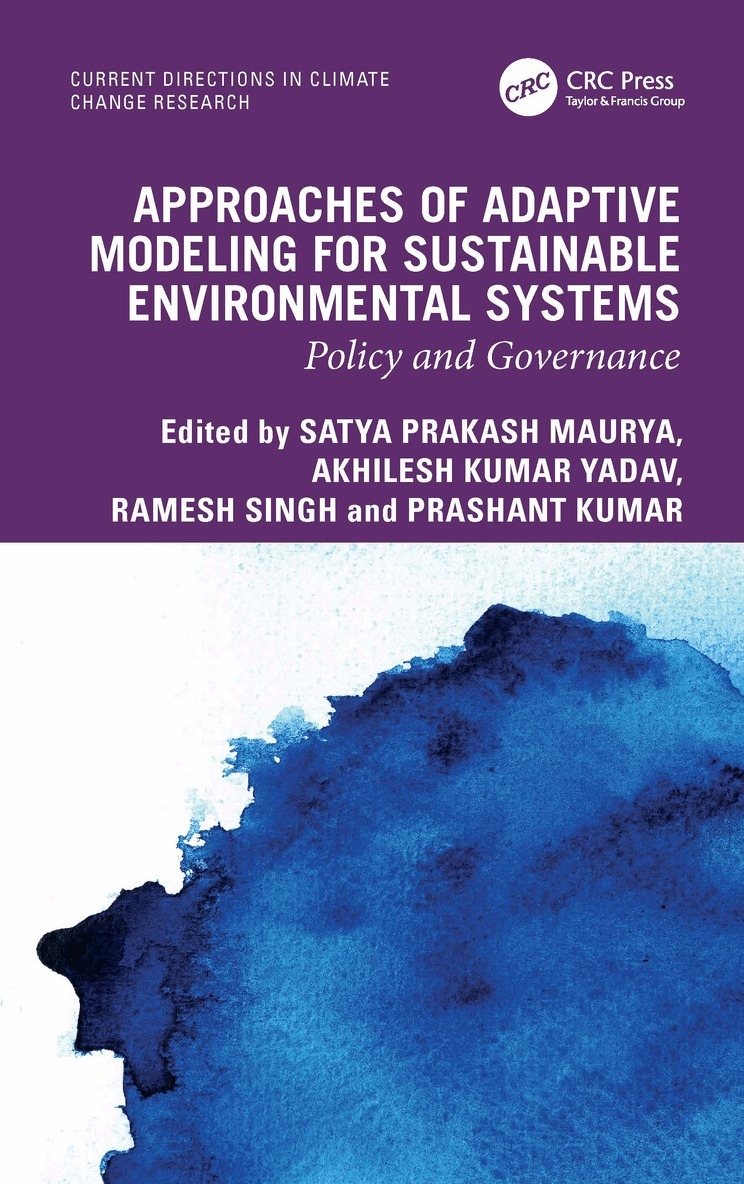
    Approaches of Adaptive Modeling for Sustainable Environmental Systems

    Policy and Governance

    AvSatya Prakash Maurya,Akhilesh Kumar Yadav

    Inbunden, Engelska, 2026

    Del i serien Current Directions in Climate Change Research

    1 545 kr

    Kommande

    Beskrivning

    This book provides a comprehensive overview of adaptive modeling techniques and explores various modeling approaches, including system dynamics, agent-based modeling, and integrated assessment modeling, with a focus on key environmental challenges.It examines how adaptive modeling can inform evidence-based policymaking, foster stakeholder engagement, support adaptive governance structures, and facilitate the implementation of sustainable practices. The book presents real-world case studies and examples from diverse environmental contexts to illustrate the practical application of adaptive modeling approaches.Key Features:Provides an overview of adaptive modeling approaches for sustainable developmentEmphasizes policy and governance integration for adaptive modeling to achieve sustainable outcomesProposes the development of sustainable and resilient environmental systemsExplains how adaptive modeling informs policy, fosters participation, and supports adaptive governance structuresIncludes both theoretical and practical case studiesThis book is aimed at graduate students and researchers in environmental and civil engineering.

    Produktinformation

    • Utgivningsdatum:2026-09-24
    • Mått:156 x 234 x undefined mm
    • Format:Inbunden
    • Språk:Engelska
    • Serie:Current Directions in Climate Change Research
    • Antal sidor:192
    • Förlag:Taylor & Francis Ltd
    • ISBN:9781032866475

    Utforska kategorier

    • Miljövetenskap och miljöpolitik inom Naturvetenskap och teknik
    • Energiteknik inom Naturvetenskap och teknik
    • Byggnadsteknik inom Naturvetenskap och teknik

    Mer om författaren

    Satya Prakash Maurya earned his B. Tech. in Computer Science & Engineering, M. Tech. in GIS & RS. He completed his PhD in Geoinformatics under the research domain of Spatial Decision Support System from Indian Institute of Technology (BHU), Varanasi (India). He has also studied Civil Engineering from IEI (India), Kolkata. He has worked as an Assistant Professor in CSED at PCE, Jaipur (India) with research interest in computational approach in machine learning, data modeling, expert systems, and artificial intelligence with application of urban water modeling and futuristic prediction and soft computing. Presently, he is working as a Project Scientist-I in NSDI funded project at IIT (BHU). He has published a number of research papers and is also a reviewer in a few reputed journals. He is an associate member in professional bodies such as International Association of Engineers, the IRED,USA and IEI, India.Akhilesh Kumar Yadav graduated with a Bachelor of Technology in Electronics and Communication Engineering from the Chaudhary Charan Singh University, Meerut, India. He subsequently obtained a Master of Technology in Environmental Engineering from Madan Mohan Malaviya Engineering College, Gorakhpur, India (affiliated with Dr. A. P. J. Abdul Kalam Technical University, Lucknow). His doctoral degree, with a research focus on air pollution, was awarded by the Indian Institute of Technology (Banaras Hindu University), Varanasi, India. Dr. Yadav has served at various institutions, including Indian Institute of Technology (Banaras Hindu University), Varanasi, India; Indian Institute of Technology Bombay, Mumbai, India; Bhabha Atomic Research Centre, Mumbai, India (as a research collaborator); and Chaoyang University of Technology, Taichung, Taiwan. He has authored/co-authored several research and review articles, book chapters, and edited/authored books, and holds a patent. Dr. Yadav received the Young Engineer Award from the Institution of Engineers (India) and the Young Scientist Award from VDGOOD Technology Factory, Kolkata. His research interests include air, water, and soil pollution; climate change; vulnerability; human health risk assessments; and GIS applications in environmental pollution and management. He is an active member of several reputed international professional bodies, including the IEI (Kolkata), ECI (New Delhi), AEACI (Mumbai), MSI (New Delhi), and IASTA (Mumbai).Ramesh Singh earned his B.Tech in Civil Engineering with a Gold Medal from IT-BHU, Varanasi and M.S. in Sanitary Engineering from IHE Netherland. He worked as field engineer for 37+ years with Govt. of U.P. (India) and was involved with planning and implementation of various national and foreign aided projects for abatement works of rivers and lakes, and urban and rural water supply and environmental sanitation. He has worked as Visiting Faculty in Civil Engineering at IIT(BHU), Varanasi. Presently, he is engaged as Technical Advisor of Kokusai Kogyo Co. Ltd, Tokyo, Japan, and Directorate Environment and Climate Change, Govt. of Manipur (India). He has published a few research papers and is also a reviewer for reputed journals. He is fellow member of Indian Water Works Association (India), life member of Institution of Engineers (India), Indian Association of Environmental Management and The Indian Concrete Journal.Prasant Kumar is a founding Co-Director of the pan-university Institute for Sustainability, Professor & Chair in Air Quality and Health, and founding Director of the internationally-leading research centre Global Centre for Clean Air Research (GCARE) at the University of Surrey, UK. He is the founder of successfully running Guildford Living Lab, a Trustee at Zero Carbon Guildford (ZERO), an Adjunct Professor at Trinity College Dublin, Ireland; and a Guest Professor at Southeast University, China. He joined the Senior Leadership team of the Faculty of Engineering and Physical Sciences as an Associate Dean (International) in 2020 and subsequently took up another senior leadership role to help set up the new pan-University Institute for Sustainability as a founding Co-Director in 2023. As an Associate Dean (International), he worked on implementing the University’s Global Strategy and provided leadership to the international agenda, including student recruitment, transforming the PGR international placements through Turing and other mobility schemes, building several successful international research partnerships, coordinated numerous UG and PGT partnerships and joint PhD programmes, and led the QS submission for the University as a ‘QS Impact Champion’. An engineer by training, Prof Kumar obtained his PhD (Engineering) from the University of Cambridge (UK) after winning a Cambridge-Nehru Scholarship and Overseas Research Scholarship award. He earned his master’s degree in environmental engineering & management from the Indian Institute of Technology, Delhi, where he won the ‘Outstanding Postgraduate Student Award’ for his exemplary performance (CGPA 9.8/10 and rank 1). Prior to his PhD, he worked in the construction industry and at a CSIR Research Institute for about 7 years.

    Innehållsförteckning

    • Part-I: Essentials of Sustainable Environmental System Modeling 1. Current Directions of Sustainable Environmental System: Modeling Aspects 2. Mathematical Approaches for Sustainable Environmental System: Towards Adaptive Action 3. Intervention of Artificial Intelligence in Sustainable Environmental System Monitoring & Prediction 4. Role of Remote Sensing in Climate Change Detection & Remediation 5. Adaptive Modeling for Climate Change Action Plans: Principles & Practices Part-II: Climate Change: Towards Sustainable Resource Planning and Management 6. Sustainable Development Goal 13 (SDG-13) for Climate Change Actions: Tasks, Methods & Implementation Aspects 7. Framework for Adaptive Capacity to Climate-related Natural Disaster: Statistical Data and Machine Learning 8. Integrating Measures into Policy, Strategy & Planning: An Automation Approach for Assessment 9. Artificial Intelligence Approaches/Tools in Decision Making of Climate Change Extreme Events 10. Future Frameworks for Climate Change Action Plan - 2030: A Global Perspective.