• Fri frakt över 249 kr
  • •
  • Snabba leveranser
  • •
  • Billiga böcker
Kundservice

Du är på sajten för privatpersoner.

Företag, bibliotek eller offentlig verksamhet?

Du handlar på classic.bokus.com, där alla dina funktioner finns intakta.
Till classic.bokus.com
Bokus logotyp. Gå till startsidan.
  • Erbjudanden
  • Nyheter
  • Student
  • Topplistor
  • Barn & ungdom
  • Bokus Play
  • E-böcker
  • Pocketböcker
  • Spel & pussel

10% rabatt på allt med kod: NYSTART10 →

Sidfot

Mina sidor

    Hjälp

    • Kundservice
    • Vanliga frågor och svar
    • Frakt och leverans
    • Retur vid ångerrätt
    • Reklamera vara
    • Betalning
    • Köpvillkor
    • Allmänna villkor
    • Information om webbplatsens tillgänglighet

    Om Bokus

    • Om oss
    • Pressrum
    • För studenter
    • För företag
    • För bibliotek och offentlig verksamhet
    • För leverantörer
    • Hållbarhet

    Populärt

    • Aktuella erbjudanden
    • Presentkort
    • Studentlitteratur
    • Nya böcker
    • Topplistor
    • Signerade böcker
    • Engelska böcker

    Inspiration

    • Boktips
    • BookTok
    • Populära bokserier
    • Barnbokskaraktärer
    • Populära författare
    Logotyp för Bokus
    Följ oss på Facebook (extern länk)Följ oss på Instagram (extern länk)Följ oss på YouTube (extern länk)Följ oss på TikTok (extern länk)
    bokus @ CookiesAnpassa cookiesIntegritetspolicyKöpvillkor
    Till Citymail hemsida (extern länk)Till Budbee hemsida (extern länk)Till Postnord hemsida (extern länk)Till Schenker hemsida (extern länk)Till Early Bird hemsida (extern länk)Till Walleys hemsida (extern länk)
    1. Psykologi och pedagogik
    2. Psykologi
    3. Socialpsykologi och gruppsykologi

    Psychology for Sustainability

    AvElise L. Amel,Britain A. Scott

    Häftad, Engelska, 2026

    1 061 kr

    Beställningsvara. Skickas inom 10-15 vardagar. Fri frakt över 249 kr.

    Fler format och utgåvor

    Inbunden

    2 423 kr

    Beskrivning

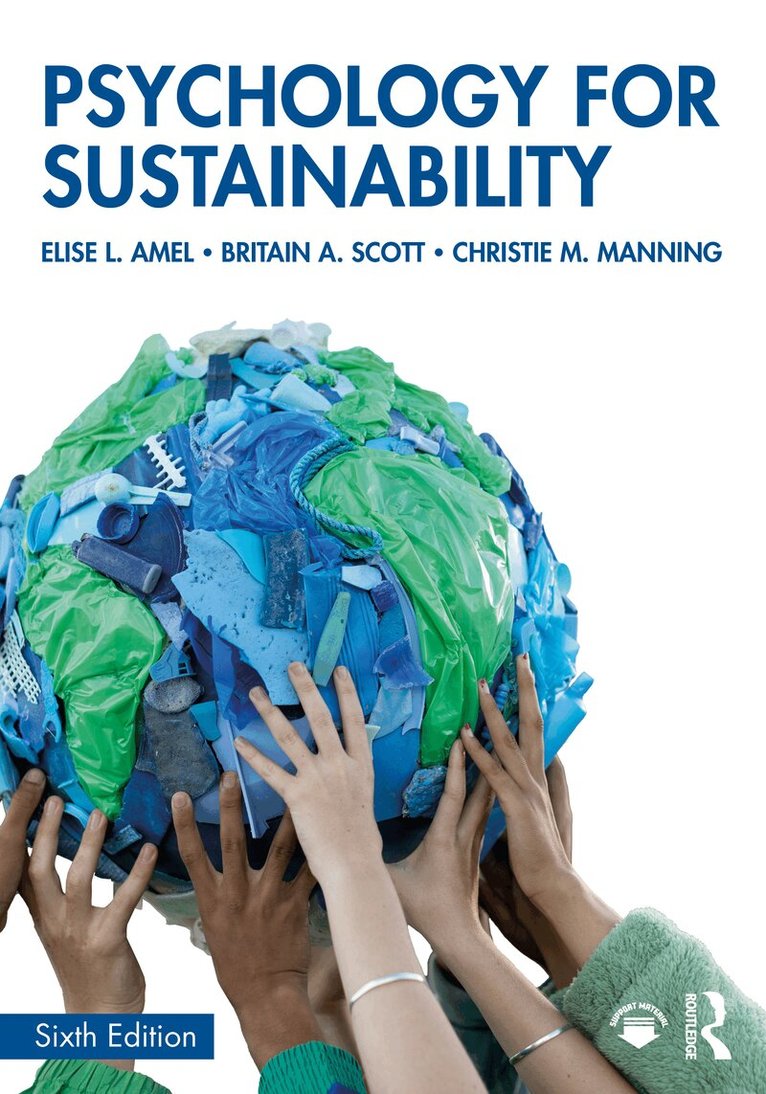
    Now in its sixth edition and more crucial than ever, Psychology for Sustainability applies psychological science to environmental problems that manifest when human behavior disrupts and degrades natural systems. Drawing on environmental psychology, ecopsychology, conservation psychology, and related disciplines, the authors provide an extensive review of relevant theory and research in a lively and easy-to-read style.The book is organised into four parts that follow (1) the history of psychology as a sustainability science and our current ecological crisis, (2) research methods, theory, and findings pertinent to understanding and shifting unsustainable behavior, (3) the reciprocal relationship between planetary and human health, and (4) key takeaways for how to apply psychology in the world to promote both personal and systemic change.Key features of the new edition includepedagogical features to enhance comprehension and reflectiona renewed focus on positive actionup-to-date treatment of burgeoning research and global ecological, political, and social developments.The text is carefully tailored to the length of a standard academic semester and is essential reading for courses on sustainability across disciplines. It will be invaluable to people outside academia as well, including policymakers, legislators, and those working on sustainable communities.

    Produktinformation

    • Utgivningsdatum:2026-05-28
    • Mått:178 x 254 x 29 mm
    • Vikt:900 g
    • Format:Häftad
    • Språk:Engelska
    • Antal sidor:488
    • Upplaga:6
    • Förlag:Taylor & Francis Ltd
    • ISBN:9781032873275

    Utforska kategorier

    • Socialpsykologi och gruppsykologi inom Psykologi och pedagogik
    • Kognitiv psykologi inom Psykologi och pedagogik
    • Miljövetenskap och miljöpolitik inom Naturvetenskap och teknik

    Mer om författaren

    Elise L. Amel is a professor of psychology at the University of St. Thomas, MN, where she has been a faculty member since 1997. She earned her PhD in industrial-organizational psychology from Purdue University. Elise is a Fellow of the American Psychological Association and former president of SEPCP/Division 34. At St. Thomas she has worn many hats including inaugural chair of the Department of Earth, Environment, and Society; and co-founder and faculty director of the St. Thomas Office of Sustainability Initiatives.Britain A. Scott is a professor of psychology at the University of St. Thomas, MN, where she has been on the faculty since 1996. She earned her PhD in social psychology at the University of Minnesota. Britain is a former president of the Society for Environmental, Population, and Conservation Psychology (SEPCP/Division 34 of the American Psychological Association) and is a co-creator of Teaching Psychology for Sustainability at www.teachgreenpsych.com.Christie M. Manning is a faculty member in environmental studies at Macalester College. She earned her PhD in cognitive and biological psychology from the University of Minnesota. In addition to her academic roles, Christie is an activist working with local climate justice groups to fight for a just and livable future.

    Recensioner i media

    The 6th edition of Psychology for Sustainability is an engaging and expansive resource that equips students with the psychological insights needed to address environmental challenges. This revised edition both meaningfully deepens its scope with updated references, expanded coverage of the impacts of climate change on human functioning, pathways for climate mitigation and adaptation, as well as a more comprehensive psychological account of human ecological cognition. Bridging these components together allows for a stronger emphasis on evidence-based action, offering both a solid foundation in experimental methods and practical tools for behavior change. By balancing urgency with empowerment, the book motivates without overwhelming—guiding readers toward meaningful, informed action and a more hopeful relationship with the planet.Dr. Stylianos Syropoulos, Assistant Professor, School of Sustainability College of Global Future, Arizona State UniversityThe sixth edition of Psychology for Sustainability is a timely and welcome update to a foundational text in the field. Written with clarity and care, it offers a comprehensive and rigorous exploration of the psychological dimensions underlying environmental degradation and sustainability. Drawing on a wide range of subfields, the text presents a well-organized synthesis of theory, empirical research, and real-world applications, making it an invaluable resource for students, educators, and practitioners across disciplines. By centering the ecological crisis as a fundamentally behavioral problem, this volume provides a compelling case for why psychological science must play a central role in achieving sustainability.Dr. Hannes Zacher, Chair of Work and Organizational Psychology, Wilhelm Wundt Institute of Psychology, Leipzig University, GermanyThis thoughtfully updated, expanded and improved edition of Psychology for Sustainability couldn’t have come at a better time. The field of conservation psychology has grown tremendously over the past five years and many new findings and frameworks have emerged that both expand and, in some cases, challenge what we thought we knew about the core drivers of environmental degradation and the role of human psychology. The authors have done a masterful job of integrating these new insights and findings with well-established knowledge in the field to produce a text that will be practically useful for a wide range of readers, including students, educators, researchers and practitioners. This will be the "go-to" text for the field for years to come!Dr. Ezra Markowitz, Professor, Department of Environmental Conservation,University of Massachusetts, AmherstAmel, Scott, & Manning's book, Psychology for Sustainability, is an accessible, student-friendly text that illustrates psychology's contributions to sustainability with updated research and useful teaching materials. The textbook provides an interdisciplinary context by describing a range of environmental problems, driven by human decision-making and behavior and affecting human health and well-being. It draws from concepts and studies from different psychological specializations that illustrate how psychological research aids understanding why the problems stubbornly persist and how people can contribute to personal and collective solutions. Thus, it provides a realistic overview of challenges to sustainability and an uplifting view of psychology’s contributions to possible paths forward.Dr. Janet K. Swim, Professor, Penn State

    Innehållsförteckning

    • Part 1. What on Earth Are We Doing? Prologue Growth in Green Psychology 1. What on Earth Are We Doing? 2. How Did We Get Here? Power, Privilege, and a Paradigm Problem 3. Where Do We Go From Here? Applying an Ecological Worldview Part 2. Psychology for a Sustainable Future 4. Psychology Can Help Save the Planet 5. The Power of the (Unsustainable) Situation 6. It’s Not Easy Thinking Green 7. Putting the “I” in Environment 8. To Be (Green) or Not to Be (Green) . . . It’s a Question of Motivation Part 3. What’s Good for the Planet Is Good for Us 9. Making Ourselves Sick: Health Costs of Unsustainable Living 10. Healing the Split Between Planet and Self: We All Need to Walk on the Wild Side Part 4. Being the Change We Want to See 11. When the Going Gets Tough, the Tough Get . . . Together 12. Getting Psyched for Sustainability Appendix: Self-Change Project