• Fri frakt över 249 kr
  • •
  • Snabba leveranser
  • •
  • Billiga böcker
Kundservice

Du är på sajten för privatpersoner.

Företag, bibliotek eller offentlig verksamhet?

Du handlar på classic.bokus.com, där alla dina funktioner finns intakta.
Till classic.bokus.com
Bokus logotyp. Gå till startsidan.
  • Erbjudanden
  • Nyheter
  • Student
  • Topplistor
  • Barn & ungdom
  • Bokus Play
  • E-böcker
  • Pocketböcker
  • Spel & pussel

10% rabatt på allt med kod: NYSTART10 →

Sidfot

Mina sidor

    Hjälp

    • Kundservice
    • Vanliga frågor och svar
    • Frakt och leverans
    • Retur vid ångerrätt
    • Reklamera vara
    • Betalning
    • Köpvillkor
    • Allmänna villkor
    • Information om webbplatsens tillgänglighet

    Om Bokus

    • Om oss
    • Pressrum
    • För studenter
    • För företag
    • För bibliotek och offentlig verksamhet
    • För leverantörer
    • Hållbarhet

    Populärt

    • Aktuella erbjudanden
    • Presentkort
    • Studentlitteratur
    • Nya böcker
    • Topplistor
    • Signerade böcker
    • Engelska böcker

    Inspiration

    • Boktips
    • BookTok
    • Populära bokserier
    • Barnbokskaraktärer
    • Populära författare
    Logotyp för Bokus
    Följ oss på Facebook (extern länk)Följ oss på Instagram (extern länk)Följ oss på YouTube (extern länk)Följ oss på TikTok (extern länk)
    bokus @ CookiesAnpassa cookiesIntegritetspolicyKöpvillkor
    Till Citymail hemsida (extern länk)Till Budbee hemsida (extern länk)Till Postnord hemsida (extern länk)Till Schenker hemsida (extern länk)Till Early Bird hemsida (extern länk)Till Walleys hemsida (extern länk)
    1. Medicin
    2. Medicin: allmänt
    3. Samhällsmedicin och preventiv medicin
    4. Folkhälsa och hälsopedagogik

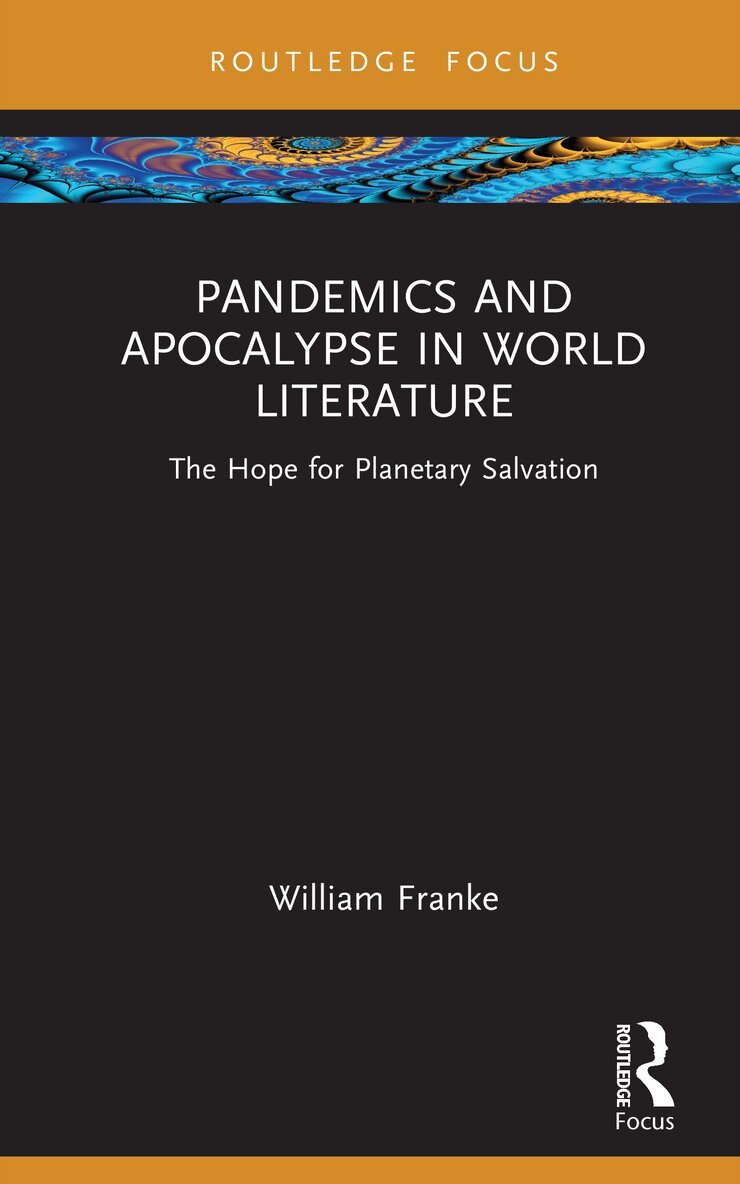
    Pandemics and Apocalypse in World Literature

    The Hope for Planetary Salvation

    AvWilliam Franke

    Inbunden, Engelska, 2025

    Del i serien Routledge Focus on Literature

    1 105 kr

    Beställningsvara. Skickas inom 10-15 vardagar. Fri frakt över 249 kr.

    Fler format och utgåvor

    Häftad

    686 kr

    E-bok

    482 kr

    E-bok

    482 kr

    Beskrivning

    Pandemics and Apocalypse rereads classical narratives of plague from the Bible (Exodus) and classical antiquity, both Greek (Homer, Thucydides, Sophocles) and Roman (Lucretius, Virgil, Ovid), through the Middle Ages (Dante, Boccaccio) and Modernity (Defoe, Manzoni, Artaud, Camus) as a basis for contemplating the significance of the recent Covid-19 pandemic. It concerns how we are to confront future pandemics and other inextricably related crises, notably those of an ecological nature. Responses to Covid-19 typically set everything on defeating this “enemy,” but actually we cannot eliminate viruses without eliminating ourselves. We need to see the pandemic as revealing us to ourselves in our inherently vulnerable condition as a first step to admitting the infinite openness to one another and to our Ground—physical and metaphysical—that alone can save our world by engendering a different attitude, open and engaged, to one another and to the Earth as sources of our collective life.

    Produktinformation

    • Utgivningsdatum:2025-02-19
    • Mått:138 x 216 x 15 mm
    • Vikt:450 g
    • Format:Inbunden
    • Språk:Engelska
    • Serie:Routledge Focus on Literature
    • Antal sidor:146
    • Förlag:Taylor & Francis Ltd
    • ISBN:9781032895857

    Utforska kategorier

    • Folkhälsa och hälsopedagogik inom Medicin
    • Litteraturvetenskap inom Skönlitteratur

    Mer om författaren

    William Franke is Professor of Comparative Literature at Vanderbilt University. He is currently Francesco de Dombrowski Professor in Residence at the Harvard University Center for Renaissance Studies (Villa I Tatti) in Florence, Italy, and Senior Fellow of the International Institute for Hermeneutics. He has been Research Fellow of the Alexander von Humboldt-Stiftung, Professor of Philosophy at the University of Macao, Visiting Professor of Philosophy at the University of Navarra, and Fulbright Distinguished Chair in Intercultural Theology and the Study of Religions at the University of Salzburg. His books include On What Cannot Be Said (2007); Poetry and Apocalypse (2009); Dante and the Sense of Transgression (2013); A Philosophy of the Unsayable (2014); The Revelation of Imagination (2015); Secular Scriptures (2016); A Theology of Literature (2018); The Universality of What Is Not (2020); The Divine Vision of Dante’s Paradiso (2021); The Vita Nuova and the New Testament (2021); Dante's Paradiso and the Theological Origins of Modern Thought (2021); Dantologies (2024); Don Quixote and the Quest for the Absolute in Literature (2024); and others.

    Recensioner i media

    William Franke delves into how disease and death force humanity to confront its deepest vulnerabilities in this profound exploration of pandemics in literature. Much like apocalyptic events, pandemics raise fundamental questions about the viability of human society, the fragility of life, and the structures that bind us together. These crises level all distinctions, revealing the often-ignored truths about inequality, mortality, and our shared existence. Yet amidst the despair, the text argues for hope—not as a solution to our vulnerability, but as an openness to life in all its uncertainty. This hope inspires us to transcend self-preservation, fostering solidarity and collective action toward a more meaningful life. The book illuminates the inexpressible dimensions of these world-shattering experiences through personal witness and reflection, offering a powerful meditation on the human condition.-Prof. Massimo Lollini, Professor Emeritus of Italian, University of Oregon, USAPandemics and Apocalypse in World Literature is not just a scholarly survey but a constructive approach that gives itself the task to wrest possibilities of an eschatological hope from the night of apocalyptic despair. Written in the wake of the recent pandemics, the work deploys negative theology at its most creative possibility: it consists of an infinite affirmation of the unconditioned which nevertheless remains irreducibly ineffable. Franke brings together, without reducing their disparate character, the agonal traits of the end and the beginning, of despair and hope, of the abyss of the night and the first morning glow; and he shows, through rigorous exegesis of some of the very difficult texts, that perhaps the only task that is worthy today is to see the possibility of the radical, incalculable alterity that our history never ceases exposing us to. Dense, profound, thought-provoking.-Prof. Saitya Brata Das, Associate Professor, JNU, IndiaWilliam Franke's history of pandemic literature, from the ancient world to COVID, helps us understand what we are all still wondering about: what exactly happened to the us in 2020? The pandemic made us all more aware of the contingency of order, and the religious significance of this awarness, while overlooked by many, is for Franke the big take away. An eye-opener.-Prof. Sean J. McGrath, Professor, Memorial University, CanadaWilliam Franke's book is exceptionally important as it masterfully combines three areas of expertise: literary, anthropological, and philosophical-theological. On one hand, it offers an erudite and nearly unprecedentedly broad reconstruction of the phenomenology of the plague from its origins to the present, covering not only Western cultures but also Jewish and Chinese perspectives. On the other hand, it presents a sociological reflection on the deep-rooted causes of the plague’s reemergence (today in the form of Covid-19) and its philosophical and existential implications. Saint Paul's saying, spes contra spem (hope against hope) is reimagined and explored within the context of apophatic theology. The reference to the Native American model of vital experience, along with Western and Eastern mysticism, underscores the depth of this approach.-Walter Minella, Philosopher in Neurotheoretical Research Group, Pavia, ItalyWilliam Franke meditates on the currently constitutive crisis of human materiality, as it manifests in the collective imbalance symptomatized by an epidemic and crashes in on every shoreline of our ecological future. In his distinctive reading of the unspeakability of our circumstance through apophasis, and the intensity of the crisis through apokalypsis, fresh insight breaks through for more spirited collective response.-Prof. Catherine Keller, G.T. Cobb Professor of Constructive Theology, Drew Theological School, USA

    Innehållsförteckning

    • List of Illustrations1. Prologue and AcknowledgmentsPart I. Plague Literature 2. The Engendering of Hope from Human Helplessness3. Myth, History, Fiction, and the Limits of Representation4. The Mystery of the Supernatural at the Limit of Naturalism5. From Ambiguity of Causes to Moral Certitude through Existential Conversion6. Securing Control versus Acknowledging Grace and Vulnerability7. Hope in a Negative Theological and Apocalyptic-Fictive Register of Wholeness8. Theology of Hope as Negative Theology—Moltmann and Bloch9. Partial Action Combined with Hope in Wholeness10. Othering Hope: Postmodern, Extra-European, and Indigenous Perspectives11. The Vision of the Whole versus Parceled PerceptionPart II. Political Ecology12. The Web of Connections: Integral Ecology, Culture, and Society13. Pandemics and Environmental Apocalypse: Their Common Causes14. Progressive versus Apocalyptic Perspectives on Pandemics 15. Hope in Civil Society between Private and Public16. From Social to Cosmic Consciousness: Latour’s Apocalyptic Reading of the Coronavirus Crisis17. Relativizing Scientific “Truth”18. Truth and Transcendence versus Technique19. Negative Theology of the Earth According to Bruno LatourPart III. Apocalyptic Hope20. Eschatology, Incarnation, Kenosis21. Indigenous Salvation as Guide22. From “Theology of Hope” to “Theology of the Earth”23. Science, Faith, and Social Belief—Not Strictly Separable24. Control and Excess in Dissembling the Unspeakable25. Parallel Perspectives and the Novel26. A Semiotic Model of Contagion—Viral Informatics27. Hoping against Hope: From Reason to Religion, or Spiritualizing Rationality28. Conclusion: Hope-fail Enactment of Eternity29. Coda: Plague and War30. Appendix: Abstracts of Selected Plague Narratives in Literature, Classical to ModernBibliographyIndex