• Fri frakt över 249 kr
  • •
  • Snabba leveranser
  • •
  • Billiga böcker
Kundservice

Du är på sajten för privatpersoner.

Företag, bibliotek eller offentlig verksamhet?

Du handlar på classic.bokus.com, där alla dina funktioner finns intakta.
Till classic.bokus.com
Bokus logotyp. Gå till startsidan.
  • Erbjudanden
  • Nyheter
  • Student
  • Topplistor
  • Barn & ungdom
  • Bokus Play
  • E-böcker
  • Pocketböcker
  • Spel & pussel

10% rabatt på allt med kod NYSTART10 →

Sidfot

Mina sidor

    Hjälp

    • Kundservice
    • Vanliga frågor och svar
    • Frakt och leverans
    • Retur vid ångerrätt
    • Reklamera vara
    • Betalning
    • Köpvillkor
    • Allmänna villkor
    • Information om webbplatsens tillgänglighet

    Om Bokus

    • Om oss
    • Pressrum
    • För studenter
    • För företag
    • För bibliotek och offentlig verksamhet
    • För leverantörer
    • Hållbarhet

    Populärt

    • Aktuella erbjudanden
    • Presentkort
    • Studentlitteratur
    • Nya böcker
    • Topplistor
    • Signerade böcker
    • Engelska böcker

    Inspiration

    • Boktips
    • BookTok
    • Populära bokserier
    • Barnbokskaraktärer
    • Populära författare
    Logotyp för Bokus
    Följ oss på Facebook (extern länk)Följ oss på Instagram (extern länk)Följ oss på YouTube (extern länk)Följ oss på TikTok (extern länk)
    bokus @ CookiesAnpassa cookiesIntegritetspolicyKöpvillkor
    Till Citymail hemsida (extern länk)Till Budbee hemsida (extern länk)Till Postnord hemsida (extern länk)Till Schenker hemsida (extern länk)Till Early Bird hemsida (extern länk)Till Walleys hemsida (extern länk)
    1. Samhälle och politik
    2. Samhälle och kultur
    3. Kultur och medier
    4. Referensverk och tvärvetenskap

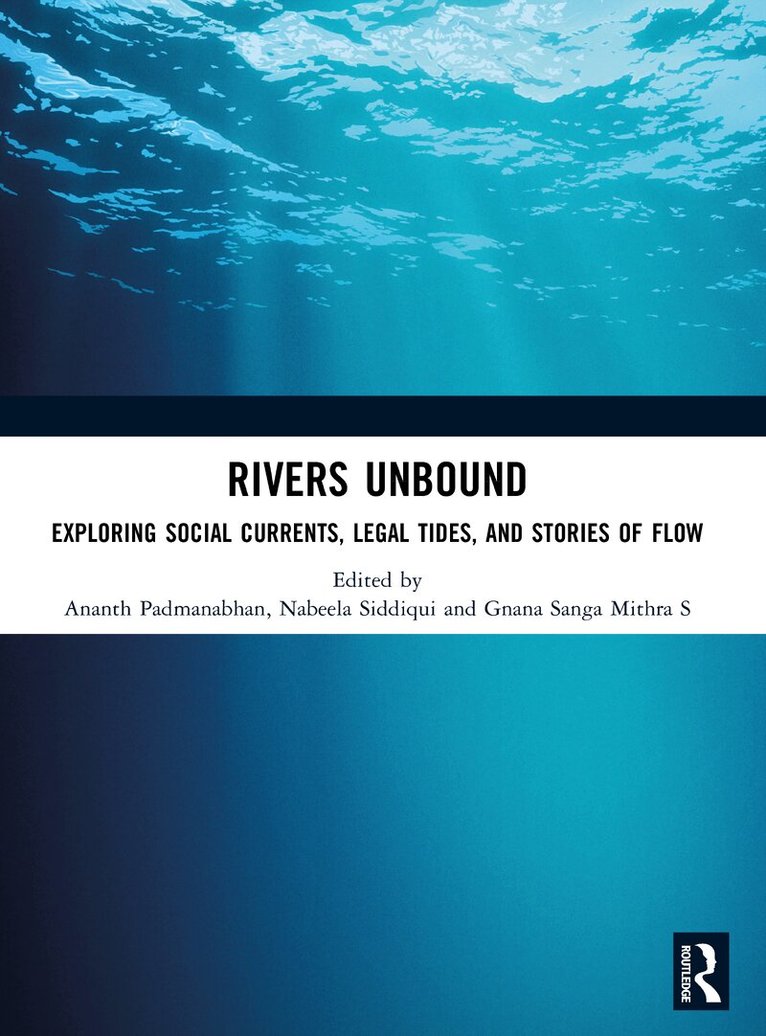
    Rivers Unbound

    Exploring Social Currents, Legal Tides, and Stories of Flow

    AvAnanth Padmanabhan,Nabeela Siddiqui

    Häftad, Engelska, 2025

    934 kr

    Beställningsvara. Skickas inom 10-15 vardagar. Fri frakt över 249 kr.

    Beskrivning

    Rivers Unbound: Exploring Social Currents, Legal Tides, and Stories of Flow addresses the complex challenges facing river systems in an era of climate change, geopolitical tension, and environmental degradation. Drawing from the International Conference on Rivers 2024, this volume brings together critical perspectives on how rivers—from the Indus to the Ganges, the Nile to the Amazon—are increasingly becoming sites of contestation over access, governance, and rights.This interdisciplinary collection features contributions from scholars, policymakers, legal experts, environmentalists, and community advocates who participated in the International Conference on Rivers 2024. The book is structured around three thematic pillars—social currents, legal tides, and stories of flow—that weave together diverse perspectives on river governance. It presents case studies from major river systems across continents, offering comparative insights into transboundary water management, legal precedents in water rights, community-centered conservation approaches, and innovative governance models.The book serves as a comprehensive resource for graduate students and educators in environmental law, geography, anthropology, political science, and interdisciplinary environmental studies programs seeking to understand the interconnected social, legal, and ecological dimensions of river systems. It will also appeal to environmental researchers, legal scholars, and policy analysts working on water governance, climate adaptation, and natural resource management.

    Produktinformation

    • Utgivningsdatum:2025-08-19
    • Mått:210 x 280 x 16 mm
    • Vikt:760 g
    • Format:Häftad
    • Språk:Engelska
    • Antal sidor:270
    • Förlag:Taylor & Francis Ltd
    • ISBN:9781041123484

    Utforska kategorier

    • Referensverk och tvärvetenskap inom Samhälle och politik
    • Geografi inom Naturvetenskap och teknik
    • Miljövetenskap och miljöpolitik inom Naturvetenskap och teknik

    Mer om författaren

    Ananth Padmanabhan is an expert in intellectual property rights and technology policy. He has been serving as the Dean of VMLS from July, 2023, after completing a mid-career business program (MSx Sloan Fellow ‘23) from the Stanford University Graduate School of Business in June 2023. He has authored a leading treatise, Intellectual Property Rights: Infringement and Remedies and co-edited an important volume, India as a Pioneer of Innovation. His co-authored chapter on Big Data in an impactful volume on Regulation in India: Design, Capacity, Performance, is part of a continuing initiative to examine the public law and regulatory dimensions of new technologies. It builds on his understanding of the Indian State and the Supreme Court within the constitutional context, explored through chapters in Rethinking Public Institutions in India, and the Oxford Handbook of the Indian Constitution. He engages in broader public conversations on the impact of technology through his opinion pieces in Hindustan Times, ThePrint, Livemint, Indian Express, and other print / new media.Nabeela Siddiqui is currently serving as an Assistant Professor at Vinayaka Mission’s Law School (VMLS), Vinayaka Mission’s Research Foundation (Deemed to be University), Chennai with a strong focus on contemporary issues such as climate change, international water disputes, and cooperation. Throughout her impressive career, she has held esteemed positions at renowned institutions, including CHRIST (Deemed to be University), Dharamshastra National Law University (DNLU), and the National Green Tribunal, Principal Bench, New Delhi. Ms. Siddiqui’s dedication and commitment to her field have been recognized with prestigious honors, such as the President of India, Dr. Shankar Dayal Sharma Gold Medal, The Innes Prize, The Carmicheal Prize, and The V. Suresham Memorial Award, all of which she earned during her master’s program at the esteemed University of Madras, Chennai. As an avid researcher, Ms. Siddiqui has authored and co-authored numerous book chapters and articles, many of which are indexed in Scopus. Her expertise in legal matters and her insights into current affairs have garnered widespread recognition and she is a regular contributor to leading national newspapers and forums, including The Deccan Herald, The Hindu, Economic Political Weekly, Financial Express, among others.Gnana Sanga Mithra S. is currently serving as an Associate Professor at Vinayaka Mission’s Law School (VMLS), Vinayaka Mission’s Research Foundation (Deemed to be University), Chennai. She is an accomplished scholar in the field of Sociology, particularly specializing in Transgender Studies and Gender Studies.Throughout her career, she has made significant contributions to research, with numerous papers published in Scopus Indexed journals. Her accolades further underscore her research prowess, including receiving the Raman Research Cash Award from VIT and being recognized as a Situational Leader in the educational sector by Ooruni Foundation, Chennai.Her expertise has been sought after by organizations such as the TN Forest Department, where she acted as a project consultant for a scheme funded by the Japan International Cooperation Agency. Her research projects have been supported by seed grants from VMRF, demonstrating her capability to secure funding and carry out impactful research. She has an editorial role in the Humanities and Social Science Journal and is a reviewer for Frontiers and Taylor & Francis journals.

    Innehållsförteckning

    • 1. Securing Water, Empowering Women: A Study of ‘Jal Saheli’ and ‘Pani Panchayat’ as Water Conservation Models in Drought-Prone Bundelkhand Saumya Verma2. Comparative Analysis of Legal Responses to Industrial Pollution of Rivers: Strategies for Mitigating Environmental Impacts Across Asian Countries with Special Reference to India Abraham S. and Swati V.3. (Geopolitical) Water: Sovereignty, Equity, and The Limits of Global Water Governance Frameworks Hari Godara4. The Role of International Law in Water Governance Between India and China Neeraj Singh Manhas, Hari Yadav G., Neha Manhas and Jayati Raval5. The Role of Narratives in the India-China Water Dispute Neeraj Singh Manhas, Pintu Kumar Mahla, Arpan A Chakravarty and Aishwarya Singh Raikwar6. Indigenous Voices in River Conservation: Legal Barriers and Pathways in India Kasturi Bhagat7. Re-shaping Hydro-diplomacy: India’s Role in South Asian Water Politics Sreshtha Chakraborty and Nupur Kumari8. Clean Water as a Fundamental Human Right in India: Challenges and Solutions Tilak Raj Sharma and Vikash Sharma9. Assessing the Role of Self-Help Groups in Empowering Single Mothers through River-based Livelihoods in Chennai Aarthy Jonathan Kennedy, Shoba Jasmin K. S. and Anju Mohan10. Rivers of Justice: Navigating Maritime Arbitration Practices in India Pallab Das, Sanjampreet Singh and Dhruv Kalia11. Flowing Beyond Binaries: Exploring Gender Fluidity and Identity through Trans-ecology Anee Bhattacharyya12. From Anthropocentrism to Ecocentrism: The Legal Journey of the Asia-Pacific Region and Indian Judiciary’s Tryst with Rights of Rivers Somabha Bandopadhay and Jina Im13. Navigating the Legal and Political Currents of the Mahadayi Dispute Vaibhavi Rane and Mohit Sukhtankar14. Kaptai Dam as the Lake of Tears: An Injustice to the Jummas’ Rights Fahim Abrar Abid and Mahbuba Kamal15. Liminal Spaces and Riverine Lives: Third-Space Theory in The Boatman of the PadmaArnab Das and Manjusha C. B.16. Alternate Dispute Resolution in Water Conflicts with Special Reference to India: Navigating Rights and Resources Shubham Shukla, Shobhitabh Srivastava and Kunal Rohira17. Enhancing India’s Legal Framework for Transboundary Water Governance: The Role of Spatial Overlap Assessment in Policy Scaling Amrita Nambiar18. Leveraging ESG Principles for Effective Mitigation of Urban Water Pollution in Bangalore Anuja Paul, Vahibaya Khali and Kartik Agre19. Teesta River Diplomacy: Challenges and Opportunities in Transboundary Water Governance Between India and Bangladesh Vijeta Verma, Tanvi Sharma, Aryan Clement, Aiswarya Sai and Christos Aidan Samuel20. Protecting the Traditional Knowledge of Coastal Communities for Climate Resilience Anurag Sarthi and Gabriela Michael21. Surviving the Annual Yamuna Flood: Communities in Yamuna Bank and Kalindi Kunj, Delhi NCR Anukriti Sharma and Nidhi Kulkarni22. Realizing the Right to Clean Water in India: Legal Obligations, Policy Frameworks, and Ground Realities Suryansh Tripathi and Swain Alekh Ranjan23. The Ganges Treaty at a Crossroads: Reconsidering International Water Law Principles for Future Cooperation Masrur Salekin and Mst. Nila Khatun24. Water Privatization and Public Rights: Balancing Efficiency, Equity, and Access to a Fundamental Human Right Aaratrika Pandey, Hartej Singh Kochher and Anjali Yadav25. AI in River Monitoring: Legal Perspectives on Ownership and Governance of AI-Generated Data Chesha P. Chellappan26. Inter-River Water Allocation and Conflict: A Study of Competing Constitutional Dialogue and Legislative Framework in India V. Balakista Reddy, Neha Tripathi and Aditi Nidhi27. Inequitable Water Distribution: Socio-Legal Implications of Krishna River Allocation on Agricultural Labour in Andhra Pradesh Krishna Kishore Padala and Madhu Bala R.28. Assessing the Legal Mechanism of Integrated River Basin Management Systems in the Ganga and Pamba Basins Ananya Saroha and Daksh Saroha29. River Management and Conservation in India through the Lens of Participatory Democracy Mathews P. George, Sushma George Mathew and Aavani R. C.30. Livelihood, Rituals, and Resilience: The Riverine Experiences of the Vannar Community in Tamil Nadu Suriya S., Anee Bhattacharyya and R. Arul Selvan31. Mining the Mahanadi: The Contested Terrain of Coal Extraction, Ecological Sustainability, and Community Rights in Eastern India Shrey Kapoor, Mrinalini Banerjee and Abhay Singh32. Transboundary Waters Under Pressure: Climate Risks and the Indus Water Treaty Renuka and Showkat Ahmad Wani33. Rivers of Discord: The Ganga-Teesta Water Disputes and the Politics of River Diplomacy Anugrah Pratap Singh Rajawat, Vishambhar Raghuwanshi and Vidhita Rakhe34. Revolutionizing Access to Clean Water Through ICT in Underdeveloped Nations: A Policy Study Bijoy Sharma and Saji Sivan S.35. Balancing Ecological Conservation with Tribal Livelihoods: A Secondary Data Analysis of the Nilgiris Biosphere Reserve and Bhavani Basin in Tamil Nadu Sathyapriya B. and K. Sathyamurthi36. Debating Legal Rights of Rivers Najeed Naved Siddiqui, Amisha Dash and Mirza Shaaz Beg37. Water Footprint and Virtual Water as Regulatory Tools for India P. Sakthivel and K. Mohanakrishnan38. Gendered Access to Water: Inequalities and Policy Gaps in Water Management Garima Pahwa and Minakshi Bansal39. Negotiating Rivers, Law and Boundaries: Towards a More Nuanced Understanding of River Management for the Sustainability Era Tiina Paloniitty40. The Yamuna River Pollution Crisis Post-G20 Clean-Up Efforts Shrabani Kar, Pratiti Nayak, Sonali Swetapadma, Swati Mohapatra and Shubham Shakti