• Fri frakt över 249 kr
  • •
  • Snabba leveranser
  • •
  • Billiga böcker
Kundservice

Du är på sajten för privatpersoner.

Företag, bibliotek eller offentlig verksamhet?

Du handlar på classic.bokus.com, där alla dina funktioner finns intakta.
Till classic.bokus.com
Bokus logotyp. Gå till startsidan.
  • Erbjudanden
  • Nyheter
  • Student
  • Topplistor
  • Barn & ungdom
  • Bokus Play
  • E-böcker
  • Pocketböcker
  • Spel & pussel

10% rabatt på allt med kod NYSTART10 →

Sidfot

Mina sidor

    Hjälp

    • Kundservice
    • Vanliga frågor och svar
    • Frakt och leverans
    • Retur vid ångerrätt
    • Reklamera vara
    • Betalning
    • Köpvillkor
    • Allmänna villkor
    • Information om webbplatsens tillgänglighet

    Om Bokus

    • Om oss
    • Pressrum
    • För studenter
    • För företag
    • För bibliotek och offentlig verksamhet
    • För leverantörer
    • Hållbarhet

    Populärt

    • Aktuella erbjudanden
    • Presentkort
    • Studentlitteratur
    • Nya böcker
    • Topplistor
    • Signerade böcker
    • Engelska böcker

    Inspiration

    • Boktips
    • BookTok
    • Populära bokserier
    • Barnbokskaraktärer
    • Populära författare
    Logotyp för Bokus
    Följ oss på Facebook (extern länk)Följ oss på Instagram (extern länk)Följ oss på YouTube (extern länk)Följ oss på TikTok (extern länk)
    bokus @ CookiesAnpassa cookiesIntegritetspolicyKöpvillkor
    Till Citymail hemsida (extern länk)Till Budbee hemsida (extern länk)Till Postnord hemsida (extern länk)Till Schenker hemsida (extern länk)Till Early Bird hemsida (extern länk)Till Walleys hemsida (extern länk)
    1. Juridik
    2. Särskilda rättsområden
    3. Författningsrätt och förvaltningsrätt
    4. Offentlig förvaltning

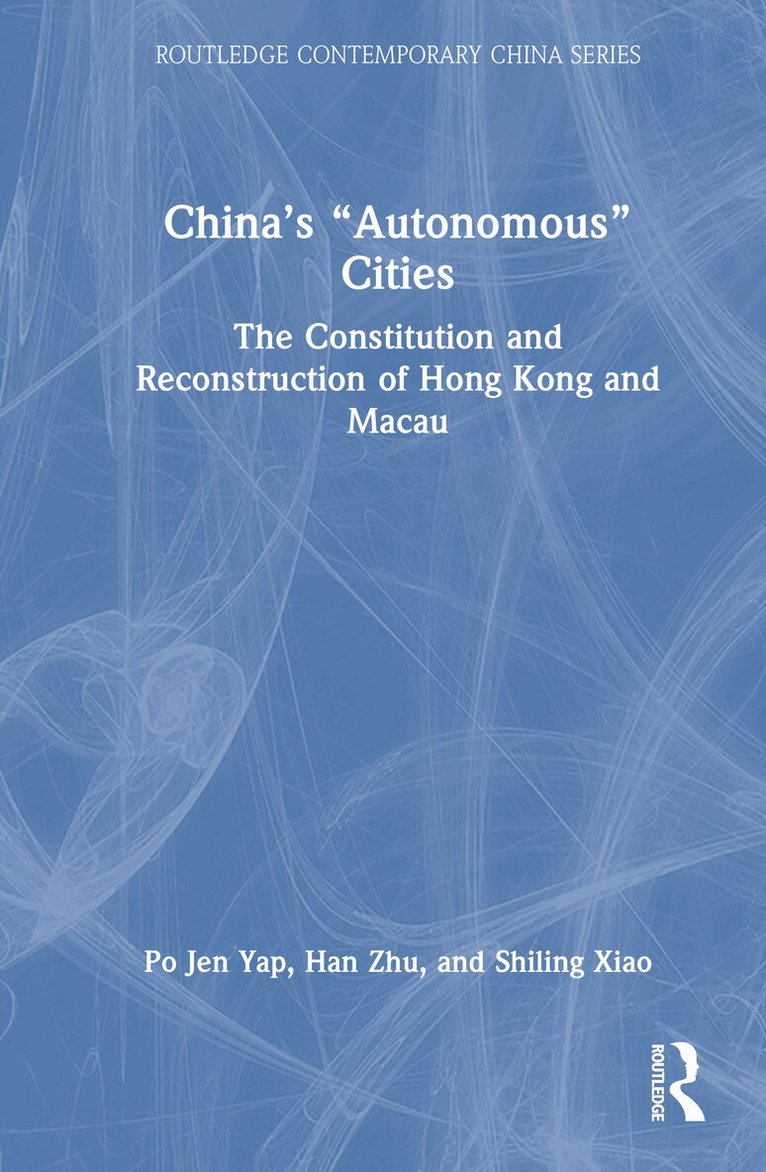
    China’s “Autonomous” Cities

    The Constitution and Reconstruction of Hong Kong and Macau

    AvPo Jen Yap,Han Zhu

    Inbunden, Engelska, 2026

    Del i serien Routledge Contemporary China Series

    2 229 kr

    Slutsåld

    Beskrivning

    This book explores the constitutional evolution of Hong Kong and Macau as Beijing asserts "comprehensive jurisdiction" over both Special Administrative Regions, compelling them to align with the national agenda of security, patriotic education, and Mainland integration.The book delivers a comparative study of Hong Kong alongside its "younger sibling" Macau – just 3% of its land size and 38 miles away – where, unlike their Hong Kong counterparts, Macau's residents have been politically quiescent and street protests remain rare. It examines Hong Kong’s notable judicial autonomy, particularly in advancing gay rights, and the dramatic expansion of national security laws in both cities, with enforcement concentrated in Hong Kong. Readers gain critical insights into the differing levels of political quiescence and judicial independence between the two territories, as Beijing reshapes them under a unified framework of central control.China’s “Autonomous” Cities is essential reading for students and scholars of Chinese politics, comparative constitutional law, and East Asian studies, as well as policymakers and analysts focused on Hong Kong, Macau, and China's governance strategies.

    Produktinformation

    • Utgivningsdatum:2026-09-07
    • Mått:156 x 234 x undefined mm
    • Format:Inbunden
    • Språk:Engelska
    • Serie:Routledge Contemporary China Series
    • Antal sidor:226
    • Förlag:Taylor & Francis Ltd
    • ISBN:9781041163152

    Utforska kategorier

    • Offentlig förvaltning inom Juridik
    • Mänskliga och medborgerliga rättigheter inom Juridik
    • Grundlagar, konstitution inom Juridik

    Mer om författaren

    Po Jen Yap is Professor of Law at The University of Hong Kong.Han Zhu is Research Assistant Professor at The University of Hong Kong.Shiling Xiao is Lecturer in Public Law at the University of Manchester.

    Innehållsförteckning

    • 1. Introduction 2. Political Systems of Hong Kong and Macau 3. Judiciaries of Hong Kong and Macau 4. National Security Laws of Hong Kong and Macau 5. Constitutional Interface with Mainland China 6. Conclusion