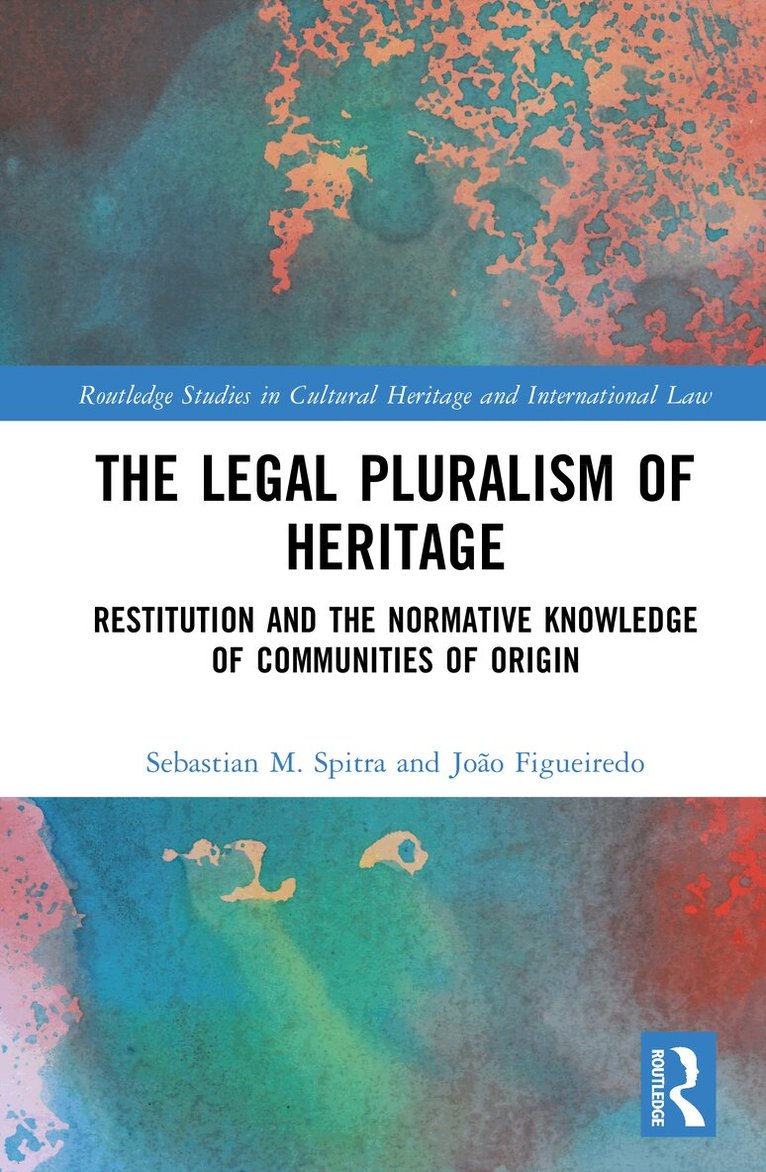
Inbunden, Engelska, 2027
Legal Pluralism of Heritage
Restitution and the Normative Knowledge of Communities of Origin
Av Sebastian M. Spitra, João Figueiredo
Del i serien Routledge Studies in Cultural Heritage and International Law
2269 kr
Kommande
Beskrivning
Produktinformation
- Utgivningsdatum: 2027-01-14
- Mått: 156 x 234 x undefined mm
- Format: Inbunden
- Språk: Engelska
- Serie: Routledge Studies in Cultural Heritage and International Law
- Antal sidor: 300
- Förlag: Taylor & Francis Ltd
- ISBN: 9781041254799
Utforska kategorier
Mer om författaren
Sebastian M. Spitra is Post-Doctoral Researcher in Law and Legal History at University of Vienna. He was previously a Member of the Junge Akademie of the Academy of Sciences and Literature in Mainz and a research professor at the Käte Hamburger Kolleg “Legal Unity and Pluralism” at the University of Münster. He was Fulbright Grantee and Grotius Fellow at the University of Michigan Law School, Visiting Post-Doc at the Max Planck Institute for European Legal History in Frankfurt and Visiting Fellow Grant Recipient of the Max Planck Institute of International Law and Comparative Public Law in Heidelberg.João Figueiredo is Post-Doctoral Researcher at University of Basel. Previously, he was postdoctoral researcher at the Käte Hamburger Kolleg ‘Legal Unity and Pluralism’ of the University of Münster and the University of Hanover. Before, he was a post-doctoral researcher at the project ‘LEGALPL: Legal Pluralism in the Portuguese Empire (18th-20th centuries)’, funded by the Portuguese Science and Technology Foundation and worked as researcher at the Nova University Lisbon School of Law. He has also taught and acted as a consultant at the University Jean Piaget Luanda (Angola) and worked as an anthropologist for Portuguese municipalities and museums. He is a member of the scientific committee of the Memorial to the Enslaved of Lisbon.
Recensioner i media
In this essential new volume, a diverse array of experts challenge the legal status of material culture that has been removed from its original context, often to become museum objects. The Legal Pluralism of Heritage serves as a vital call for a more inclusive approach to heritage governance, one which respects different cultural narratives and legal frameworks.Kristin Hausler, Director of the Centre for International Law at the British Institute of International and Comparative LawThe Legal Pluralism of Heritage intervenes at the heart of current restitution debates by foregrounding what remains too often sidelined: the plural normative worlds in which cultural objects are embedded. It shows with analytical clarity how both colonial appropriation and many contemporary returns risk reproducing forms of jurispathic closure—silencing alternative legal ontologies in the very name of justice. The result is theoretically ambitious, empirically grounded, and politically attuned scholarship that reframes the field while opening concrete pathways for engaging the legal pluralism of heritage—a reference point for debates to come.Olaf Zenker, Professor of Social and Cultural Anthropology at Martin Luther University Halle-WittenbergAll too often contemporary restitution arguments, which seek to decolonize collections and associated knowledges, are based on assumptions that are themselves deeply Eurocentric. The Legal Pluralism of Heritage offers a timely and important contribution to the debate, bringing together a collection of essay that pluralize the legal and normative contexts, which are, in fact, part of the very heritage being contested.Paul Basu, Professor of Anthropology at the University of Oxford and Curator at the Pitt Rivers Museum
Betyg & recensioner
0 recensioner
Inga recensioner tillgängliga.