• Fri frakt över 249 kr
  • •
  • Snabba leveranser
  • •
  • Billiga böcker
Kundservice

Du är på sajten för privatpersoner.

Företag, bibliotek eller offentlig verksamhet?

Du handlar på classic.bokus.com, där alla dina funktioner finns intakta.
Till classic.bokus.com
Bokus logotyp. Gå till startsidan.
  • Erbjudanden
  • Nyheter
  • Student
  • Topplistor
  • Barn & ungdom
  • Bokus Play
  • E-böcker
  • Pocketböcker
  • Spel & pussel

Må bättre, för mindre! Upp till 50% rabatt på hälsoböcker

Sidfot

Mina sidor

    Hjälp

    • Kundservice
    • Vanliga frågor och svar
    • Frakt och leverans
    • Retur vid ångerrätt
    • Reklamera vara
    • Betalning
    • Köpvillkor
    • Allmänna villkor
    • Information om webbplatsens tillgänglighet

    Om Bokus

    • Om oss
    • Pressrum
    • För studenter
    • För företag
    • För bibliotek och offentlig verksamhet
    • För leverantörer
    • Hållbarhet

    Populärt

    • Aktuella erbjudanden
    • Presentkort
    • Studentlitteratur
    • Nya böcker
    • Topplistor
    • Signerade böcker
    • Engelska böcker

    Inspiration

    • Boktips
    • BookTok
    • Populära bokserier
    • Barnbokskaraktärer
    • Populära författare
    Logotyp för Bokus
    Följ oss på Facebook (extern länk)Följ oss på Instagram (extern länk)Följ oss på YouTube (extern länk)Följ oss på TikTok (extern länk)
    bokus @ CookiesAnpassa cookiesIntegritetspolicyKöpvillkor
    Till Citymail hemsida (extern länk)Till Budbee hemsida (extern länk)Till Postnord hemsida (extern länk)Till Schenker hemsida (extern länk)Till Early Bird hemsida (extern länk)Till Walleys hemsida (extern länk)
    1. Psykologi och pedagogik
    2. Pedagogik
    3. Pedagogisk teori och filosofi

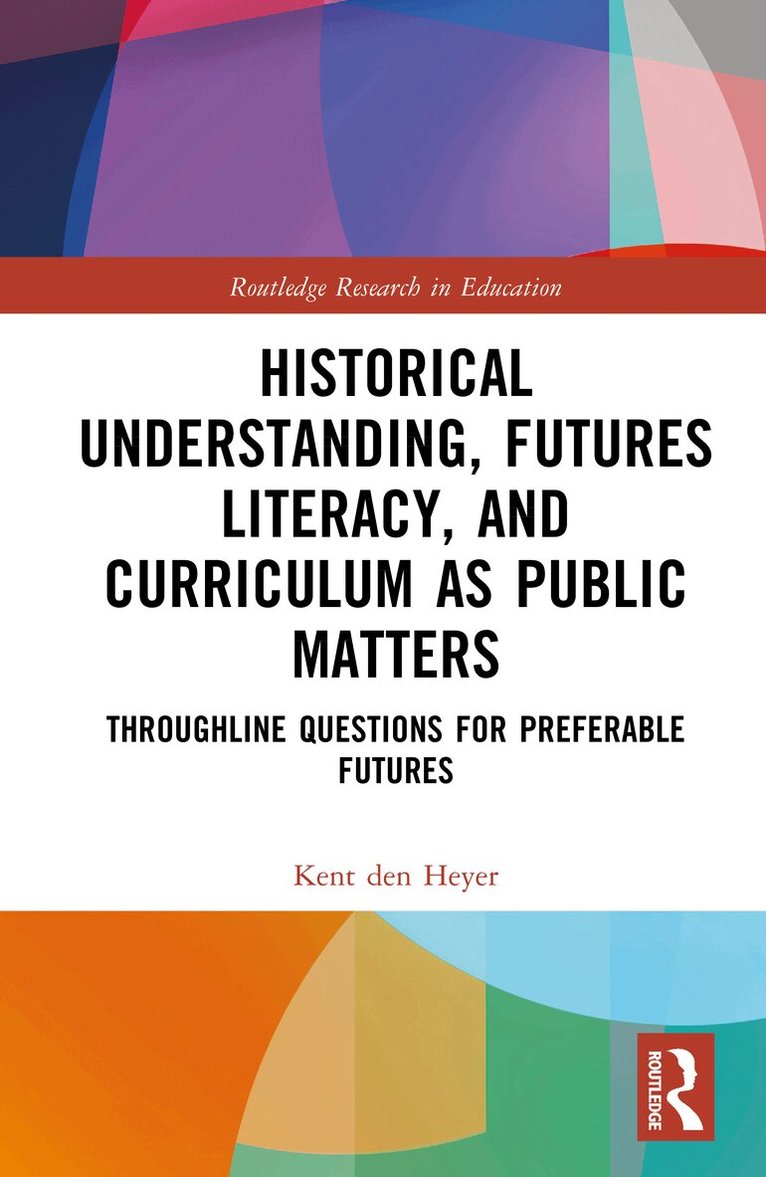
    Historical Understanding, Futures Literacy, and Curriculum as Public Matters

    Throughline Questions for Preferable Futures

    AvKent den Heyer

    Inbunden, Engelska, 2026

    Del i serien Routledge Research in Education

    2 352 kr

    Slutsåld

    Beskrivning

    This book asks a deceptively simple question: What is education for? Drawing on curriculum theory, history and social studies research, education philosophy, Indigenous scholarship, and futures studies, it argues that schooling too often socializes students into inherited ways of knowing while neglecting education’s deeper democratic purpose: enabling youth to make judgments about their nation-state and cultural inheritances and to distinguish between their probable and preferable futures. Engaging with timely debates in education, such as the emergence of AI, the author makes the case for a pedagogical approach centred on the use of ‘throughline questions,’ which ask students to connect subject matter to future thinking and critically examine their own role in shaping social worlds. Through innovative concepts such as KINships (knowledge–ignorance–privilege relations), curriculum as encounter, and becoming ‘story smart,’ the book outlines a path beyond both standardized schooling and decontextualized “best practices” toward learning organized around ethical inquiry, Treaty relationships, and preferable collective futures.Recommended reading for educators and researchers with interests in democratic education, curriculum design, and educational philosophy and civic education.

    Produktinformation

    • Utgivningsdatum:2026-11-24
    • Mått:152 x 229 x undefined mm
    • Format:Inbunden
    • Språk:Engelska
    • Serie:Routledge Research in Education
    • Antal sidor:196
    • Förlag:Taylor & Francis Ltd
    • ISBN:9781041291848

    Utforska kategorier

    • Pedagogisk teori och filosofi inom Psykologi och pedagogik
    • Pedagogisk metodik inom Psykologi och pedagogik
    • Undervisning i specifika ämnen inom Psykologi och pedagogik

    Mer om författaren

    Kent den Heyer is a Full Professor in the Faculty of Education, University of Alberta.

    Innehållsförteckning

    • Chapter 1 In what ways do KINships shape what we can/not bear to know? Commitments, KINships, and an ethics of learning Chapter 2: In what ways do we not belong to ourselves alone? Events and Source Codes Chapter 3 When does schooling become educational? Education Aims, Paradigms, and the Work of Becoming Chapter 4 In what ways do ‘event’-ful encounters educate? Badiou, Socratic Education, and Learning in Relation with Indigenous Traditions Chapter 5: When AI Can Answer, What Remains to Be Taught? Throughline Questions and Civic Possibilities in Schools Chapter 6: Whose stories future our lives? Narrative Thinking, Historical Perspectives, and Scenarios in Social Studies Chapter 7 In what ways might we travel well through learning’s bear territory? KINships, Terror Management, and Thriving in the Educational Encounter