• Fri frakt över 249 kr
  • •
  • Snabba leveranser
  • •
  • Billiga böcker
Kundservice

Du är på sajten för privatpersoner.

Företag, bibliotek eller offentlig verksamhet?

Du handlar på classic.bokus.com, där alla dina funktioner finns intakta.
Till classic.bokus.com
Bokus logotyp. Gå till startsidan.
  • Erbjudanden
  • Student
  • Topplistor
  • Barn & ungdom
  • Bokus Play
  • E-böcker
  • Ljudböcker
  • Pocketböcker
  • Spel och pussel

5% studentrabatt – använd koden KURSBOK27 →

Sidfot

Mina sidor

    Hjälp

    • Kundservice
    • Vanliga frågor och svar
    • Frakt och leverans
    • Retur vid ångerrätt
    • Reklamera vara
    • Betalning
    • Köpvillkor
    • Allmänna villkor
    • Information om webbplatsens tillgänglighet

    Om Bokus

    • Om oss
    • Pressrum
    • För studenter
    • För företag
    • För bibliotek och offentlig verksamhet
    • För leverantörer
    • Hållbarhet

    Populärt

    • Aktuella erbjudanden
    • Presentkort
    • Studentlitteratur
    • Nya böcker
    • Topplistor
    • Signerade böcker
    • Engelska böcker

    Inspiration

    • Boktips
    • BookTok
    • Barnbokskaraktärer
    • Populära författare
    Logotyp för Bokus
    Följ oss på Facebook (extern länk)Följ oss på Instagram (extern länk)Följ oss på YouTube (extern länk)Följ oss på TikTok (extern länk)
    bokus @ CookiesAnpassa cookiesIntegritetspolicyKöpvillkor
    Till Citymail hemsida (extern länk)Till Budbee hemsida (extern länk)Till Postnord hemsida (extern länk)Till Schenker hemsida (extern länk)Till Early Bird hemsida (extern länk)Till Walleys hemsida (extern länk)
    1. Historia och arkeologi
    2. Historia
    3. Europas historia

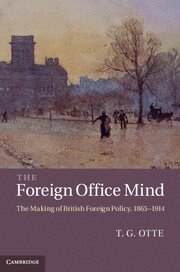
    Foreign Office Mind

    The Making of British Foreign Policy, 1865–1914

    AvT. G. Otte

    Inbunden, Engelska, 2011

    1 513 kr

    Tillfälligt slut

    Beskrivning

    With this pioneering approach to the study of international history, T. G. Otte reconstructs the underlying principles, élite perceptions and 'unspoken assumptions' that shaped British foreign policy between the death of Palmerston and the outbreak of the First World War. Grounded in a wide range of public and private archival sources, and drawing on sociological insights, The Foreign Office Mind presents a comprehensive analysis of the foreign service as a 'knowledge-based organization', rooted in the social and educational background of the diplomatic élite and the broader political, social and cultural fabric of Victorian and Edwardian Britain. The book charts how the collective mindset of successive generations of professional diplomats evolved, and reacted to and shaped changes in international relations during the second half of the nineteenth century, including the balance of power and arms races, the origins of appeasement and the causes of the First World War.

    Produktinformation

    • Utgivningsdatum:2011-09-29
    • Mått:161 x 235 x 25 mm
    • Vikt:880 g
    • Format:Inbunden
    • Språk:Engelska
    • Antal sidor:468
    • Förlag:Cambridge University Press
    • ISBN:9781107006508

    Utforska kategorier

    • Europas historia inom Historia och arkeologi
    • Internationella relationer inom Samhälle och politik

    Mer om författaren

    T. G. Otte is Senior Lecturer in Diplomatic History at the University of East Anglia. His recent publications include The China Question: Great Power Rivalry and British Isolation, 1894–1905 (2007), The Permanent Under-Secretary for Foreign Affairs, 1854–1946 (with Keith Neilson, 2009) and Coalition Government in Britain: From Glorious Revolution to Cameron-Clegg (as editor, 2010).

    Recensioner i media

    'Otte opens up our understanding of the role of the diplomatic professionals in the long nineteenth century, keeping a careful balance in his analysis of the role of the professionals and that of their political masters. Meticulous in its scholarship, written with great clarity, this work demonstrates with ease a mastery of a complex and intricate subject.' Erik Goldstein, Boston University

    Innehållsförteckning

    • Introduction; 1. Illusions of supremacy: the Foreign Office mind, 1865–74; 2. The problems of isolation: the Foreign Office mind, 1874–85; 3. Problems of consolidation: the Foreign Office mind, 1885–92; 4. Two eastern questions: the Foreign Office mind and the period of flux in great power politics, 1892–1900; 5. The transformation of great power politics: the Edwardian Foreign Office mind, 1900–7; 6. The end of an era: the late-Edwardian Foreign Office mind, 1907–14; Conclusion.