• Fri frakt över 249 kr
  • •
  • Snabba leveranser
  • •
  • Billiga böcker
Kundservice

Du är på sajten för privatpersoner.

Företag, bibliotek eller offentlig verksamhet?

Du handlar på classic.bokus.com, där alla dina funktioner finns intakta.
Till classic.bokus.com
Bokus logotyp. Gå till startsidan.
  • Erbjudanden
  • Nyheter
  • Student
  • Topplistor
  • Barn & ungdom
  • Bokus Play
  • E-böcker
  • Pocketböcker
  • Spel & pussel

10% rabatt på allt med kod: NYSTART10 →

Sidfot

Mina sidor

    Hjälp

    • Kundservice
    • Vanliga frågor och svar
    • Frakt och leverans
    • Retur vid ångerrätt
    • Reklamera vara
    • Betalning
    • Köpvillkor
    • Allmänna villkor
    • Information om webbplatsens tillgänglighet

    Om Bokus

    • Om oss
    • Pressrum
    • För studenter
    • För företag
    • För bibliotek och offentlig verksamhet
    • För leverantörer
    • Hållbarhet

    Populärt

    • Aktuella erbjudanden
    • Presentkort
    • Studentlitteratur
    • Nya böcker
    • Topplistor
    • Signerade böcker
    • Engelska böcker

    Inspiration

    • Boktips
    • BookTok
    • Populära bokserier
    • Barnbokskaraktärer
    • Populära författare
    Logotyp för Bokus
    Följ oss på Facebook (extern länk)Följ oss på Instagram (extern länk)Följ oss på YouTube (extern länk)Följ oss på TikTok (extern länk)
    bokus @ CookiesAnpassa cookiesIntegritetspolicyKöpvillkor
    Till Citymail hemsida (extern länk)Till Budbee hemsida (extern länk)Till Postnord hemsida (extern länk)Till Schenker hemsida (extern länk)Till Early Bird hemsida (extern länk)Till Walleys hemsida (extern länk)
    1. Samhälle och politik
    2. Politik och statsskick
    3. Statsvetenskap och politisk teori

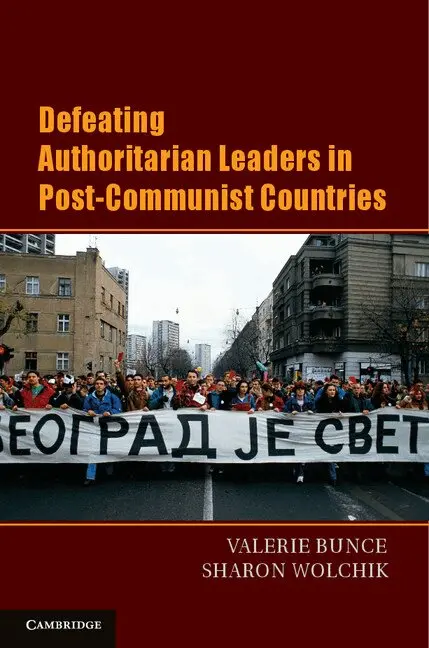
    Defeating Authoritarian Leaders in Postcommunist Countries

    AvValerie J. Bunce,Sharon L. Wolchik

    Inbunden, Engelska, 2011

    Del i serien Cambridge Studies in Contentious Politics

    1 201 kr

    Beställningsvara. Skickas inom 10-15 vardagar. Fri frakt över 249 kr.

    Fler format och utgåvor

    Häftad

    405 kr

    Beskrivning

    From 1998 to 2005, six elections took place in postcommunist Europe that had the surprising outcome of empowering the opposition and defeating authoritarian incumbents or their designated successors. Valerie J. Bunce and Sharon L. Wolchik compare these unexpected electoral breakthroughs. They draw three conclusions. First, the opposition was victorious because of the hard and creative work of a transnational network composed of local opposition and civil society groups, members of the international democracy assistance community and graduates of successful electoral challenges to authoritarian rule in other countries. Second, the remarkable run of these upset elections reflected the ability of this network to diffuse an ensemble of innovative electoral strategies across state boundaries. Finally, elections can serve as a powerful mechanism for democratic change. This is especially the case when civil society is strong, the transfer of political power is through constitutional means, and opposition leaders win with small mandates.

    Produktinformation

    • Utgivningsdatum:2011-06-30
    • Mått:160 x 240 x 25 mm
    • Vikt:680 g
    • Format:Inbunden
    • Språk:Engelska
    • Serie:Cambridge Studies in Contentious Politics
    • Antal sidor:396
    • Förlag:Cambridge University Press
    • ISBN:9781107006850

    Utforska kategorier

    • Statsvetenskap och politisk teori inom Samhälle och politik

    Mer om författaren

    Valerie J. Bunce is Professor of Government and International Studies at Cornell University, where she served as chair of the Department of Government from 2001 to 2007. Since receiving her doctorate in political science at the University of Michigan in 1976, Bunce has taught, in addition to Cornell, at Lake Forest College, Northwestern University, the Central European University (Budapest) and the University of Zagreb. She recently served as the President of the American Association for the Advancement of Slavic Studies and Vice-President of the American Political Science Association and is a member of the American Academy of Arts and Sciences. A leading expert on Central and Eastern Europe and the former Soviet Union, Bunce has focused her research since the fall of communism on four issues, all involving comparisons among the postcommunist states of Europe and Eurasia. She is the author of articles that have appeared in the American Political Science Review, Comparative Political Studies, Comparative Politics, World Politics, International Organization, the American Journal of Political Science, the British Journal of Political Science, the Slavic Review, Communist and Postcommunist Studies and East European Politics and Societies. She has written two books: Do New Leaders Make a Difference? Executive Succession and Public Policy under Capitalism and Socialism and Subversive Institutions: The Design and the Destruction of Socialism and the State. She is also the co-editor of Democracy and Authoritarianism in the Postcommunist World. She has received grants from the Council for the International Exchange of Scholars, Smith Richardson Foundation, International Research and Exchange Board, the Russell Sage Foundation, the American Council of Learned Societies, the National Endowment for Democracy, the National Council for Eurasian and East European Research, the MacArthur Foundation, the Rockefeller Foundation (Resident Fellowship at Bellagio), the International Cen Sharon L. Wolchik is Professor of Political Science and International Affairs at George Washington University. She has served as Director of the Russian and East European Studies Program and the mid-career Masters in International Policy and Practice Program at the Elliott School of International Affairs and is a member of the Institute for European, Russian, and Eurasian Studies. She has served on the board of the American Association for Slavic Studies, the Advisory Committee of the Cold War International History Project of the Woodrow Wilson Center of the Smithsonian Institution, the Association of Women in Slavic Studies and Friends of Slovakia and as Chair of the Board of the National Council for Eurasian and East European Research. She is also Adjunct Chair of the Advanced Area Studies Seminar of the Foreign Service Institute of the US Department of State and a member of the Advisory Council of the Academic Academy of the Ministry of Foreign Affairs of the Czech Republic. She has done research on a variety of aspects of politics in communist and postcommunist Europe, including gender issues, ethnic relations, mass-elite relations, citizens' political values and attitudes, and transitions to democracy. She is the author of Czechoslovakia in Transition: Politics, Societies, and Economics and is the co-editor of Domestic and Foreign Policies in Eastern Europe in the 1980s; Women, State, and Party in Eastern Europe; Women and Democracy: Latin America and Central and Eastern Europe; Women in Power in Post-communist Parliaments; The Social Legacies of Communism and Central and East European Politics: From Communism to Democracy. She has also authored numerous articles in the Slavic Review, Comparative Political Studies, World Politics, Women and Politics, Current History, Problems of Post-Communism, Studies in Comparative Communism, the Journal of Communist and Post-Communist Studies, the Japanese Journal of Political Science, the Journal of Women's History and East

    Recensioner i media

    'This book is a valuable addition to the literature on post-communist democratisation.' Political Studies

    Innehållsförteckning

    • Part I. The Puzzle: 1. Breakthrough elections: mixed regimes, democracy assistance, and international diffusion; 2. Electoral stability and change in mixed regimes; Part II. Case Studies: 3. The 1998 election in Slovakia and the 2000 election in Croatia: model solidifies and is transferred; 4. Defeating a dictator at the polls and in the streets: the 2000 Yugoslav election; 5. Ukraine: the orange revolution; 6. Georgia and Kyrgyzstan: fraudulent parliamentary elections, mass protests, and presidential abdications; 7. Failed cases: Armenia, Azerbaijan and Belarus; Part III. Comparative Analyses: 8. Explaining divergent electoral outcomes: regime strength, international democracy assistance, and electoral dynamics; 9. The electoral model: evolution and elements; 10. The cross-national diffusion of democratizing elections; 11. After the elections: explaining divergent regime trajectories; 12. Conclusions: democratizing elections, international diffusion and US democracy assistance.