• Fri frakt över 249 kr
  • •
  • Snabba leveranser
  • •
  • Billiga böcker
Kundservice

Du är på sajten för privatpersoner.

Företag, bibliotek eller offentlig verksamhet?

Du handlar på classic.bokus.com, där alla dina funktioner finns intakta.
Till classic.bokus.com
Bokus logotyp. Gå till startsidan.
  • Erbjudanden
  • Nyheter
  • Student
  • Topplistor
  • Barn & ungdom
  • Bokus Play
  • E-böcker
  • Pocketböcker
  • Spel & pussel

10% rabatt på allt med kod NYSTART10 →

Sidfot

Mina sidor

    Hjälp

    • Kundservice
    • Vanliga frågor och svar
    • Frakt och leverans
    • Retur vid ångerrätt
    • Reklamera vara
    • Betalning
    • Köpvillkor
    • Allmänna villkor
    • Information om webbplatsens tillgänglighet

    Om Bokus

    • Om oss
    • Pressrum
    • För studenter
    • För företag
    • För bibliotek och offentlig verksamhet
    • För leverantörer
    • Hållbarhet

    Populärt

    • Aktuella erbjudanden
    • Presentkort
    • Studentlitteratur
    • Nya böcker
    • Topplistor
    • Signerade böcker
    • Engelska böcker

    Inspiration

    • Boktips
    • BookTok
    • Populära bokserier
    • Barnbokskaraktärer
    • Populära författare
    Logotyp för Bokus
    Följ oss på Facebook (extern länk)Följ oss på Instagram (extern länk)Följ oss på YouTube (extern länk)Följ oss på TikTok (extern länk)
    bokus @ CookiesAnpassa cookiesIntegritetspolicyKöpvillkor
    Till Citymail hemsida (extern länk)Till Budbee hemsida (extern länk)Till Postnord hemsida (extern länk)Till Schenker hemsida (extern länk)Till Early Bird hemsida (extern länk)Till Walleys hemsida (extern länk)
    1. Historia och arkeologi
    2. Arkeologi
    3. Arkeologiska perioder och områden

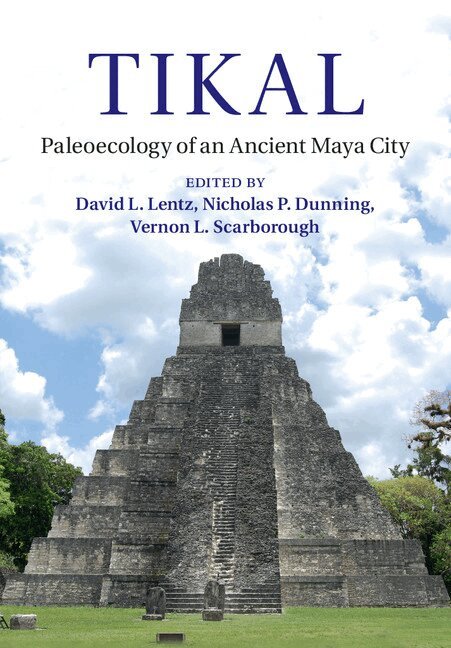
    Tikal

    Paleoecology of an Ancient Maya City

    AvDavid L. Lentz,Nicholas P. Dunning

    Inbunden, Engelska, 2015

    1 043 kr

    Beställningsvara. Skickas inom 10-15 vardagar. Fri frakt över 249 kr.

    Beskrivning

    The primary theoretical question addressed in this book focuses on the lingering concern of how the ancient Maya in the northern Petén Basin were able to sustain large populations in the midst of a tropical forest environment during the Late Classic period. This book asks how agricultural intensification was achieved and how essential resources, such as water and forest products, were managed in both upland areas and seasonal wetlands, or bajos. All of these activities were essential components of an initially sustainable land use strategy that eventually failed to meet the demands of an escalating population. This spiraling disconnect with sound ecological principles undoubtedly contributed to the Maya collapse. The book's findings provide insights that broaden the understanding of the rise of social complexity - the expansion of the political economy, specifically - and, in general terms, the trajectory of cultural evolution of the ancient Maya civilization.

    Produktinformation

    • Utgivningsdatum:2015-02-23
    • Mått:186 x 260 x 23 mm
    • Vikt:980 g
    • Format:Inbunden
    • Språk:Engelska
    • Antal sidor:374
    • Förlag:Cambridge University Press
    • ISBN:9781107027930

    Utforska kategorier

    • Arkeologiska perioder och områden inom Historia och arkeologi

    Mer om författaren

    David L. Lentz is Professor of Biological Sciences and Executive Director of the Center for Field Studies at the University of Cincinnati. He is the author of more than ninety publications that have appeared as journal articles, book chapters, and three books, including this volume. He is the editor of Imperfect Balance: Landscape Transformations in the Precolumbian Americas (2000) and the coauthor of Seeds of Central America and Southern Mexico (2005, with Ruth Dickau). A Fellow of the Linnean Society of London and a former Fulbright Scholar, he has received support for his ancient landscape studies and paleoethnobotanical research from the National Science Foundation, the Wenner-Gren Foundation, the National Endowment for the Humanities, the National Geographic Society, the Heinz Family Foundation, and the Foundation for the Advancement of Mesoamerican Studies. Nicholas P. Dunning is Professor of Geography at the University of Cincinnati. He is a geoarchaeologist and cultural ecologist specializing in the neotropics. He has published several books and more than ninety articles and book chapters, including those in this volume. Vernon L. Scarborough is Distinguished University Research Professor and Charles Phelps Taft Professor in the Department of Anthropology at the University of Cincinnati. His work emphasizes sustainability and global water systems through an examination of past engineered landscapes, using comparative ecological and transdisciplinary perspectives. In addition to editing Water and Humanity: A Historical Overview for UNESCO, he is a steering committee member of the Integrated History and Future of People on Earth (IHOPE) network, whose main office is located at Uppsala University, and an active organizer of the subgroup IHOPE-Maya. He is a senior editor for the journal WIREs Water and a series editor for Cambridge University Press's New Directions in Sustainability and Society series. He has published ten books – eight of them edited, including this volume – and authored more than ninety book chapters or journal articles.

    Recensioner i media

    'This interdisciplinary study blends agroforestry and hydroarchaeology to show culture and nature interacting in the florescence and fall of a great Maya city. Rarely has the engineered environment of an ancient community been analyzed in such scrupulous detail: Tikal's temples and their socioeconomic foundations are, we now perceive, equally impressive.' Norman Hammond, University of Cambridge

    Innehållsförteckning

    • 1. Tikal land, water, and forest: an introduction Nicholas P. Dunning, David L. Lentz and Vernon L. Scarborough; 2. The evolution of an ancient waterworks system at Tikal Vernon L. Scarborough and Liwy Grazioso Sierra; 3. At the core of Tikal: terrestrial sediment sampling and water management Brian Lane, Vernon L. Scarborough and Nicholas P. Dunning; 4. Bringing the University of Pennsylvania maps of Tikal into the era of electronic GIS Christopher Carr, Eric Weaver, Nicholas P. Dunning and Vernon L. Scarborough; 5. Examining landscape modifications for water management at Tikal using three-dimensional modeling with Arcgis .91 Eric Weaver, Christopher Carr, Nicholas P. Dunning, Lee Florea and Vernon L. Scarborough; 6. Life on the edge: Tikal in a bajo landscape Nicholas P. Dunning, Robert E. Griffin, John G. Jones, Richard E. Terry, Zachary Larsen and Christopher Carr; 7. Connecting contemporary ecology and ethnobotany to ancient plant use practices of the Maya at Tikal Kim Thompson, Angela Hood, Dana Cavallaro and David L. Lentz; 8. Agroforestry and agricultural practices of the ancient Maya at Tikal David L. Lentz, Kevin Magee, Eric Weaver, John G. Jones, Kenneth B. Tankersley, Angela Hood, Gerald Islebe, Carmen Ramos and Nicholas P. Dunning; 9. Fire and water: the archaeological significance of Tikal's Quaternary sediments Kenneth B. Tankersley, Nicholas P. Dunning, Vernon L. Scarborough, John G. Jones, Christopher Carr and David L. Lentz; 10. Fractious farmers at Tikal David Webster and Timothy Murtha; 11. The material culture of Tikal Palma Buttles, Carmen Ramos and Fred Valdez, Jr; 12. A neighborly view: water and environmental history of the El Zotz region Timothy Beach, Sheryl Luzzadder-Beach, Jonathan Flood, Stephen Houston, Thomas Garrison, Edwin Román, Steve Bozarth and James Doyle; 13. Defining the constructed niche of Tikal: a summary view David L. Lentz, Nicholas P. Dunning and Vernon L. Scarborough.