• Fri frakt över 249 kr
  • •
  • Snabba leveranser
  • •
  • Billiga böcker
Kundservice

Du är på sajten för privatpersoner.

Företag, bibliotek eller offentlig verksamhet?

Du handlar på classic.bokus.com, där alla dina funktioner finns intakta.
Till classic.bokus.com
Bokus logotyp. Gå till startsidan.
  • Erbjudanden
  • Nyheter
  • Student
  • Topplistor
  • Barn & ungdom
  • Bokus Play
  • E-böcker
  • Pocketböcker
  • Spel & pussel

10% rabatt på allt med kod: NYSTART10 →

Sidfot

Mina sidor

    Hjälp

    • Kundservice
    • Vanliga frågor och svar
    • Frakt och leverans
    • Retur vid ångerrätt
    • Reklamera vara
    • Betalning
    • Köpvillkor
    • Allmänna villkor
    • Information om webbplatsens tillgänglighet

    Om Bokus

    • Om oss
    • Pressrum
    • För studenter
    • För företag
    • För bibliotek och offentlig verksamhet
    • För leverantörer
    • Hållbarhet

    Populärt

    • Aktuella erbjudanden
    • Presentkort
    • Studentlitteratur
    • Nya böcker
    • Topplistor
    • Signerade böcker
    • Engelska böcker

    Inspiration

    • Boktips
    • BookTok
    • Populära bokserier
    • Barnbokskaraktärer
    • Populära författare
    Logotyp för Bokus
    Följ oss på Facebook (extern länk)Följ oss på Instagram (extern länk)Följ oss på YouTube (extern länk)Följ oss på TikTok (extern länk)
    bokus @ CookiesAnpassa cookiesIntegritetspolicyKöpvillkor
    Till Citymail hemsida (extern länk)Till Budbee hemsida (extern länk)Till Postnord hemsida (extern länk)Till Schenker hemsida (extern länk)Till Early Bird hemsida (extern länk)Till Walleys hemsida (extern länk)
    1. Historia och arkeologi
    2. Historia
    3. Asiens historia

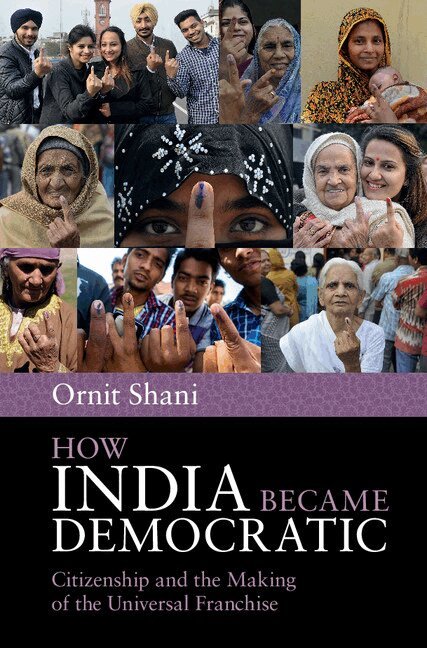
    How India Became Democratic

    Citizenship and the Making of the Universal Franchise

    AvOrnit Shani

    Inbunden, Engelska, 2017

    1 361 kr

    Beställningsvara. Skickas inom 10-15 vardagar. Fri frakt över 249 kr.

    Fler format och utgåvor

    Häftad

    496 kr

    E-bok

    602 kr

    E-bok

    602 kr

    Beskrivning

    How India Became Democratic explores the greatest experiment in democratic human history. It tells the untold story of the preparation of the electoral roll on the basis of universal adult franchise in the world's largest democracy. Ornit Shani offers a new view of the institutionalisation of democracy in India, and of the way democracy captured the political imagination of its diverse peoples. Turning all adult Indians into voters against the backdrop of the partition of India and Pakistan, and in anticipation of the drawing up of a constitution, was a staggering task. Indians became voters before they were citizens - by the time the constitution came into force in 1950, the abstract notion of universal franchise and electoral democracy were already grounded. Drawing on rich archival materials, Shani shows how the Indian people were a driving force in the making of democratic citizenship as they struggled for their voting rights.

    Produktinformation

    • Utgivningsdatum:2017-12-07
    • Mått:157 x 235 x 19 mm
    • Vikt:540 g
    • Format:Inbunden
    • Språk:Engelska
    • Antal sidor:294
    • Förlag:Cambridge University Press
    • ISBN:9781107068032

    Utforska kategorier

    • Asiens historia inom Historia och arkeologi

    Mer om författaren

    Ornit Shani is Senior Lecturer at the Department of Asian Studies, University of Haifa, Israel.

    Recensioner i media

    'This is a subtle and impressive work of scholarship, which breaks new ground in the history of modern India. Using the rich, previously neglected, archive of the Election Commission, Ornit Shani documents how multi-party democracy based on adult franchise was established in a large, diverse, divided, and desperately poor country. The research is deep and thorough, the analysis robust and thought-provoking, the writing clear and often vivid. All those interested in modern India, as well as in the history of democratic practice more generally, would profit from a close reading of this book.' Ramachandra Guha, author of India after Gandhi

    Innehållsförteckning

    • Introduction; 1. Designing for democracy: rewriting the bureaucratic colonial imagination; 2. The pursuit of citizenship in the making of the electoral roll: registering partition refugees; 3. The roll as 'serialised epic' and the personalisation of the universal franchise; 4. Disciplining the federal structure; 5. Shaping the constitution from below and the role of the Secretariat; 6. The limits of inclusion; Conclusion: a 17 crore and 220 yard democracy.