• Fri frakt över 249 kr
  • •
  • Snabba leveranser
  • •
  • Billiga böcker
Kundservice

Du är på sajten för privatpersoner.

Företag, bibliotek eller offentlig verksamhet?

Du handlar på classic.bokus.com, där alla dina funktioner finns intakta.
Till classic.bokus.com
Bokus logotyp. Gå till startsidan.
  • Erbjudanden
  • Student
  • Topplistor
  • Barn & ungdom
  • Bokus Play
  • E-böcker
  • Ljudböcker
  • Pocketböcker
  • Spel & pussel

Upp till 25% på utvalda nyheter →

Sidfot

Mina sidor

    Hjälp

    • Kundservice
    • Vanliga frågor och svar
    • Frakt och leverans
    • Retur vid ångerrätt
    • Reklamera vara
    • Betalning
    • Köpvillkor
    • Allmänna villkor
    • Information om webbplatsens tillgänglighet

    Om Bokus

    • Om oss
    • Pressrum
    • För studenter
    • För företag
    • För bibliotek och offentlig verksamhet
    • För leverantörer
    • Hållbarhet

    Populärt

    • Aktuella erbjudanden
    • Presentkort
    • Studentlitteratur
    • Nya böcker
    • Topplistor
    • Signerade böcker
    • Engelska böcker

    Inspiration

    • Boktips
    • BookTok
    • Populära bokserier
    • Barnbokskaraktärer
    • Populära författare
    Logotyp för Bokus
    Följ oss på Facebook (extern länk)Följ oss på Instagram (extern länk)Följ oss på YouTube (extern länk)Följ oss på TikTok (extern länk)
    bokus @ CookiesAnpassa cookiesIntegritetspolicyKöpvillkor
    Till Citymail hemsida (extern länk)Till Budbee hemsida (extern länk)Till Postnord hemsida (extern länk)Till Schenker hemsida (extern länk)Till Early Bird hemsida (extern länk)Till Walleys hemsida (extern länk)
    1. Samhälle och politik
    2. Sociologi och antropologi
    3. Sociologi

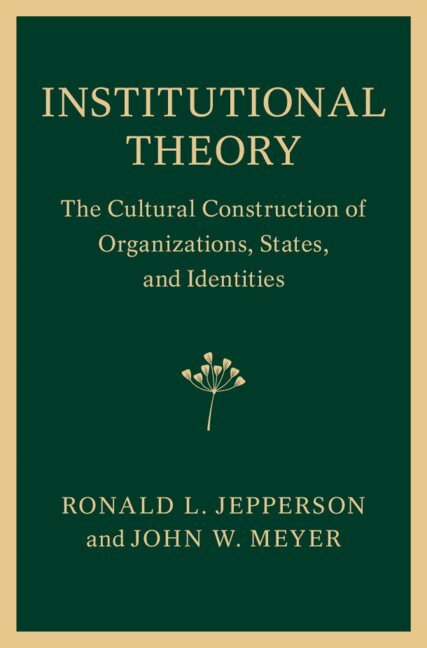
    Institutional Theory

    The Cultural Construction of Organizations, States, and Identities

    AvRonald L. Jepperson,John W. Meyer

    Inbunden, Engelska, 2021

    1 402 kr

    Beställningsvara. Skickas inom 7-10 vardagar. Fri frakt över 249 kr.

    Fler format och utgåvor

    Häftad

    443 kr

    Beskrivning

    Over the past three decades, Meyer, Jepperson, and colleagues have contributed to the development of one of the leading approaches in social theory, by analyzing the cultural frameworks that have shaped modern organizations, states, and identities. Bringing together key articles and new reflections, this volume collects the essential theoretical ideas of 'sociological neoinstitutionalism.' It clarifies the core ideas and situates them within social theory writ large. Among other topics, the authors discuss the changing nature of the "actors" that have operated within contemporary social structure. The book concludes with the evolving frameworks that have structured social activity in the post-World War II period of 'embedded liberalism,' in the more recent neoliberal period, and in an emergent post-liberal period that appears to be a radical departure.

    Produktinformation

    • Utgivningsdatum:2021-04-01
    • Mått:160 x 235 x 30 mm
    • Vikt:630 g
    • Format:Inbunden
    • Språk:Engelska
    • Antal sidor:350
    • Förlag:Cambridge University Press
    • ISBN:9781107078376

    Utforska kategorier

    • Sociologi inom Samhälle och politik

    Mer om författaren

    Ronald L. Jepperson is Associate Professor of Sociology, emeritus, at the University of Tulsa, where he taught social science, philosophy, and critical thinking to undergraduates. Previously he was a faculty member at the University of Washington, and a visiting professor at Stanford University, the University of California-Berkeley, and the European University Institute. John W. Meyer is Professor of Sociology, emeritus, at Stanford University. His research has focused on comparative sociology, education, and formal organizations, employing and developing neo-institutional theory, emphasizing the dependence of modern social structure on wider and often global cultural frameworks. He has published widely and received many academic honors.

    Recensioner i media

    'Despite its influence, neoinstitutional theory has long been known by its parts, with organizational theorists focusing one strand and political sociologists on another. Institutional Theory, a collection of foundational and in some case little known essays and new reflective chapters by the theory's progenitor, John Meyer, and one of its most gifted expositors, Ron Jepperson, is the first volume to present institutional theory as a single coherent approach to social analysis, with compelling results. Because most work in institutional theory has been published in conventional journal-article format, using unpretentious language and familiar comfortably positivist methods, it has been easy to underestimate the extent to which it represents a fundamentally radical break with received theory, challenging and reworking such basic categories as action and agency, levels of analysis, and organization in ways that will defamiliarize and reconstitute the reader's understanding of the social world. This welcome volume will be a critically important resource for social theory for many years to come.' Paul DiMaggio, Professor of Sociology, New York University

    Innehållsförteckning

    • Credits; Preface; Part I. Introduction: 1. Introduction: cultural institutionalism; Part II. Institutional Theory: Its Role in Modern Social Analysis; 2. Society without culture (1988); 3. Institutions, institutional effects, and institutionalism (1991); 4. The development and application of sociological neo-institutionalism (2002); 5. Reflections on Part II: institutional theory; Part III. The Institutional Level of Analysis: 6. Multiple levels of analysis and the limitations of methodological individualisms (2011); 7. The limitations illustrated: examples from the research literature on macrosocial change (2007); 8. Reflections on Part III: levels of analysis; Part IV. Institutions of Modernity and Post-Modernity: The Construction of Actors: 9. The 'actors' of modern society: the cultural construction of social agency (2000); 10. Reflections: institutional theory and world society (2009); 11. Reflections on Part IV: the construction of actors; Part V. Conclusion: 12. Concluding reflections: evolving cultural models in global and national society.