• Fri frakt över 249 kr
  • •
  • Snabba leveranser
  • •
  • Billiga böcker
Kundservice

Du är på sajten för privatpersoner.

Företag, bibliotek eller offentlig verksamhet?

Du handlar på classic.bokus.com, där alla dina funktioner finns intakta.
Till classic.bokus.com
Bokus logotyp. Gå till startsidan.
  • Erbjudanden
  • Nyheter
  • Student
  • Topplistor
  • Barn & ungdom
  • Bokus Play
  • E-böcker
  • Pocketböcker
  • Spel & pussel

10% rabatt på allt med kod: NYSTART10 →

Sidfot

Mina sidor

    Hjälp

    • Kundservice
    • Vanliga frågor och svar
    • Frakt och leverans
    • Retur vid ångerrätt
    • Reklamera vara
    • Betalning
    • Köpvillkor
    • Allmänna villkor
    • Information om webbplatsens tillgänglighet

    Om Bokus

    • Om oss
    • Pressrum
    • För studenter
    • För företag
    • För bibliotek och offentlig verksamhet
    • För leverantörer
    • Hållbarhet

    Populärt

    • Aktuella erbjudanden
    • Presentkort
    • Studentlitteratur
    • Nya böcker
    • Topplistor
    • Signerade böcker
    • Engelska böcker

    Inspiration

    • Boktips
    • BookTok
    • Populära bokserier
    • Barnbokskaraktärer
    • Populära författare
    Logotyp för Bokus
    Följ oss på Facebook (extern länk)Följ oss på Instagram (extern länk)Följ oss på YouTube (extern länk)Följ oss på TikTok (extern länk)
    bokus @ CookiesAnpassa cookiesIntegritetspolicyKöpvillkor
    Till Citymail hemsida (extern länk)Till Budbee hemsida (extern länk)Till Postnord hemsida (extern länk)Till Schenker hemsida (extern länk)Till Early Bird hemsida (extern länk)Till Walleys hemsida (extern länk)
    1. Data och IT
    2. Systemvetenskap och AI
    3. Artificiell intelligens
    • 10% rabatt på allt

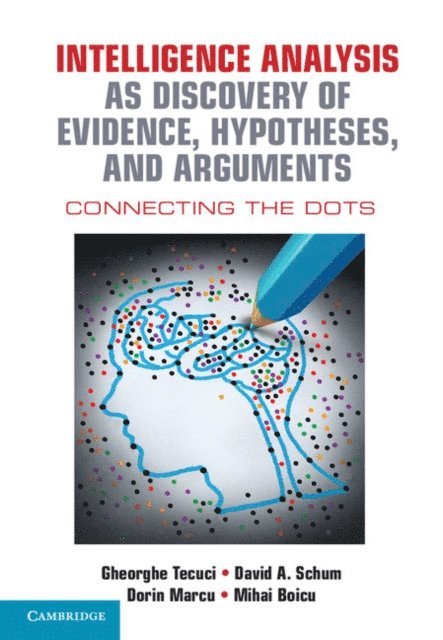
    Intelligence Analysis as Discovery of Evidence, Hypotheses, and Arguments

    Connecting the Dots

    AvGheorghe Tecuci,David A. Schum

    Inbunden, Engelska, 2016

    836 kr

    Beställningsvara. Skickas inom 10-15 vardagar. Fri frakt över 249 kr.

    Beskrivning

    This unique book on intelligence analysis covers several vital but often overlooked topics. It teaches the evidential and inferential issues involved in 'connecting the dots' to draw defensible and persuasive conclusions from masses of evidence: from observations we make, or questions we ask, we generate alternative hypotheses as explanations or answers; we make use of our hypotheses to generate new lines of inquiry and discover new evidence; and we test the hypotheses with the discovered evidence. To facilitate understanding of these issues and enable the performance of complex analyses, the book introduces an intelligent analytical tool, called Disciple-CD. Readers will practice with Disciple-CD and learn how to formulate hypotheses; develop arguments that reduce complex hypotheses to simpler ones; collect evidence to evaluate the simplest hypotheses; and assess the relevance and the believability of evidence, which combine in complex ways to determine its inferential force and the probabilities of the hypotheses.

    Produktinformation

    • Utgivningsdatum:2016-08-30
    • Mått:178 x 267 x 18 mm
    • Vikt:763 g
    • Format:Inbunden
    • Språk:Engelska
    • Antal sidor:272
    • Förlag:Cambridge University Press
    • ISBN:9781107122604

    Ingår i kampanjer

    10% rabatt på allt

    Utforska kategorier

    • Artificiell intelligens inom Data och IT

    Mer om författaren

    Gheorghe Tecuci (PhD, University of Paris-South and Polytechnic Institute of Bucharest) is Professor of Computer Science and Director of the Learning Agents Center at George Mason University, Virginia, Member of the Romanian Academy, and former Chair of Artificial Intelligence at the US Army War College. He has published eleven books and more than 190 papers. David A. Schum (PhD, Ohio State University) is Emeritus Professor of Systems Engineering, Operations Research, and Law, as well as Chief Scientist of the Learning Agents Center at George Mason University, Virginia. He has published more than one hundred research papers and six books on evidence and probabilistic inference, and is recognized as one of the founding fathers of the emerging Science of Evidence. Dorin Marcu (PhD, George Mason University) is Research Assistant Professor in the Learning Agents Center at George Mason University, Virginia. He collaborated in the development of the Disciple Learning Agent Shell and a series of cognitive assistants based on it for different application domains, such as Disciple-COA (course of action critiquing), Disciple-COG (strategic center of gravity analysis), Disciple-LTA (learning, tutoring, and assistant), and Disciple-EBR (evidence-based reasoning). Mihai Boicu (PhD, George Mason University) is Associate Professor of Information Sciences and Technology and Associate Director of the Learning Agents Center at George Mason University, Virginia. He is the main software architect of the Disciple agent development platform and coordinated the software development of Disciple-EBR. He has received the IAAI Innovative Application Award.

    Recensioner i media

    'Intelligence Analysis as Discovery of Evidence, Hypotheses, and Arguments is a valuable resource for those interested in improving intelligence analysis. It provides both prospective and current intelligence analysts with an easy to read and understand explanation of a complex process, along with suggestions for how to more effectively implement that process. The examples from intelligence analysis and comparison to similar practices in other fields such as medicine, law, and law enforcement help the reader better understand how the interplay of evidence, hypotheses, and arguments can develop in different contexts. In that sense, this book provides a wonderful platform for improving intelligence analysis by learning and employing best scientific reasoning practices.' Stephen Marrin, James Madison University, Virginia

    Innehållsförteckning

    • 1. Intelligence analysis: 'connecting the dots'; 2. Marshaling thoughts and evidence for imaginative analysis; 3. Disciple-CD: a cognitive assistant for connecting the dots; 4. Evidence; 5. Divide and conquer: a necessary approach to complex analysis; 6. Assessing the believability of evidence; 7. Chains of custody; 8. Recurrent substance-blind combinations of evidence; 9. Major sources of uncertainty in masses of evidence; 10. Assessing and reporting uncertainty: some alternative methods; 11. Analytic bias; 12. Learning and reusing analytic expertise: beyond Disciple-CD.