David A. Schum – författare
Visar alla böcker från författaren David A. Schum. Handla med fri frakt och snabb leverans.
12 produkter
12 produkter
Inbunden, Engelska, 1999
2 221 kr
Skickas inom 10-15 vardagar
The subject of this book is the founder of behavioural decision theory, which addresses the question of how people actually confront decisions, as opposed to the question of how they should make decisions. Second, Ward laid the groundwork for sound normative systems by noticing which tasks humans can do well and which tasks computers should perform. This volume, organized into five parts, reflects those accomplishments and more. The book is divided into four sections: "Behavioral Decision Theory" examines theoretical descriptions and empirical findings about human decision making. "Decision Analysis" examines topics in decision analysis. "Decision in Society" explores issues in societal decision making. The final section, "Historical Notes", provides some historical perspectives on the development of the decision theory. Within these sections, major, multi-disciplinary scholars in decision theory have written chapters exploring some very bold themes in the field, as an examination of the book's contents will show. The main reason for the health of the Decision Analysis field is its close links between theory and applications that have characterized it over the years.In this volume, the chapters by Barron and Barrett; Fishburn; Fryback; Keeney; Moreno, Pericchi, and Kadane; Howard; Phillips; Slovic and Gregory; Winkler; and, above all, von Winterfeldt focus on those links. Decision science originally developed out of concern with real decision problems; and applied work, such as is represented in this volume, will help the field to remain strong.
Häftad, Engelska, 2001
517 kr
Skickas inom 5-8 vardagar
No matter how irrefutable it may seem, evidence is often a matter of interpretation. Incomplete, inconclusive, imprecise, or vague, it is nonetheless the basis of myriad everyday conclusions and decisions. In this authoritative work, David A. Schum develops a general theory of evidence as it is understood and applied across a broad range of disciplines and practical undertakings.Synthesizing insights from law, philosophy and logic, probability, semiotics, artificial intelligence, psychology, and history, Schum provides a detailed examination of the various properties and uses of evidence and the evaluative skills evidence requires. Along with the evidential subtleties of probabilistic reasoning, Schum also explores the processes by which evidence is generated or discovered and looks at the intellectual and practical underpinnings of probabilistic reasoning. It is a useful resourse for students, researchers, and practitioners of every discipline concerned with evidence and its inferential use.
Inbunden, Engelska, 2016
1 050 kr
Skickas inom 7-10 vardagar
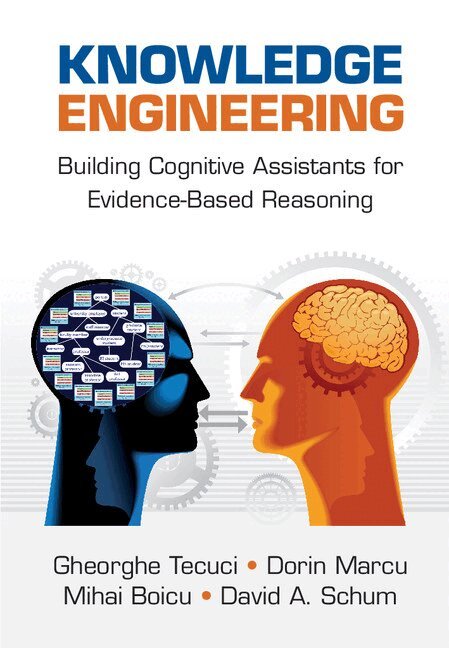
This book presents a significant advancement in the theory and practice of knowledge engineering, the discipline concerned with the development of intelligent agents that use knowledge and reasoning to perform problem solving and decision-making tasks. It covers the main stages in the development of a knowledge-based agent: understanding the application domain, modeling problem solving in that domain, developing the ontology, learning the reasoning rules, and testing the agent. The book focuses on a special class of agents: cognitive assistants for evidence-based reasoning that learn complex problem-solving expertise directly from human experts, support experts, and nonexperts in problem solving and decision making, and teach their problem-solving expertise to students. A powerful learning agent shell, Disciple-EBR, is included with the book, enabling students, practitioners, and researchers to develop cognitive assistants rapidly in a wide variety of domains that require evidence-based reasoning, including intelligence analysis, cybersecurity, law, forensics, medicine, and education.
Inbunden, Engelska, 2016
809 kr
Skickas inom 7-10 vardagar
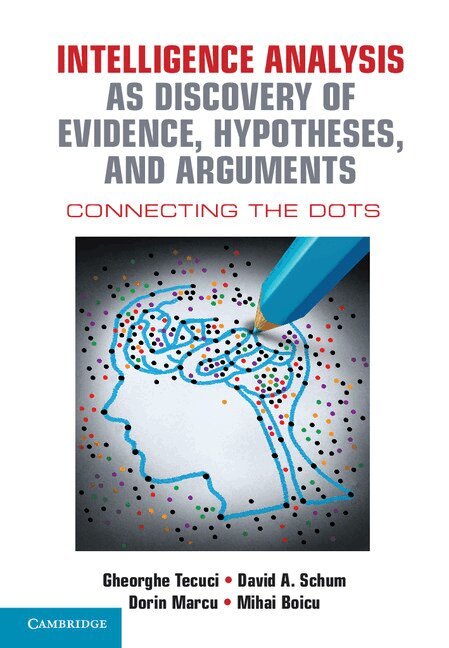
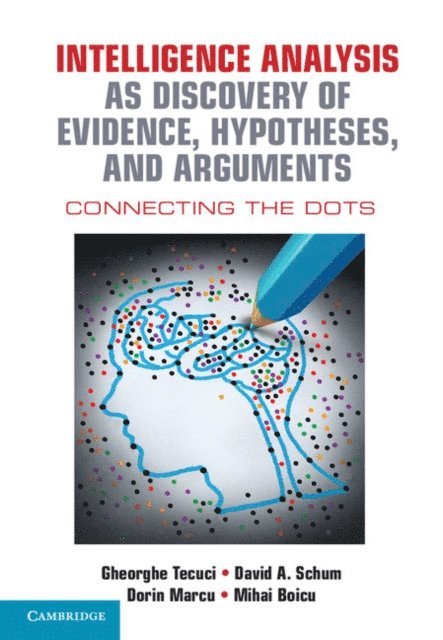
This unique book on intelligence analysis covers several vital but often overlooked topics. It teaches the evidential and inferential issues involved in 'connecting the dots' to draw defensible and persuasive conclusions from masses of evidence: from observations we make, or questions we ask, we generate alternative hypotheses as explanations or answers; we make use of our hypotheses to generate new lines of inquiry and discover new evidence; and we test the hypotheses with the discovered evidence. To facilitate understanding of these issues and enable the performance of complex analyses, the book introduces an intelligent analytical tool, called Disciple-CD. Readers will practice with Disciple-CD and learn how to formulate hypotheses; develop arguments that reduce complex hypotheses to simpler ones; collect evidence to evaluate the simplest hypotheses; and assess the relevance and the believability of evidence, which combine in complex ways to determine its inferential force and the probabilities of the hypotheses.
E-bok
PDF, Engelska, 20161 227 kr
Läs direkt efter köp
This book presents a significant advancement in the theory and practice of knowledge engineering, the discipline concerned with the development of intelligent agents that use knowledge and reasoning to perform problem solving and decision-making tasks. It covers the main stages in the development of a knowledge-based agent: understanding the application domain, modeling problem solving in that domain, developing the ontology, learning the reasoning rules, and testing the agent. The book focuses on a special class of agents: cognitive assistants for evidence-based reasoning that learn complex problem-solving expertise directly from human experts, support experts, and nonexperts in problem solving and decision making, and teach their problem-solving expertise to students. A powerful learning agent shell, Disciple-EBR, is included with the book, enabling students, practitioners, and researchers to develop cognitive assistants rapidly in a wide variety of domains that require evidence-based reasoning, including intelligence analysis, cybersecurity, law, forensics, medicine, and education.
E-bok
PDF, Engelska, 2016952 kr
Läs direkt efter köp
This unique book on intelligence analysis covers several vital but often overlooked topics. It teaches the evidential and inferential issues involved in ''connecting the dots'' to draw defensible and persuasive conclusions from masses of evidence: from observations we make, or questions we ask, we generate alternative hypotheses as explanations or answers; we make use of our hypotheses to generate new lines of inquiry and discover new evidence; and we test the hypotheses with the discovered evidence. To facilitate understanding of these issues and enable the performance of complex analyses, the book introduces an intelligent analytical tool, called Disciple-CD. Readers will practice with Disciple-CD and learn how to formulate hypotheses; develop arguments that reduce complex hypotheses to simpler ones; collect evidence to evaluate the simplest hypotheses; and assess the relevance and the believability of evidence, which combine in complex ways to determine its inferential force and the probabilities of the hypotheses.
Häftad, Engelska, 2012
2 221 kr
Skickas inom 10-15 vardagar
Decision Science and Technology is a compilation of chapters written in honor of a remarkable man, Ward Edwards. Among Ward's many contributions are two significant accomplishments, either of which would have been enough for a very distinguished career. First, Ward is the founder of behavioral decision theory. This interdisciplinary discipline addresses the question of how people actually confront decisions, as opposed to the question of how they should make decisions. Second, Ward laid the groundwork for sound normative systems by noticing which tasks humans can do well and which tasks computers should perform. This volume, organized into five parts, reflects those accomplishments and more. The book is divided into four sections: `Behavioral Decision Theory' examines theoretical descriptions and empirical findings about human decision making. `Decision Analysis' examines topics in decision analysis.`Decision in Society' explores issues in societal decision making. The final section, `Historical Notes', provides some historical perspectives on the development of the decision theory. Within these sections, major, multi-disciplinary scholars in decision theory have written chapters exploring some very bold themes in the field, as an examination of the book's contents will show. The main reason for the health of the Decision Analysis field is its close links between theory and applications that have characterized it over the years. In this volume, the chapters by Barron and Barrett; Fishburn; Fryback; Keeney; Moreno, Pericchi, and Kadane; Howard; Phillips; Slovic and Gregory; Winkler; and, above all, von Winterfeldt focus on those links. Decision science originally developed out of concern with real decision problems; and applied work, such as is represented in this volume, will help the field to remain strong.
E-bok
PDF, Engelska, 20122 741 kr
Läs direkt efter köp
Decision Science and Technology is a compilation of chapters written in honor of a remarkable man, Ward Edwards. Among Ward''s many contributions are two significant accomplishments, either of which would have been enough for a very distinguished career. First, Ward is the founder of behavioral decision theory. This interdisciplinary discipline addresses the question of how people actually confront decisions, as opposed to the question of how they should make decisions. Second, Ward laid the groundwork for sound normative systems by noticing which tasks humans can do well and which tasks computers should perform. This volume, organized into five parts, reflects those accomplishments and more. The book is divided into four sections: `Behavioral Decision Theory'' examines theoretical descriptions and empirical findings about human decision making. `Decision Analysis'' examines topics in decision analysis.`Decision in Society'' explores issues in societal decision making. The final section, `Historical Notes'', provides some historical perspectives on the development of the decision theory. Within these sections, major, multi-disciplinary scholars in decision theory have written chapters exploring some very bold themes in the field, as an examination of the book''s contents will show. The main reason for the health of the Decision Analysis field is its close links between theory and applications that have characterized it over the years. In this volume, the chapters by Barron and Barrett; Fishburn; Fryback; Keeney; Moreno, Pericchi, and Kadane; Howard; Phillips; Slovic and Gregory; Winkler; and, above all, von Winterfeldt focus on those links. Decision science originally developed out of concern with real decision problems; and applied work, such as is represented in this volume, will help the field to remain strong.
E-bok
PDF, Engelska, 2014756 kr
Läs direkt efter köp
Introduction to Applied Probability provides a basis for an intelligent application of probability ideas to a wide variety of phenomena for which it is suitable. It is intended as a tool for learning and seeks to point out and emphasize significant facts and interpretations which are frequently overlooked or confused by the beginner. The book covers more than enough material for a one semester course, enhancing the value of the book as a reference for the student. Notable features of the book are: the systematic handling of combinations of events (Section 3-5); extensive use of the mass concept as an aid to visualization; an unusually careful treatment of conditional probability, independence, and conditional independence (Section 6-4); the resulting clarification facilitates the formulation of many applied problems; the emphasis on events determined by random variables, which gives unity and clarity to many topics important for interpretation; and the utilization of the indicator function, both as a tool for dealing with events and as a notational device in the handling of random variables. Students of mathematics, engineering, biological and physical sciences will find the text highly useful.
Inbunden, Engelska, 1996
1 646 kr
Tillfälligt slut
Inbunden, Engelska, 1988
946 kr
Tillfälligt slut
This book, divided into two volumes, is intended to bring intelligence analysts and others abreast of current scholarship, from many disciplines, on the process of drawing conclusions from a mass of incomplete, inconclusive, and unreliable evidence. Volume I contains seventeen chapters on various evidential and inferential issues; though they contain some symbols and diagrams, the chapters in this volume contain almost no mathematics.
Inbunden, Engelska, 1988
822 kr
Tillfälligt slut
This is the companion volume to the book described above. Volume II contains supplementary material for Chapters 3 through 12 in Volume I. These supplements contain various formal, logical, or mathematical arguments in support of assertions made in the chapters in Volume I. The supplements also contain additional topical examples of evidentiary and inferential matters discussed in the chapter of Volume I; the examples in eight of these supplements are numerical in nature and are designed to illustrate the operations of the various formal systems of probability/inference under consideration.