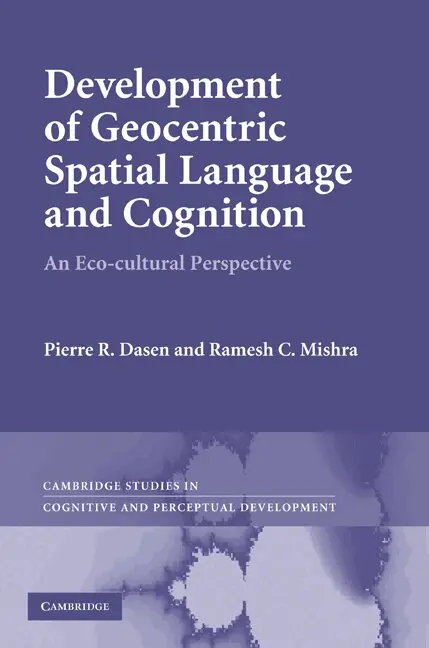
Development of Geocentric Spatial Language and Cognition

An Eco-cultural Perspective

AvPierre R. Dasen,Ramesh C. Mishra

Häftad, Engelska, 2013

476 kr

Beställningsvara. Skickas inom 7-10 vardagar. Fri frakt över 249 kr.
Fler format och utgåvor

Beskrivning

Egocentric spatial language uses coordinates in relation to our body to talk about small-scale space ('put the knife on the right of the plate and the fork on the left'), while geocentric spatial language uses geographic coordinates ('put the knife to the east, and the fork to the west'). How do children learn to use geocentric language? And why do geocentric spatial references sound strange in English when they are standard practice in other languages? This book studies child development in Bali, India, Nepal, and Switzerland and explores how children learn to use a geocentric frame both when speaking and performing non-verbal cognitive tasks (such as remembering locations and directions). The authors examine how these skills develop with age, look at the socio-cultural contexts in which the learning takes place, and explore the ecological, cultural, social, and linguistic conditions that favor the use of a geocentric frame of reference.

Produktinformation

Utforska kategorier

Recensioner i media

Innehållsförteckning

Hoppa över listan

Mer från samma serie

Hoppa över listan

Du kanske också är intresserad av

Del 11

Mind, Brain, and Education in Reading Disorders

Kurt W. Fischer, Jane Holmes Bernstein, Mary Helen Immordino-Yang, Massachusetts) Fischer, Kurt W. (Harvard University, Boston) Holmes Bernstein, Jane (The Children's Hospital, Mary Helen (University of Southern California) Immordino-Yang

Inbunden

1 553 kr