• Fri frakt över 249 kr
  • •
  • Snabba leveranser
  • •
  • Billiga böcker
Kundservice

Du är på sajten för privatpersoner.

Företag, bibliotek eller offentlig verksamhet?

Du handlar på classic.bokus.com, där alla dina funktioner finns intakta.
Till classic.bokus.com
Bokus logotyp. Gå till startsidan.
  • Erbjudanden
  • Nyheter
  • Student
  • Topplistor
  • Barn & ungdom
  • Bokus Play
  • E-böcker
  • Pocketböcker
  • Spel & pussel

10% rabatt på allt med kod: NYSTART10 →

Sidfot

Mina sidor

    Hjälp

    • Kundservice
    • Vanliga frågor och svar
    • Frakt och leverans
    • Retur vid ångerrätt
    • Reklamera vara
    • Betalning
    • Köpvillkor
    • Allmänna villkor
    • Information om webbplatsens tillgänglighet

    Om Bokus

    • Om oss
    • Pressrum
    • För studenter
    • För företag
    • För bibliotek och offentlig verksamhet
    • För leverantörer
    • Hållbarhet

    Populärt

    • Aktuella erbjudanden
    • Presentkort
    • Studentlitteratur
    • Nya böcker
    • Topplistor
    • Signerade böcker
    • Engelska böcker

    Inspiration

    • Boktips
    • BookTok
    • Populära bokserier
    • Barnbokskaraktärer
    • Populära författare
    Logotyp för Bokus
    Följ oss på Facebook (extern länk)Följ oss på Instagram (extern länk)Följ oss på YouTube (extern länk)Följ oss på TikTok (extern länk)
    bokus @ CookiesAnpassa cookiesIntegritetspolicyKöpvillkor
    Till Citymail hemsida (extern länk)Till Budbee hemsida (extern länk)Till Postnord hemsida (extern länk)Till Schenker hemsida (extern länk)Till Early Bird hemsida (extern länk)Till Walleys hemsida (extern länk)
    1. Juridik
    2. Internationell rätt
    3. Folkrätt

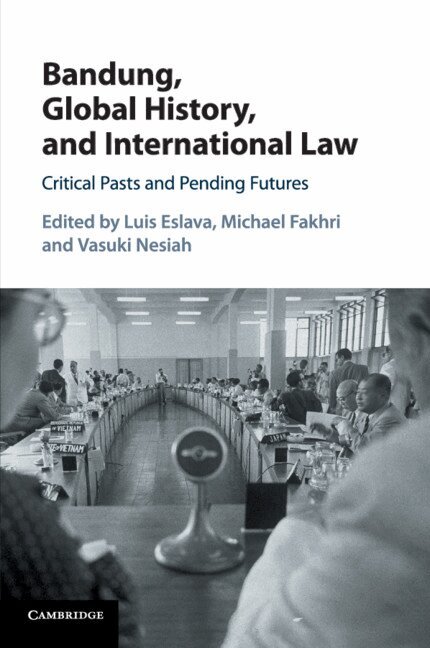
    Bandung, Global History, and International Law

    Critical Pasts and Pending Futures

    AvLuis Eslava,Michael Fakhri

    Häftad, Engelska, 2018

    611 kr

    Beställningsvara. Skickas inom 10-15 vardagar. Fri frakt över 249 kr.

    Beskrivning

    In 1955, a conference was held in Bandung, Indonesia that was attended by representatives from twenty-nine nations. Against the backdrop of crumbling European empires, Asian and African leaders forged new alliances and established anti-imperial principles for a new world order. The conference came to capture popular imaginations across the Global South and, as counterpoint to the dominant world order, it became both an act of collective imagination and a practical political project for decolonization that inspired a range of social movements, diplomatic efforts, institutional experiments and heterodox visions of the history and future of the world. In this book, leading international scholars explore what the spirit of Bandung has meant to people across the world over the past decades and what it means today. It analyzes Bandung's complicated and pivotal impact on global history, international law and, most of all, justice struggles after the end of formal colonialism.

    Produktinformation

    • Utgivningsdatum:2018-12-13
    • Mått:152 x 229 x 37 mm
    • Vikt:967 g
    • Format:Häftad
    • Språk:Engelska
    • Antal sidor:733
    • Förlag:Cambridge University Press
    • ISBN:9781107561045

    Utforska kategorier

    • Folkrätt inom Juridik

    Mer om författaren

    Luis Eslava is Senior Lecturer in International Law and Co-Director of the Centre for Critical International Law at Kent Law School. He is also a Senior Fellow at Melbourne Law School, International Professor at Universidad Externado de Colombia and core faculty member of the Institute for Global Law and Policy, Harvard Law School. He is the author of Local Space, Global Life: The Everyday Operation of International Law and Development (2015) and the co-editor of Imperialismo y Derecho Internacional (with Liliana Obregón and René Urueña, 2016). He is an active member of the Third World Approaches to International Law (TWAIL) network. Michael Fakhri teaches in the areas of international economic law, law and development, and food and agriculture at the University of Oregon. His research interests include Third World Approaches to International Law (TWAIL), international legal history, and legal accounts of imperialism. He has given talks at Harvard Law School, Princeton University, New Jersey, Brown University, Rhode Island, Cornell University, New York, London School of Economics and Political Science, University of Cambridge, the American University of Beirut, and the American University in Cairo. He is the author of Sugar and the Making of International Law (Cambridge, 2014). Vasuki Nesiah teaches human rights, legal and social theory at New York University and at the Institute for Global Law and Policy at Harvard Law School. She has published widely on the history and politics of human rights, humanitarianism, international criminal law, international feminisms and colonial legal history. A founding member of Third World Approaches to International Law (TWAIL), she continues as an active participant in this network. She serves on the international editorial committees of Feminist Legal Studies and the London Review of International Law.

    Recensioner i media

    'This book is an incredibly rich tool to all those seeking to understand the paths towards the civilizational transitions needed to face the multiple crises of climate, food, poverty, and meaning. It should be of great interest to students and scholars in fields well beyond international law, including anthropology, geography, sociology, global studies, and cultural studies.' Arturo Escobar, University of North Carolina, Chapel Hill

    Innehållsförteckning

    • List of illustrations; List of contributors; Foreword; Acknowledgements; Introduction: the Spirit of Bandung; Part I. Bandung Histories: 1. Anti-imperialism: then and now; 2. Newer is truer: time, space, and subjectivity at the Bandung Conference; 3. From Versailles to Bandung: the interwar origins of anti-colonialism; 4. Bandung: reflections on the sea, the world, and colonialism; 5. Nationalism, imperialism, and Bandung: nineteenth-century Japan as a prelude; 6. Ghostly visitations: 'questioning heirs' and the tragic tasks of narrating Bandung futures; 7. Bandung 1955: the deceit and the conceit; 8. Not a place, but a project: Bandung, TWAIL, and the aesthetics of Thirdness; Part II. Political Solidarities and Geographical Affiliations: 9. Challenging the lifeline of imperialism: reassessing Afro-Asian solidarity and related activism in the decade 1955–1965; 10. Bandung, China, and the making of world order in East Asia; 11. Decolonization as a Cold War imperative: Bandung and the Soviets; 12. Central Asia as an object of Orientalist narratives in the age of Bandung; 13. Latin American anti-imperialist movements and anti-communist states during the Bandung era; 14. Peripheral parallels? Europe's edges and the world of Bandung; 15. The Bandung Conference and Latin America: a decolonial dialogue with Oscar Correas; 16. A triple struggle: non-alignment, Yugoslavia, and national, social and geopolitical emancipation; 17. 'Let us first of all have unity among us': Bandung, international law, and the empty politics of solidarity; Part III. Nations and their Others: Bandung at Home: 18. The colonial debris of Bandung: equality and facilitating the rise of the Hindu right in India; 19. From Bandung 1955 to Bangladesh 1971: postcolonial self-determination and Third-World failures in South Asia; 20. Reimagining Bandung for women at work in Egypt: law and the woman between the factory and the 'social factory'; 21. Rethinking the concept of colonialism in Bandung and its African Union aftermath; 22. China and Africa: development, land, and the colonial legacy; 23. Bandung's legacy for the Arab Spring; 24. Applying the memory of the Bandung: lessons from Australia's negative case study; 25. Bandung in the shadow: the Brazilian experience; Part IV. Post-Colonial Agendas: Justice, Rights and Development: 26. The humanization of the Third World; 27. Bandung's legacy: solidarity and contestation in global women's rights; 28. Reflections on rhetoric and rage: Bandung and environmental injustice; 29. From statesmen to technocrats to financiers: development agents in the Third World; 30. Between Bandung and Doha: international economic law and developing countries; 31. The Bandung ethic and international human rights praxis: yesterday, today, and tomorrow; Part V. Another International Law: 32. Bandung and the origins of Third World sovereignty; 33. Letters from Bandung: encounters with another international law; 34. Altering international law: Nasser, Bandung, and the Suez Crisis; 35. Palestine at Bandung: the longwinded start of a re-imagined international law; 36. 'Must have been love': the non-aligned future of 'a warm December'; 37. The Bandung Declaration in the twenty-first century: are we there yet?; 38. Virtue pedagogy and international law teaching; Epilogue: the legacy of Bandung; Index.