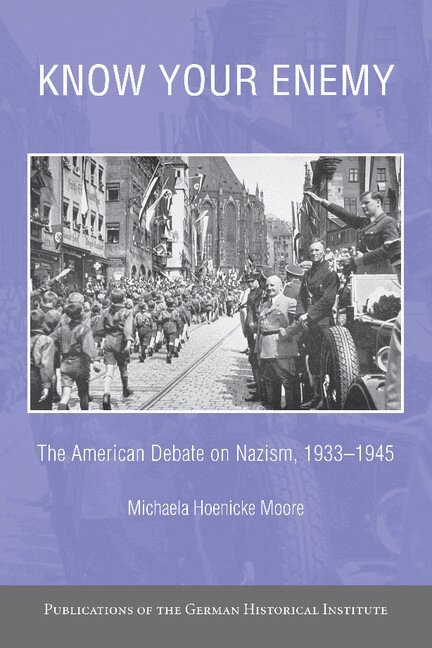
Häftad, Engelska, 2014
Know your Enemy
The American Debate on Nazism, 1933-1945
Del i serien Publications of the German Historical Institute
653 kr
Beställningsvara. Skickas inom 5-8 vardagar. Fri frakt över 249 kr.
Beskrivning
Produktinformation
- Utgivningsdatum: 2014-03-06
- Mått: 156 x 234 x 23 mm
- Vikt: 630 g
- Format: Häftad
- Språk: Engelska
- Serie: Publications of the German Historical Institute
- Antal sidor: 410
- Förlag: Cambridge University Press
- ISBN: 9781107655140
Utforska kategorier
Mer om författaren
Michaela Hoenicke Moore is Professor of History at the University of Iowa. She has taught at the Kennedy Institute of the Free University in Berlin, at the University of North Carolina, and at York University in Toronto and worked as a Senior Fellow in US Foreign Policy at the German Council on Foreign Relations in Berlin. She is the co-editor (with Bernard May) of The Uncertain Superpower: Domestic Dimensions of US Foreign Policy after the Cold War, and her articles have appeared in journals including Diplomatic History and Amerikastudien.
Recensioner i media
'This book provides the general and the scholarly interested reader with exceptionally important insights. First, the author tells us, on the basis of extensive primary source research, how and why the various American perceptions of Nazi Germany during the 1930s and during WWII tended to differentiate between Germans and Nazis. Second, that the Roosevelt administration itself was divided about its own war aims. Third, that this division allowed, in due course, a better, positive treatment of the postwar Germany than anticipated. And finally, that the legacy of pre-WWII appeasement, and of an alleged, coherent American crusade against Nazi totalitarian ambitions, which was hardly the case, became the root of American behavior during the Cold War all the way to our times. This work is highly recommended.' Shlomo Aronson, Hebrew University, Jerusalem
Betyg & recensioner
0 recensioner
Inga recensioner tillgängliga.