• Fri frakt över 249 kr
  • •
  • Snabba leveranser
  • •
  • Billiga böcker
Kundservice

Du är på sajten för privatpersoner.

Företag, bibliotek eller offentlig verksamhet?

Du handlar på classic.bokus.com, där alla dina funktioner finns intakta.
Till classic.bokus.com
Bokus logotyp. Gå till startsidan.
  • Erbjudanden
  • Nyheter
  • Student
  • Topplistor
  • Barn & ungdom
  • Bokus Play
  • E-böcker
  • Pocketböcker
  • Spel & pussel

10% rabatt på allt med kod NYSTART10 →

Sidfot

Mina sidor

    Hjälp

    • Kundservice
    • Vanliga frågor och svar
    • Frakt och leverans
    • Retur vid ångerrätt
    • Reklamera vara
    • Betalning
    • Köpvillkor
    • Allmänna villkor
    • Information om webbplatsens tillgänglighet

    Om Bokus

    • Om oss
    • Pressrum
    • För studenter
    • För företag
    • För bibliotek och offentlig verksamhet
    • För leverantörer
    • Hållbarhet

    Populärt

    • Aktuella erbjudanden
    • Presentkort
    • Studentlitteratur
    • Nya böcker
    • Topplistor
    • Signerade böcker
    • Engelska böcker

    Inspiration

    • Boktips
    • BookTok
    • Populära bokserier
    • Barnbokskaraktärer
    • Populära författare
    Logotyp för Bokus
    Följ oss på Facebook (extern länk)Följ oss på Instagram (extern länk)Följ oss på YouTube (extern länk)Följ oss på TikTok (extern länk)
    bokus @ CookiesAnpassa cookiesIntegritetspolicyKöpvillkor
    Till Citymail hemsida (extern länk)Till Budbee hemsida (extern länk)Till Postnord hemsida (extern länk)Till Schenker hemsida (extern länk)Till Early Bird hemsida (extern länk)Till Walleys hemsida (extern länk)
    1. Samhälle och politik
    2. Samhälle och kultur
    3. Kultur och medier
    4. Medievetenskap

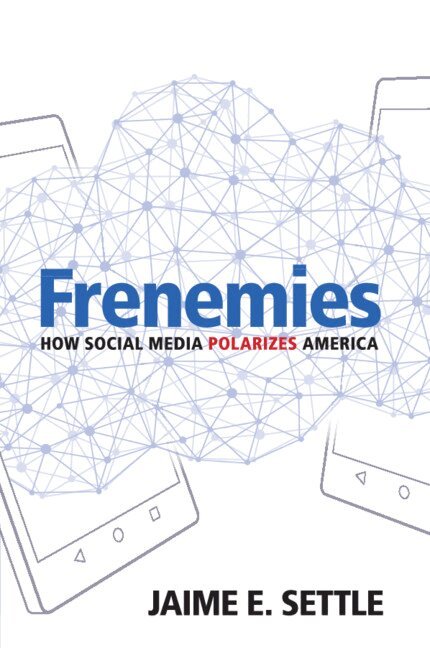
    Frenemies

    How Social Media Polarizes America

    AvJaime E. Settle

    Häftad, Engelska, 2019

    353 kr

    Beställningsvara. Skickas inom 10-15 vardagar. Fri frakt över 249 kr.

    Fler format och utgåvor

    E-bok

    426 kr

    E-bok

    426 kr

    Inbunden

    Tillf. slut

    Beskrivning

    Why do Americans have such animosity for people who identify with the opposing political party? Jaime E. Settle argues that in the context of increasing partisan polarization among American political elites, the way we communicate on Facebook uniquely facilitates psychological polarization among the American public. Frenemies introduces the END Framework of social media interaction. END refers to a subset of content that circulates in a social media ecosystem: a personalized, quantified blend of politically informative 'expression', 'news', and 'discussion' seamlessly interwoven into a wider variety of socially informative content. Scrolling through the News Feed triggers a cascade of processes that result in negative attitudes about those who disagree with us politically. The inherent features of Facebook, paired with the norms of how people use the site, heighten awareness of political identity, bias the inferences people make about others' political views, and foster stereotyped evaluations of the political out-group.

    Produktinformation

    • Utgivningsdatum:2019-08-15
    • Mått:151 x 228 x 20 mm
    • Vikt:400 g
    • Format:Häftad
    • Språk:Engelska
    • Antal sidor:334
    • Förlag:Cambridge University Press
    • ISBN:9781108459952

    Utforska kategorier

    • Medievetenskap inom Samhälle och politik

    Mer om författaren

    Jaime E. Settle is an Associate Professor of Government, director of the SNaPP Lab, and co-director of the Social Science Research Methods Center at the College of William and Mary, Virginia. She studies the American public's day-to-day experience with politics. Settle has published in Nature, the American Journal of Political Science, and has been supported by the National Science Foundation.

    Recensioner i media

    'Easily the most comprehensive, theory-driven examination of social media and political polarization to date.' Diana Mutz, Samuel A. Stouffer Professor of Political Science and Communication, University of Pennsylvania

    Innehållsförteckning

    • 1. A fundamental change in political communication; 2. Facebook in context: theorizing interaction on twenty-first century social media; 3. The END framework of political interaction on social media; 4. How do END interactions on the news feed psychologically polarize users?; 5. In the eye of the beholder: politically informative news feed content; 6. Political inference from content on the news feed; 7. Biased inference from END interactions; 8. Judging the other side; 9. Erasing the coast of Bohemia in the era of social media; Appendix A; Appendix B.