• Fri frakt över 249 kr
  • •
  • Snabba leveranser
  • •
  • Billiga böcker
Kundservice

Du är på sajten för privatpersoner.

Företag, bibliotek eller offentlig verksamhet?

Du handlar på classic.bokus.com, där alla dina funktioner finns intakta.
Till classic.bokus.com
Bokus logotyp. Gå till startsidan.
  • Erbjudanden
  • Student
  • Topplistor
  • Barn & ungdom
  • Bokus Play
  • E-böcker
  • Ljudböcker
  • Pocketböcker
  • Spel och pussel

Pocketfynda! Hundratals böcker för 49 kr/st →

Sidfot

Mina sidor

    Hjälp

    • Kundservice
    • Vanliga frågor och svar
    • Frakt och leverans
    • Retur vid ångerrätt
    • Reklamera vara
    • Betalning
    • Köpvillkor
    • Allmänna villkor
    • Information om webbplatsens tillgänglighet

    Om Bokus

    • Om oss
    • Pressrum
    • För studenter
    • För företag
    • För bibliotek och offentlig verksamhet
    • För leverantörer
    • Hållbarhet

    Populärt

    • Aktuella erbjudanden
    • Presentkort
    • Studentlitteratur
    • Nya böcker
    • Topplistor
    • Signerade böcker
    • Engelska böcker

    Inspiration

    • Boktips
    • BookTok
    • Barnbokskaraktärer
    • Populära författare
    Logotyp för Bokus
    Följ oss på Facebook (extern länk)Följ oss på Instagram (extern länk)Följ oss på YouTube (extern länk)Följ oss på TikTok (extern länk)
    bokus @ CookiesAnpassa cookiesIntegritetspolicyKöpvillkor
    Till Citymail hemsida (extern länk)Till Budbee hemsida (extern länk)Till Postnord hemsida (extern länk)Till Schenker hemsida (extern länk)Till Early Bird hemsida (extern länk)Till Walleys hemsida (extern länk)
    1. Ekonomi och Ledarskap
    2. Företagsekonomi
    3. Entreprenörskap

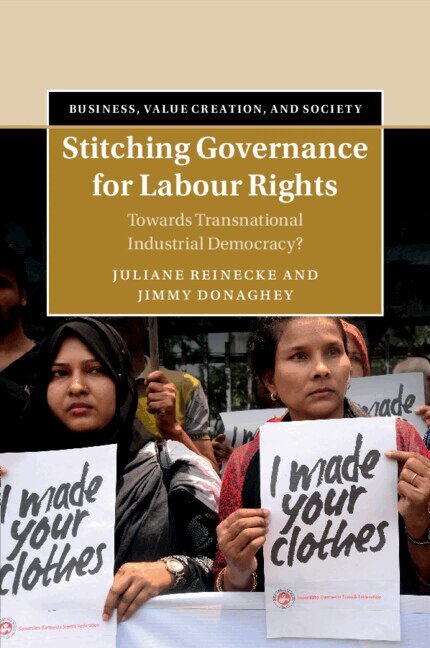
    Stitching Governance for Labour Rights

    Towards Transnational Industrial Democracy?

    AvJuliane Reinecke,Jimmy Donaghey

    Häftad, Engelska, 2024

    Del i serien Business, Value Creation, and Society

    423 kr

    Beställningsvara. Skickas inom 7-10 vardagar. Fri frakt över 249 kr.

    Fler format och utgåvor

    Inbunden

    1 444 kr

    Beskrivning

    Transnational labour governance is in urgent need of a new paradigm of democratic participation, with those who are most affected - typically workers - placed at the centre. To achieve this, principles of industrial democracy and transnational governance must come together to inform institutions within global supply chains. This book traces the development of 'transnational industrial democracy', using responses to the 2013 Rana Plaza disaster as the empirical context. A particular focus is placed on the Bangladesh Accord and the JETI Workplace Social Dialogue programme. Drawing on longitudinal field research from 2013-2020, the authors argue that the reality of modern-day supply chain capitalism has neither optimal institutional frameworks nor effective structures of industrial relations. Informed by principles of industrial democracy, the book aims at enhancing emerging forms of private transnational governance as second-best institutions.

    Produktinformation

    • Utgivningsdatum:2024-08-22
    • Mått:152 x 229 x 15 mm
    • Vikt:403 g
    • Format:Häftad
    • Språk:Engelska
    • Serie:Business, Value Creation, and Society
    • Antal sidor:276
    • Förlag:Cambridge University Press
    • ISBN:9781108708388

    Utforska kategorier

    • Entreprenörskap inom Ekonomi och Ledarskap
    • Affärsetik inom Ekonomi och Ledarskap
    • Affärsförhandlingar inom Ekonomi och Ledarskap

    Mer om författaren

    Juliane Reinecke is Professor of Management at Said Business School, University of Oxford. She is a Fellow at the Cambridge Institute for Sustainability Leadership and Research Fellow at Cambridge Judge Business School, from where she received her Ph.D. Juliane's research focuses on transnational governance, collective action and multi-stakeholder collaboration, sustainability in organizations and in global value chains. She serves as Associate Editor of Academy of Management Journal and as a trustee of the Society for the Advancement of Management Studies (SAMS). Jimmy Donaghey is Professor of Human Resource Management at the University of South Australia, Australia. His main research interests focus on the effects of internationalisation on the employment relationship. He is an editor of the journal Work, Employment and Society. Aside from his academic interest in employment relations, Jimmy has been an active participant in industrial relations in both the UK, where he was a branch officer and national executive member of UCU for over fifteen years, and Australia, where he is currently branch secretary of the UniSA NTEU branch.

    Recensioner i media

    'Through their detailed empirical work on the ground in Bangladesh and their thoughtful theorising on democratic representation, the authors show that what seems like an unsolveable problem - achieving better labour standards in the global garment industry - hinges on one core ingredient: the voice of workers. Their book sheds light on who can legitimately take up this role in the absence of institutionalised structures of representation, taking us through the complex and fragile alliances on different levels that have emerged in the aftermath of the Rana Plaza disaster. A great read for anyone interested in the intricacies of making global supply chains more sustainable, be it from an industrial relations, a governance or a management perspective.' Elke Schüßler, Head of Institute of Organizational Science, Johannes Kepler University Linz

    Innehållsförteckning

    • 1. Introduction; 2. The democratic deficit of global supply chains; 3. Democratic representation: structures and claims; 4. After Rana Plaza: mending a toxic supply chain; 5. Representative alliances in the creation of the Bangladesh Accord; 6. Creating representation through industrial democracy vs. CSR: the Accord and Alliance as a natural experiment; 7. When transnational governance meets national actors: The politics of exclusion in the Bangladesh Accord; 8. Building representative structures at the workplace level; 9. Conclusions: the emergence of transnational industrial democracy?; Appendix 1. The practical and political issues of studying transnational labour representation; Appendix 2. When CSR meets industrial relations: reflections on doing interdisciplinary scholarship.