• Fri frakt över 249 kr
  • •
  • Snabba leveranser
  • •
  • Billiga böcker
Kundservice

Du är på sajten för privatpersoner.

Företag, bibliotek eller offentlig verksamhet?

Du handlar på classic.bokus.com, där alla dina funktioner finns intakta.
Till classic.bokus.com
Bokus logotyp. Gå till startsidan.
  • Erbjudanden
  • Nyheter
  • Student
  • Topplistor
  • Barn & ungdom
  • Bokus Play
  • E-böcker
  • Pocketböcker
  • Spel & pussel

10% rabatt på allt med kod NYSTART10 →

Sidfot

Mina sidor

    Hjälp

    • Kundservice
    • Vanliga frågor och svar
    • Frakt och leverans
    • Retur vid ångerrätt
    • Reklamera vara
    • Betalning
    • Köpvillkor
    • Allmänna villkor
    • Information om webbplatsens tillgänglighet

    Om Bokus

    • Om oss
    • Pressrum
    • För studenter
    • För företag
    • För bibliotek och offentlig verksamhet
    • För leverantörer
    • Hållbarhet

    Populärt

    • Aktuella erbjudanden
    • Presentkort
    • Studentlitteratur
    • Nya böcker
    • Topplistor
    • Signerade böcker
    • Engelska böcker

    Inspiration

    • Boktips
    • BookTok
    • Populära bokserier
    • Barnbokskaraktärer
    • Populära författare
    Logotyp för Bokus
    Följ oss på Facebook (extern länk)Följ oss på Instagram (extern länk)Följ oss på YouTube (extern länk)Följ oss på TikTok (extern länk)
    bokus @ CookiesAnpassa cookiesIntegritetspolicyKöpvillkor
    Till Citymail hemsida (extern länk)Till Budbee hemsida (extern länk)Till Postnord hemsida (extern länk)Till Schenker hemsida (extern länk)Till Early Bird hemsida (extern länk)Till Walleys hemsida (extern länk)
    1. Data och IT
    2. Systemvetenskap och AI

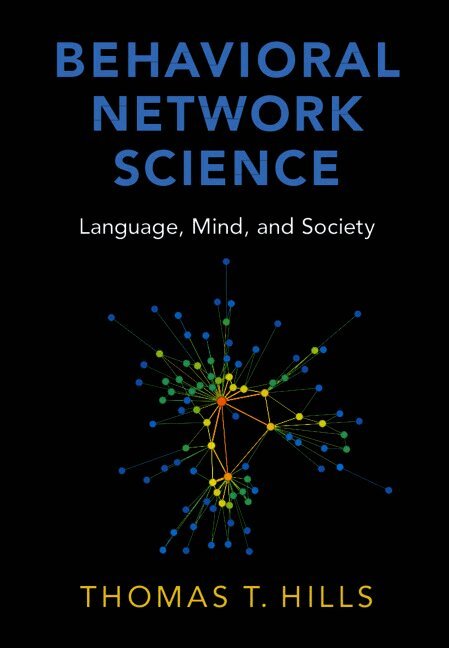
    Behavioral Network Science

    Language, Mind, and Society

    AvThomas T. Hills

    Häftad, Engelska, 2024

    505 kr

    Beställningsvara. Skickas inom 10-15 vardagar. Fri frakt över 249 kr.

    Fler format och utgåvor

    Inbunden

    1 571 kr

    E-bok

    614 kr

    E-bok

    614 kr

    Beskrivning

    Behavioral Network Science explains how and why structure matters in the behavioral sciences. Exploring open questions in language evolution, child language learning, memory search, age-related cognitive decline, creativity, group problem solving, opinion dynamics, conspiracies, and conflict, readers will learn essential behavioral science theory alongside novel network science applications. This book also contains an introductory guide to network science, demonstrating how to turn data into networks, quantify network structure across scales, and hone one's intuition for how structure arises and evolves. Online R code allows readers to explore the data and reproduce all the visualizations and simulations for themselves, empowering them to make contributions of their own. For data scientists interested in gaining a professional understanding of how the behavioral sciences inform network science, or behavioral scientists interested in learning how to apply network science from the ground up, this book is an essential guide.

    Produktinformation

    • Utgivningsdatum:2024-12-19
    • Mått:179 x 253 x 21 mm
    • Vikt:720 g
    • Format:Häftad
    • Språk:Engelska
    • Antal sidor:428
    • Förlag:Cambridge University Press
    • ISBN:9781108793339

    Utforska kategorier

    • Systemvetenskap och AI inom Data och IT
    • Psykologiska teorier och skolor inom Psykologi och pedagogik
    • Sociologi inom Samhälle och politik

    Mer om författaren

    Dr Thomas Hills is a Professor of Psychology at the University of Warwick. He directs the Behavioral and Data Science MSc at the University of Warwick, concentrating on how humans represent and navigate information in the mind and society. He has previously held fellowships with the Alan Turing Institute and the Royal Society.

    Recensioner i media

    'In the network of books Behavioral Network Science is the 'positive deviant' that acts as a much-needed broker between the behavioral sciences and network science. Written in a lively and engaging style, it is a must-read for anyone who wishes to acquire a powerful set of tools to measure structure, and ultimately, study the relation between structure and behavior, in language, the human mind, and societies.' Cynthia Siew, National University of Singapore

    Innehållsförteckning

    • Part I. A Brief Guide to Network Science: 1. Making and recognizing networks; 2. Network metrics; 3. Generative network models and network evolution; Part II. Language and Learning: 4. Zipf's law of meaning: the degree distribution of the mind; 5. Network learning: growing a lexicon by degrees; 6. What is distinctive: exploring edge types in multi-layer networks; 7. The small-world spectrum: using small worlds to compare networks; 8. The birthplace of new words: identifying node origins; 9. Agent-Based models of language emergence: structure favors the orangutan; Part III. Mental Processes: 10. False memories: spreading activation in memory networks; 11. Cognitive foraging: exploration versus exploitation in memory search; 12. Age-related Cognitive Decline: a network enrichment account; 13. Creativity: how noisy processes create novel structure; Part IV. Social Dynamics: 14. Network illusions: how structure misleads us; 15. Group problem solving: harnessing the wisdom of the crowds; 16. The Segregation of belief: how structure facilitates false consensus; 17. The conspiracy frame: coherence through self-supporting beliefs; 18. The Kennedy paradox: games of conflict and escalation; 19. Fund people not projects: a universal basic income for research; References.