• Fri frakt över 249 kr
  • •
  • Snabba leveranser
  • •
  • Billiga böcker
Kundservice

Du är på sajten för privatpersoner.

Företag, bibliotek eller offentlig verksamhet?

Du handlar på classic.bokus.com, där alla dina funktioner finns intakta.
Till classic.bokus.com
Bokus logotyp. Gå till startsidan.
  • Erbjudanden
  • Nyheter
  • Student
  • Topplistor
  • Barn & ungdom
  • Bokus Play
  • E-böcker
  • Pocketböcker
  • Spel & pussel

10% studentrabatt med kod TERM26

Sidfot

Mina sidor

    Hjälp

    • Kundservice
    • Vanliga frågor och svar
    • Frakt och leverans
    • Retur vid ångerrätt
    • Reklamera vara
    • Betalning
    • Köpvillkor
    • Allmänna villkor
    • Information om webbplatsens tillgänglighet

    Om Bokus

    • Om oss
    • Pressrum
    • För studenter
    • För företag
    • För bibliotek och offentlig verksamhet
    • För leverantörer
    • Hållbarhet

    Populärt

    • Aktuella erbjudanden
    • Presentkort
    • Studentlitteratur
    • Nya böcker
    • Topplistor
    • Signerade böcker
    • Engelska böcker

    Inspiration

    • Boktips
    • BookTok
    • Populära bokserier
    • Barnbokskaraktärer
    • Populära författare
    Logotyp för Bokus
    Följ oss på Facebook (extern länk)Följ oss på Instagram (extern länk)Följ oss på YouTube (extern länk)Följ oss på TikTok (extern länk)
    bokus @ CookiesAnpassa cookiesIntegritetspolicyKöpvillkor
    Till Citymail hemsida (extern länk)Till Budbee hemsida (extern länk)Till Postnord hemsida (extern länk)Till Schenker hemsida (extern länk)Till Early Bird hemsida (extern länk)Till Walleys hemsida (extern länk)
    1. Kultur
    2. Scenkonst och film
    3. Teater

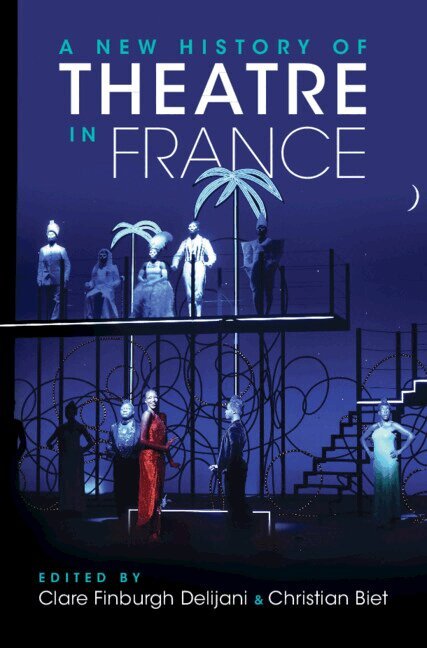
    A New History of Theatre in France

    AvClare Finburgh Delijani

    Häftad, Engelska, 2026

    403 kr

    Beställningsvara. Skickas inom 10-15 vardagar. Fri frakt över 249 kr.

    Beskrivning

    Theatre in France was the first in Europe to be written in the vernacular as opposed to Latin. It has provided the English language with the medieval word farce, the early-modern word role, and the modern term mise en scène. Molière is single-handedly responsible for launching European-style playwriting in North Africa. Today, it is only a slight exaggeration to say that it's harder to get tickets for the Festival d'Avignon, one of the world's largest theatre festivals, than for the Rolling Stones' farewell tour. Containing chapters by globally eminent theatre experts, many of whom will be read in English for the first time, this collaborative history testifies to the central part theatre has played for over a thousand years in both French culture and world culture. Crucially, too, it places centre-stage the genders, ethnicities and classes that have had to wait in the wings of theatres, and of theatre criticism.

    Produktinformation

    • Utgivningsdatum:2026-01-08
    • Mått:152 x 229 x 26 mm
    • Vikt:683 g
    • Format:Häftad
    • Språk:Engelska
    • Antal sidor:476
    • Förlag:Cambridge University Press
    • ISBN:9781108827904

    Utforska kategorier

    • Teater inom Kultur
    • Scenkonstens historia inom Kultur

    Mer om författaren

    Clare Finburgh Delijani is the recipient of a Leverhulme Major Research Fellowship (2023–26) and is one of the leading specialists in theatre and performance from the French-speaking world. She is currently writing a history of postcolonial theatre in France from the 1950s to the present day. Christian Biet was professor of theatre and performance at Paris Nanterre University, and visiting professor at New York University. Beginning his career as a specialist in the seventeenth-century French golden age, he diversified into areas including performance studies and theatre from East Asia.

    Recensioner i media

    'A New History of Theatre in France is an exciting book that brings fresh insight and ranges from the fifteenth century to the present time. Unlike previous histories of French theatre, Finburgh Delijani's collection both highlights the central part theatre has played in French culture over the centuries and updates the specificities and interconnections between different periods and geographical locations that make up the French theatrical landscape.' Osita Okagbue, Professor of Theatre and Performance, Goldsmiths, University of London

    Innehållsförteckning

    • Introduction Clare Finburgh Delijani; 1. The performing arts in fifteenth- and sixteenth-century France: the making of theatre Marie Bouhaïk-Gironès and Estelle Doudet; 2. Drama during the wars of religion: a contextual approach Charlotte Bouteille and Tiphaine Karsenti; 3. Drama before standardization: the theatre of blood Christian Biet; 4. Neoclassical tragedy: listening to women John D. Lyons; 5. Molière, a man of the stage? Martial Poirson; 6. Theatres as economic concerns: Molière, the Hôtel Guénégaud and the Comédie-Française Jan Clarke; 7. Seventeenth-century printed theatre: gender and peritext Derval Conroy; 8. Non-official eighteenth-century stages: censorship, subversion and entertainment Guy Spielmann; 9. The expanded theatre of the French revolution Sanja Perovic; 10. Nineteenth-century melodrama, vaudeville and entertainment: the vitality and richness of a marginalized theatre Roxane Martin; 11. New approaches to women actors and celebrity in nineteenth-century France Clare Siviter and Emmanuela Wroth; 12. Extended romanticism in the extended nineteenth century Florence Naugrette; 13. Poetry in action, 1945–1968: from Antonin Artaud to Lettrism and the Domaine Poétique Cristina De Simone; 14. Performance and installation art: re-turning to Artaud through Christian Boltanski Carl Lavery and Rezvan Zandieh; 15. Twentieth- and twenty-first-century theatre directing: perception at play Christophe Triau; 16. Political theatre in France (1954–2020): The Brechtian ordinate Olivier Neveux; 17. Liberating third world theatre: Serreau, Kateb, Césaire, and Genet Joanne Brueton; 18. Francophone theatre-makers in France: Traumatizing the French stage Judith G. Miller; 19. Migration in modern and contemporary playwriting: uprooting and rerouting Clare Finburgh Delijani; 20. An interview with Éric Ruf Clare Siviter; 21. An interview with Magali Mougel Chris Campbell; 22. An interview with Phia Ménard Estel Baudou.