• Fri frakt över 249 kr
  • •
  • Snabba leveranser
  • •
  • Billiga böcker
Kundservice

Du är på sajten för privatpersoner.

Företag, bibliotek eller offentlig verksamhet?

Du handlar på classic.bokus.com, där alla dina funktioner finns intakta.
Till classic.bokus.com
Bokus logotyp. Gå till startsidan.
  • Erbjudanden
  • Nyheter
  • Student
  • Topplistor
  • Barn & ungdom
  • Bokus Play
  • E-böcker
  • Pocketböcker
  • Spel & pussel

10% rabatt på allt med kod NYSTART10 →

Sidfot

Mina sidor

    Hjälp

    • Kundservice
    • Vanliga frågor och svar
    • Frakt och leverans
    • Retur vid ångerrätt
    • Reklamera vara
    • Betalning
    • Köpvillkor
    • Allmänna villkor
    • Information om webbplatsens tillgänglighet

    Om Bokus

    • Om oss
    • Pressrum
    • För studenter
    • För företag
    • För bibliotek och offentlig verksamhet
    • För leverantörer
    • Hållbarhet

    Populärt

    • Aktuella erbjudanden
    • Presentkort
    • Studentlitteratur
    • Nya böcker
    • Topplistor
    • Signerade böcker
    • Engelska böcker

    Inspiration

    • Boktips
    • BookTok
    • Populära bokserier
    • Barnbokskaraktärer
    • Populära författare
    Logotyp för Bokus
    Följ oss på Facebook (extern länk)Följ oss på Instagram (extern länk)Följ oss på YouTube (extern länk)Följ oss på TikTok (extern länk)
    bokus @ CookiesAnpassa cookiesIntegritetspolicyKöpvillkor
    Till Citymail hemsida (extern länk)Till Budbee hemsida (extern länk)Till Postnord hemsida (extern länk)Till Schenker hemsida (extern länk)Till Early Bird hemsida (extern länk)Till Walleys hemsida (extern länk)
    1. Naturvetenskap och teknik
    2. Matematik och naturvetenskap
    3. Matematik
    4. Talteori

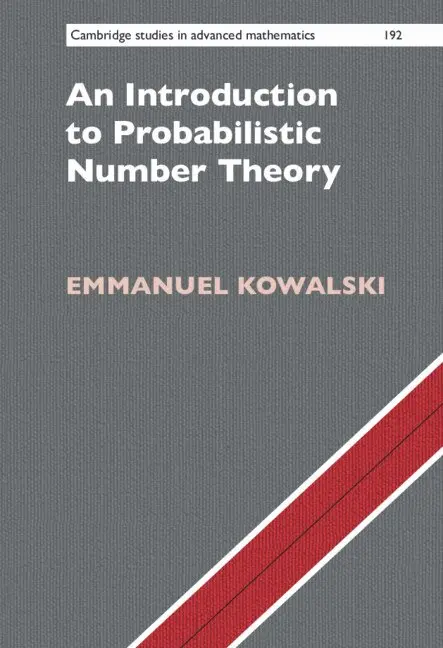
    An Introduction to Probabilistic Number Theory

    AvEmmanuel Kowalski

    Inbunden, Engelska, 2021

    Del 192 i serien Cambridge Studies in Advanced Mathematics

    571 kr

    Beställningsvara. Skickas inom 10-15 vardagar. Fri frakt över 249 kr.

    Beskrivning

    Despite its seemingly deterministic nature, the study of whole numbers, especially prime numbers, has many interactions with probability theory, the theory of random processes and events. This surprising connection was first discovered around 1920, but in recent years the links have become much deeper and better understood. Aimed at beginning graduate students, this textbook is the first to explain some of the most modern parts of the story. Such topics include the Chebychev bias, universality of the Riemann zeta function, exponential sums and the bewitching shapes known as Kloosterman paths. Emphasis is given throughout to probabilistic ideas in the arguments, not just the final statements, and the focus is on key examples over technicalities. The book develops probabilistic number theory from scratch, with short appendices summarizing the most important background results from number theory, analysis and probability, making it a readable and incisive introduction to this beautiful area of mathematics.

    Produktinformation

    • Utgivningsdatum:2021-05-06
    • Mått:152 x 229 x 19 mm
    • Vikt:568 g
    • Format:Inbunden
    • Språk:Engelska
    • Serie:Cambridge Studies in Advanced Mathematics
    • Antal sidor:270
    • Förlag:Cambridge University Press
    • ISBN:9781108840965

    Utforska kategorier

    • Talteori inom Naturvetenskap och teknik
    • Matematisk statistik inom Naturvetenskap och teknik
    • Beräkning och matematisk analys inom Naturvetenskap och teknik

    Mer om författaren

    Emmanuel Kowalski is Professor in the Mathematics Department of the Swiss Federal Institute of Technology, Zurich. He is the author of five previous books, including the widely cited Analytic Number Theory (2004) with H. Iwaniec, which is considered to be the standard graduate textbook for analytic number theory.

    Recensioner i media

    'an excellent resource for someone trying to enter the field of probabilistic number theory' Bookshelf by Notices of the American Mathematical Society

    Innehållsförteckning

    • 1. Introduction; 2. Classical probabilistic number theory; 3. The distribution of values of the Riemann zeta function, I; 4. The distribution of values of the Riemann zeta function, II; 5. The Chebychev bias; 6. The shape of exponential sums; 7. Further topics; Appendix A. Analysis; Appendix B. Probability; Appendix C. Number theory; References; Index.