• Fri frakt över 249 kr
  • •
  • Snabba leveranser
  • •
  • Billiga böcker
Kundservice

Du är på sajten för privatpersoner.

Företag, bibliotek eller offentlig verksamhet?

Du handlar på classic.bokus.com, där alla dina funktioner finns intakta.
Till classic.bokus.com
Bokus logotyp. Gå till startsidan.
  • Erbjudanden
  • Nyheter
  • Student
  • Topplistor
  • Barn & ungdom
  • Bokus Play
  • E-böcker
  • Pocketböcker
  • Spel & pussel

10% rabatt på allt med kod: NYSTART10 →

Sidfot

Mina sidor

    Hjälp

    • Kundservice
    • Vanliga frågor och svar
    • Frakt och leverans
    • Retur vid ångerrätt
    • Reklamera vara
    • Betalning
    • Köpvillkor
    • Allmänna villkor
    • Information om webbplatsens tillgänglighet

    Om Bokus

    • Om oss
    • Pressrum
    • För studenter
    • För företag
    • För bibliotek och offentlig verksamhet
    • För leverantörer
    • Hållbarhet

    Populärt

    • Aktuella erbjudanden
    • Presentkort
    • Studentlitteratur
    • Nya böcker
    • Topplistor
    • Signerade böcker
    • Engelska böcker

    Inspiration

    • Boktips
    • BookTok
    • Populära bokserier
    • Barnbokskaraktärer
    • Populära författare
    Logotyp för Bokus
    Följ oss på Facebook (extern länk)Följ oss på Instagram (extern länk)Följ oss på YouTube (extern länk)Följ oss på TikTok (extern länk)
    bokus @ CookiesAnpassa cookiesIntegritetspolicyKöpvillkor
    Till Citymail hemsida (extern länk)Till Budbee hemsida (extern länk)Till Postnord hemsida (extern länk)Till Schenker hemsida (extern länk)Till Early Bird hemsida (extern länk)Till Walleys hemsida (extern länk)
    1. Skönlitteratur
    2. Litteraturvetenskap
    3. Litteraturteori

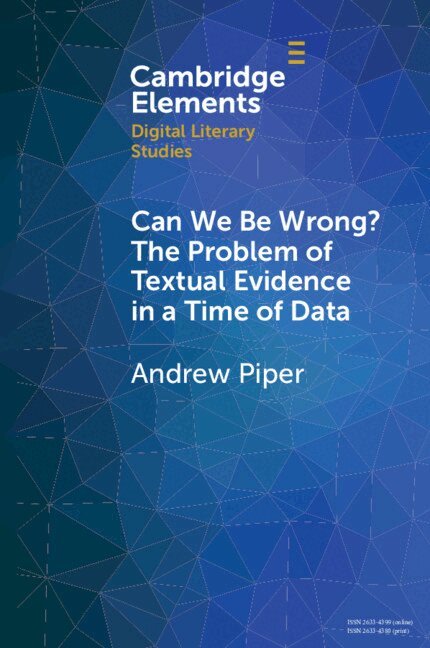
    Can We Be Wrong? The Problem of Textual Evidence in a Time of Data

    AvAndrew Piper

    Häftad, Engelska, 2020

    Del i serien Elements in Digital Literary Studies

    274 kr

    Beställningsvara. Skickas inom 10-15 vardagar. Fri frakt över 249 kr.

    Fler format och utgåvor

    E-bok

    327 kr

    E-bok

    327 kr

    Beskrivning

    This Element tackles the problem of generalization with respect to text-based evidence in the field of literary studies. When working with texts, how can we move, reliably and credibly, from individual observations to more general beliefs about the world? The onset of computational methods has highlighted major shortcomings of traditional approaches to texts when it comes to working with small samples of evidence. This Element combines a machine learning-based approach to detect the prevalence and nature of generalization across tens of thousands of sentences from different disciplines alongside a robust discussion of potential solutions to the problem of the generalizability of textual evidence. It exemplifies the way mixed methods can be used in complementary fashion to develop nuanced, evidence-based arguments about complex disciplinary issues in a data-driven research environment.

    Produktinformation

    • Utgivningsdatum:2020-11-19
    • Mått:152 x 228 x 6 mm
    • Vikt:144 g
    • Format:Häftad
    • Språk:Engelska
    • Serie:Elements in Digital Literary Studies
    • Antal sidor:86
    • Förlag:Cambridge University Press
    • ISBN:9781108926201

    Utforska kategorier

    • Litteraturteori inom Skönlitteratur

    Mer om författaren

    Andrew Piper is Professor and William Dawson Scholar in the Department of Languages, Literatures, and Cultures at McGill University. He is the director of .txtLAB, a laboratory for cultural analytics, and editor of the Journal of Cultural Analytics. He is also the author of Enumerations: Data and Literary Study (Chicago 2018).

    Innehållsförteckning

    • Introduction, or What's Wrong with Literary Studies?; Part I. Theory: 1. Probable Cause; Part II. Evidence Eve Kraicer, Nicholas King, Emma Ebowe, Matthew Hunter, Victoria Svaikovsky, and Sunyam Bagga; 2. Machine Learning as a Collaborative Process; 3. Results; Part III. Discussion: 4. Don't Generalize (from Case Studies): The Case for Open Generalization; 5. Don't Generalize (At All): The Case for the Open Mind; Conclusion: On the Mutuality of Method.