• Fri frakt över 249 kr
  • •
  • Snabba leveranser
  • •
  • Billiga böcker
Kundservice

Du är på sajten för privatpersoner.

Företag, bibliotek eller offentlig verksamhet?

Du handlar på classic.bokus.com, där alla dina funktioner finns intakta.
Till classic.bokus.com
Bokus logotyp. Gå till startsidan.
  • Erbjudanden
  • Nyheter
  • Student
  • Topplistor
  • Barn & ungdom
  • Bokus Play
  • E-böcker
  • Pocketböcker
  • Spel & pussel

10% rabatt på allt med kod: NYSTART10 →

Sidfot

Mina sidor

    Hjälp

    • Kundservice
    • Vanliga frågor och svar
    • Frakt och leverans
    • Retur vid ångerrätt
    • Reklamera vara
    • Betalning
    • Köpvillkor
    • Allmänna villkor
    • Information om webbplatsens tillgänglighet

    Om Bokus

    • Om oss
    • Pressrum
    • För studenter
    • För företag
    • För bibliotek och offentlig verksamhet
    • För leverantörer
    • Hållbarhet

    Populärt

    • Aktuella erbjudanden
    • Presentkort
    • Studentlitteratur
    • Nya böcker
    • Topplistor
    • Signerade böcker
    • Engelska böcker

    Inspiration

    • Boktips
    • BookTok
    • Populära bokserier
    • Barnbokskaraktärer
    • Populära författare
    Logotyp för Bokus
    Följ oss på Facebook (extern länk)Följ oss på Instagram (extern länk)Följ oss på YouTube (extern länk)Följ oss på TikTok (extern länk)
    bokus @ CookiesAnpassa cookiesIntegritetspolicyKöpvillkor
    Till Citymail hemsida (extern länk)Till Budbee hemsida (extern länk)Till Postnord hemsida (extern länk)Till Schenker hemsida (extern länk)Till Early Bird hemsida (extern länk)Till Walleys hemsida (extern länk)
    1. Naturvetenskap och teknik
    2. Matematik och naturvetenskap
    3. Matematik
    4. Matematisk statistik

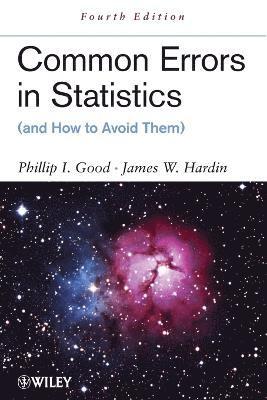
    Common Errors in Statistics (and How to Avoid Them)

    AvPhillip I. Good,James W. Hardin

    Häftad, Engelska, 2012

    746 kr

    Beställningsvara. Skickas inom 5-8 vardagar. Fri frakt över 249 kr.

    Beskrivning

    Praise for Common Errors in Statistics (and How to Avoid Them)"A very engaging and valuable book for all who use statistics in any setting."—CHOICE"Addresses popular mistakes often made in data collection and provides an indispensable guide to accurate statistical analysis and reporting. The authors' emphasis on careful practice, combined with a focus on the development of solutions, reveals the true value of statistics when applied correctly in any area of research."—MAA ReviewsCommon Errors in Statistics (and How to Avoid Them), Fourth Edition provides a mathematically rigorous, yet readily accessible foundation in statistics for experienced readers as well as students learning to design and complete experiments, surveys, and clinical trials.Providing a consistent level of coherency throughout, the highly readable Fourth Edition focuses on debunking popular myths, analyzing common mistakes, and instructing readers on how to choose the appropriate statistical technique to address their specific task. The authors begin with an introduction to the main sources of error and provide techniques for avoiding them. Subsequent chapters outline key methods and practices for accurate analysis, reporting, and model building. The Fourth Edition features newly added topics, including: Baseline dataDetecting fraudLinear regression versus linear behaviorCase control studiesMinimum reporting requirementsNon-random samplesThe book concludes with a glossary that outlines key terms, and an extensive bibliography with several hundred citations directing readers to resources for further study.Presented in an easy-to-follow style, Common Errors in Statistics, Fourth Edition is an excellent book for students and professionals in industry, government, medicine, and the social sciences.

    Produktinformation

    • Utgivningsdatum:2012-07-26
    • Mått:152 x 229 x 20 mm
    • Vikt:479 g
    • Format:Häftad
    • Språk:Engelska
    • Antal sidor:352
    • Upplaga:4
    • Förlag:John Wiley & Sons Inc
    • ISBN:9781118294390

    Utforska kategorier

    • Matematisk statistik inom Naturvetenskap och teknik

    Mer om författaren

    PHILLIP I. GOOD, PhD, is Operations Manager at Information Research, a consulting firm specializing in statistical solutions for private and public organizations. He has published more than thirty scholarly works and more than 600 popular articles. Dr. Good is the author of Introduction to Statistics Through Resampling Methods and R/S-PLUS®, Introduction to Statistics Through Resampling Methods and Microsoft Office Excel®, and Analyzing the Large Number of Variables in Biomedical and Satellite Imagery, all published by Wiley.JAMES W. HARDIN, PhD, is Associate Professor and Biostatistics Division Director of the Department of Epidemiology and Biostatistics at the University of South Carolina. Dr. Hardin has published extensively in his areas of research interest, which include generalized linear models, generalized estimating equations, survival models, and computational statistics. He is also an affiliate faculty member of the Institute for Families in Society at the University of South Carolina.

    Recensioner i media

    “Presented in an easy-to-follow style, this textbook is thought for students and professionals in industry, government, medicine, and the social sciences.”  (Zentralblatt MATH, 1 December 2013)

    Innehållsförteckning

    • Preface xiPART I FOUNDATIONS 11. Sources of Error 3Prescription 4Fundamental Concepts 5Surveys and Long-Term Studies 9Ad-Hoc, Post-Hoc Hypotheses 9To Learn More 132. Hypotheses: The Why of Your Research 15Prescription 15What Is a Hypothesis? 16How Precise Must a Hypothesis Be? 17Found Data 18Null or Nil Hypothesis 19Neyman–Pearson Theory 20Deduction and Induction 25Losses 26Decisions 27To Learn More 283. Collecting Data 31Preparation 31Response Variables 32Determining Sample Size 37Fundamental Assumptions 46Experimental Design 47Four Guidelines 49Are Experiments Really Necessary? 53To Learn More 54PART II STATISTICAL ANALYSIS 574. Data Quality Assessment 59Objectives 60Review the Sampling Design 60Data Review 62To Learn More 635. Estimation 65Prevention 65Desirable and Not-So-Desirable Estimators 68Interval Estimates 72Improved Results 77Summary 78To Learn More 786. Testing Hypotheses: Choosing a Test Statistic 79First Steps 80Test Assumptions 82Binomial Trials 84Categorical Data 85Time-To-Event Data (Survival Analysis) 86Comparing the Means of Two Sets of Measurements 90Do Not Let Your Software Do Your Thinking For You 99Comparing Variances 100Comparing the Means of K Samples 105Higher-Order Experimental Designs 108Inferior Tests 113Multiple Tests 114Before You Draw Conclusions 115Induction 116Summary 117To Learn More 1177. Strengths and Limitations of Some Miscellaneous Statistical Procedures 119Nonrandom Samples 119Modern Statistical Methods 120Bootstrap 121Bayesian Methodology 123Meta-Analysis 131Permutation Tests 135To Learn More 1378. Reporting Your Results 139Fundamentals 139Descriptive Statistics 144Ordinal Data 149Tables 149Standard Error 151p-Values 155Confidence Intervals 156Recognizing and Reporting Biases 158Reporting Power 160Drawing Conclusions 160Publishing Statistical Theory 162A Slippery Slope 162Summary 163To Learn More 1639. Interpreting Reports 165With a Grain of Salt 165The Authors 166Cost–Benefit Analysis 167The Samples 167Aggregating Data 168Experimental Design 168Descriptive Statistics 169The Analysis 169Correlation and Regression 171Graphics 171Conclusions 172Rates and Percentages 174Interpreting Computer Printouts 175Summary 178To Learn More 17810. Graphics 181Is a Graph Really Necessary? 182KISS 182The Soccer Data 182Five Rules for Avoiding Bad Graphics 183One Rule for Correct Usage of Three-Dimensional Graphics 194The Misunderstood and Maligned Pie Chart 196Two Rules for Effective Display of Subgroup Information 198Two Rules for Text Elements in Graphics 201Multidimensional Displays 203Choosing Effective Display Elements 209Oral Presentations 209Summary 210To Learn More 211PART III BUILDING A MODEL 21311. Univariate Regression 215Model Selection 215Stratification 222Further Considerations 226Summary 233To Learn More 23412. Alternate Methods of Regression 237Linear Versus Nonlinear Regression 238Least-Absolute-Deviation Regression 238Quantile Regression 243Survival Analysis 245The Ecological Fallacy 246Nonsense Regression 248Reporting the Results 248Summary 248To Learn More 24913. Multivariable Regression 251Caveats 251Dynamic Models 256Factor Analysis 256Reporting Your Results 258A Conjecture 260Decision Trees 261Building a Successful Model 264To Learn More 26514. Modeling Counts and Correlated Data 267Counts 268Binomial Outcomes 268Common Sources of Error 269Panel Data 270Fixed- and Random-Effects Models 270Population-Averaged Generalized Estimating Equation Models (GEEs) 271Subject-Specific or Population-Averaged? 272Variance Estimation 272Quick Reference for Popular Panel Estimators 273To Learn More 27515. Validation 277Objectives 277Methods of Validation 278Measures of Predictive Success 283To Learn More 285Glossary 287Bibliography 291Author Index 319Subject Index 329