• Fri frakt över 249 kr
  • •
  • Snabba leveranser
  • •
  • Billiga böcker
Kundservice

Du är på sajten för privatpersoner.

Företag, bibliotek eller offentlig verksamhet?

Du handlar på classic.bokus.com, där alla dina funktioner finns intakta.
Till classic.bokus.com
Bokus logotyp. Gå till startsidan.
  • Erbjudanden
  • Student
  • Topplistor
  • Barn & ungdom
  • Bokus Play
  • E-böcker
  • Ljudböcker
  • Pocketböcker
  • Spel och pussel

Skapa nya rutiner – hälsoböcker upp till 50% →

Sidfot

Mina sidor

    Hjälp

    • Kundservice
    • Vanliga frågor och svar
    • Frakt och leverans
    • Retur vid ångerrätt
    • Reklamera vara
    • Betalning
    • Köpvillkor
    • Allmänna villkor
    • Information om webbplatsens tillgänglighet

    Om Bokus

    • Om oss
    • Pressrum
    • För studenter
    • För företag
    • För bibliotek och offentlig verksamhet
    • För leverantörer
    • Hållbarhet

    Populärt

    • Aktuella erbjudanden
    • Presentkort
    • Studentlitteratur
    • Nya böcker
    • Topplistor
    • Signerade böcker
    • Engelska böcker

    Inspiration

    • Boktips
    • BookTok
    • Barnbokskaraktärer
    • Populära författare
    Logotyp för Bokus
    Följ oss på Facebook (extern länk)Följ oss på Instagram (extern länk)Följ oss på YouTube (extern länk)Följ oss på TikTok (extern länk)
    bokus @ CookiesAnpassa cookiesIntegritetspolicyKöpvillkor
    Till Citymail hemsida (extern länk)Till Budbee hemsida (extern länk)Till Postnord hemsida (extern länk)Till Schenker hemsida (extern länk)Till Early Bird hemsida (extern länk)Till Walleys hemsida (extern länk)
    1. Naturvetenskap och teknik
    2. Teknik och industri
    3. Transportteknik
    4. Motorfordon

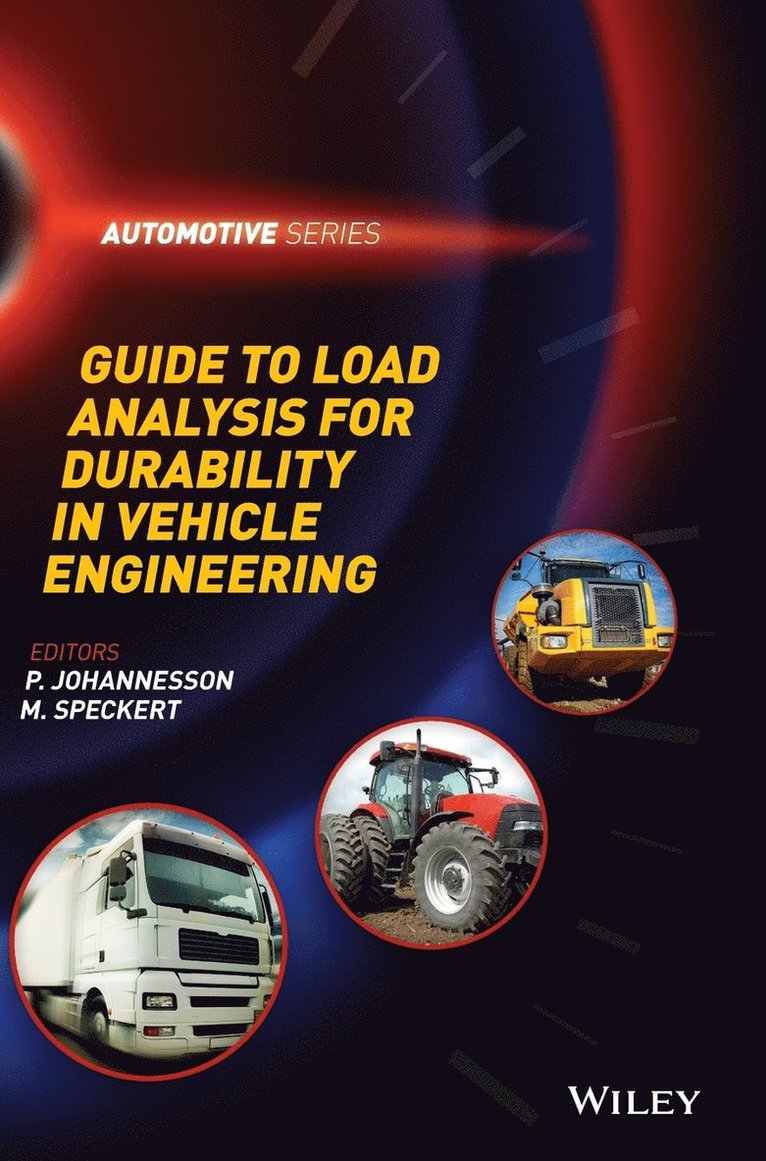
    Guide to Load Analysis for Durability in Vehicle Engineering

    AvP. Johannesson,M. Speckert

    Inbunden, Engelska, 2013

    Del 1 i serien Automotive Series

    1 409 kr

    Beställningsvara. Skickas inom 5-8 vardagar. Fri frakt över 249 kr.

    Beskrivning

    The overall goal of vehicle design is to make a robust and reliable product that meets the demands of the customers and this book treats the topic of analysing and describing customer loads with respect to durability.Guide to Load Analysis for Vehicle and Durability Engineering supplies a variety of methods for load analysis and also explains their proper use in view of the vehicle design process. In Part I, Overview, there are two chapters presenting the scope of the book as well as providing an introduction to the subject. Part II, Methods for Load Analysis, describes useful methods and indicates how and when they should be used. Part III, Load Analysis in view of the Vehicle Design Process, offers strategies for the evaluation of customer loads, in particular characterization of customer populations, which leads to the derivation of design loads, and finally to the verification of systems and components.Key features:• Is a comprehensive collection of methods for load analysis, vehicle dynamics and statistics• Combines standard load data analysis methods with statistical aspects on deriving test loads from surveys of customer usage• Sets the methods used in the framework of system dynamics and response, and derives recommendations for the application of methods in engineering practice• Presents a reliability design methodology based on statistical evaluation of component strength and customers loads• Includes case studies and illustrative examples that translate the theory into engineering practiceDeveloped in cooperation with six European truck manufacturers (DAF, Daimler, Iveco, MAN, Scania and Volvo) to meet the needs of industry, Guide to Load Analysis for Vehicle and Durability Engineering provides an understanding of the current methods in load analysis and will inspire the incorporation of new techniques in the design and test processes.

    Produktinformation

    • Utgivningsdatum:2013-11-01
    • Mått:180 x 254 x 26 mm
    • Vikt:844 g
    • Format:Inbunden
    • Språk:Engelska
    • Serie:Automotive Series
    • Antal sidor:456
    • Förlag:John Wiley & Sons Inc
    • ISBN:9781118648315

    Utforska kategorier

    • Motorfordon inom Naturvetenskap och teknik

    Mer om författaren

    Pär Johannesson received his PhD in Mathematical Statistics in 1999 at Lund Institute of Technology, Sweden, with a thesis on statistical load analysis for fatigue. During 2000 and 2001 he had a position as PostDoc at Mathematical Statistics, Chalmers within a joint project with PSA Peugeot Citroën, where he stayed one year at the Division of Automotive Research and Innovations in Paris. From 2002 to 2010 he was an applied researcher at the Fraunhofer-Chalmers Research Centre for Industrial Mathematics in Göteborg, and in 2010 he was a guest researcher at Chalmers. He is currently working as a research engineer at SP Technical Research Institute of Sweden, mainly within industrial and research projects on statistical methods for load analysis, reliability and fatigue.Michael Speckert received his PhD in Mathematics at the University of Kaiserslautern in 1990. From 1991 to 1993 he worked at TECMATH in the human modelling department on optimization algorithms. From 1993 to 2004 he worked at TECMATH and LMS in the departments for load data analysis and fatigue life estimation in the area of method as well as software development. Since 2004 he works at the department for Dynamics and Durability at Fraunhofer ITWM as an applied researcher. His main working areas are statistical and fatigue oriented load data analysis and multi body simulation techniques.

    Innehållsförteckning

    • About the Editors xiii Contributors xvSeries Editor’s Preface xviiPreface xixAcknowledgements xxiPart I OVERVIEW1 Introduction 31.1 Durability in Vehicle Engineering 41.2 Reliability, Variation and Robustness 61.3 Load Description for Trucks 71.4 Why Is Load Analysis Important? 91.5 The Structure of the Book 102 Loads for Durability 152.1 Fatigue and Load Analysis 152.1.1 Constant Amplitude Load 152.1.2 Block Load 162.1.3 Variable Amplitude Loading and Rainflow Cycles 162.1.4 Rainflow Matrix, Level Crossings and Load Spectrum 182.1.5 Other Kinds of Fatigue 202.2 Loads in View of Fatigue Design 232.2.1 Fatigue Life: Cumulative Damage 232.2.2 Fatigue Limit: Maximum Load 232.2.3 Sudden Failures: Maximum Load 242.2.4 Safety Critical Components 242.2.5 Design Concepts in Aerospace Applications 242.3 Loads in View of System Response 252.4 Loads in View of Variability 272.4.1 Different Types of Variability 272.4.2 Loads in Different Environments 282.5 Summary 29Part II METHODS FOR LOAD ANALYSIS3 Basics of Load Analysis 333.1 Amplitude-based Methods 353.1.1 From Outer Loads to Local Loads 363.1.2 Pre-processing of Load Signals 373.1.3 Rainflow Cycle Counting 403.1.4 Range-pair Counting 493.1.5 Markov Counting 513.1.6 Range Counting 533.1.7 Level Crossing Counting 553.1.8 Interval Crossing Counting 563.1.9 Irregularity Factor 563.1.10 Peak Value Counting 563.1.11 Examples Comparing Counting Methods 563.1.12 Pseudo Damage and Equivalent Loads 603.1.13 Methods for Rotating Components 673.1.14 Recommendations and Work-flow 703.2 Frequency-based Methods 723.2.1 The PSD Function and the Periodogram 733.2.2 Estimating the Spectrum Based on the Periodogram 743.2.3 Spectrogram or Waterfall Diagram 793.2.4 Frequency-based System Analysis 793.2.5 Extreme Response and Fatigue Damage Spectrum 853.2.6 Wavelet Analysis 863.2.7 Relation Between Amplitude and Frequency-based Methods 873.2.8 More Examples and Summary 873.3 Multi-input Loads 913.3.1 From Outer Loads to Local Loads 923.3.2 The RP Method 943.3.3 Plotting Pseudo Damage and Examples 953.3.4 Equivalent Multi-input Loads 993.3.5 Phase Plots and Correlation Matrices for Multi-input Loads 1013.3.6 Multi-input Time at Level Counting 1043.3.7 Biaxiality Plots 1043.3.8 The Wang-Brown Multi-axial Cycle Counting Method 1053.4 Summary 1054 Load Editing and Generation of Time Signals 1074.1 Introduction 1074.1.1 Essential Load Properties 1084.1.2 Criteria for Equivalence 1084.2 Data Inspections and Corrections 1104.2.1 Examples and Inspection of Data 1104.2.2 Detection and Correction 1124.3 Load Editing in the Time Domain 1154.3.1 Amplitude-based Editing of Time Signals 1154.3.2 Frequency-based Editing of Time Signals 1264.3.3 Amplitude-based Editing with Frequency Constraints 1364.3.4 Editing of Time Signals: Summary 1384.4 Load Editing in the Rainflow Domain 1394.4.1 Re-scaling 1394.4.2 Superposition 1414.4.3 Extrapolation on Length or Test Duration 1434.4.4 Extrapolation to Extreme Usage 1504.4.5 Load Editing for 1D Counting Results 1544.4.6 Summary, Hints and Recommendations 1544.5 Generation of Time Signals 1564.5.1 Amplitude- or Cycle-based Generation of Time Signals 1564.5.2 Frequency-based Generation of Time Signals 1634.6 Summary 1675 Response of Mechanical Systems 1695.1 General Description of Mechanical Systems 1695.1.1 Multibody Models 1705.1.2 Finite Element Models 1725.2 Multibody Simulation (MBS) for Durability Applications or: from System Loads to Component Loads 1735.2.1 An Illustrative Example 1735.2.2 Some General Modelling Aspects 1755.2.3 Flexible Bodies in Multibody Simulation 1785.2.4 Simulating the Suspension Model 1815.3 Finite Element Models (FEM) for Durability Applications or: from Component Loads to Local Stress-strain Histories 1865.3.1 Linear Static Load Cases and Quasi-static Superposition 1885.3.2 Linear Dynamic Problems and Modal Superposition 1895.3.3 From the Displacement Solution to Local Stresses and Strains 1925.3.4 Summary of Local Stress-strain History Calculation 1925.4 Invariant System Loads 1935.4.1 Digital Road and Tyre Models 1945.4.2 Back Calculation of Invariant Substitute Loads 1965.4.3 An Example 1995.5 Summary 2006 Models for Random Loads 2036.1 Introduction 2036.2 Basics on Random Processes 2066.2.1 Some Average Properties of Random Processes∗ 2076.3 Statistical Approach to Estimate Load Severity 2096.3.1 The Extrapolation Method 2106.3.2 Fitting Range-pairs Distribution 2106.3.3 Semi-parametric Approach 2136.4 The Monte Carlo Method 2156.5 Expected Damage for Gaussian Loads 2186.5.1 Stationary Gaussian Loads 2196.5.2 Non-stationary Gaussian Loads with Constant Mean∗ 2236.6 Non-Gaussian Loads: the Role of Upcrossing Intensity 2246.6.1 Bendat’s Narrow Band Approximation 2246.6.2 Generalization of Bendat’s Approach∗ 2256.6.3 Laplace Processes 2286.7 The Coefficient of Variation for Damage 2306.7.1 Splitting the Measured Signal into Parts 2306.7.2 Short Signals 2316.7.3 Gaussian Loads 2326.7.4 Compound Poisson Processes: Roads with Pot Holes 2336.8 Markov Loads 2356.8.1 Markov Chains∗ 2406.8.2 Discrete Markov Loads – Definition 2426.8.3 Markov Chains of Turning Points 2436.8.4 Switching Markov Chain Loads 2446.8.5 Approximation of Expected Damage for Gaussian Loads 2476.8.6 Intensity of Interval Upcrossings for Markov Loads∗ 2486.9 Summary 2497 Load Variation and Reliability 2537.1 Modelling of Variability in Loads 2537.1.1 The Sources of Load Variability: Statistical Populations 2547.1.2 Controlled or Uncontrolled Variation 2557.1.3 Model Errors 2557.2 Reliability Assessment 2567.2.1 The Statistical Model Complexity 2567.2.2 The Physical Model Complexity 2577.3 The Full Probabilistic Model 2587.3.1 Monte Carlo Simulations 2597.3.2 Accuracy of the Full Probabilistic Approach 2637.4 The First-Moment Method 2637.5 The Second-Moment Method 2647.5.1 The Gauss Approximation Formula 2647.6 The Fatigue Load-Strength Model 2657.6.1 The Fatigue Load and Strength Variables 2657.6.2 Reliability Indices 2667.6.3 The Equivalent Load and Strength Variables 2677.6.4 Determining Uncertainty Measures 2717.6.5 The Uncertainty due to the Estimated Damage Exponent 2737.6.6 The Uncertainty Measure of Strength 2757.6.7 The Uncertainty Measure of Load 2777.6.8 Use of the Reliability Index 2797.6.9 Including an Extra Safety Factor 2817.6.10 Reducing Uncertainties 2837.7 Summary 284Part III LOAD ANALYSIS IN VIEW OF THE VEHICLE DESIGN PROCESS8 Evaluation of Customer Loads 2878.1 Introduction 2878.2 Survey Sampling 2888.2.1 Why Use Random Samples? 2888.2.2 Simple Random Sample 2898.2.3 Stratified Random Sample 2908.2.4 Cluster Sample 2908.2.5 Sampling with Unequal Probabilities 2918.2.6 An Application 2928.2.7 Simple Random Sampling in More Detail 2938.2.8 Conclusion 2948.3 Load Measurement Uncertainty 2958.3.1 Precision in Load Severity 2958.3.2 Pair-wise Analysis of Load Severity 3018.3.3 Joint Analysis of Load Severity 3018.4 Random Sampling of Customers 3038.4.1 Customer Survey 3038.4.2 Characterization of a Market 3048.4.3 Simplified Model for a New Market 3068.4.4 Comparison of Markets 3088.5 Customer Usage and Load Environment 3088.5.1 Model for Customer Usage 3108.5.2 Load Environment Uncertainty 3128.6 Vehicle-Independent Load Descriptions 3148.7 Discussion and Summary 3189 Derivation of Design Loads 3219.1 Introduction 3219.1.1 Scalar Load Representations 3219.1.2 Other Load Representations 3229.1.3 Statistical Aspects 3229.1.4 Structure of the Chapter 3239.2 From Customer Usage Profiles to Design Targets 3249.2.1 Customer Load Distribution and Design Load 3249.2.2 Strength Distribution and Strength Requirement 3249.2.3 Defining the Reliability Target 3269.2.4 Partial Safety Factor for Load-Strength Modelling 3289.2.5 Safety Factors for Design Loads 3299.2.6 Summary and Remarks 3319.3 Synthetic Load Models 3339.4 Random Load Descriptions 3359.4.1 Models for External Load Environment 3359.4.2 Load Descriptions in Design 3369.4.3 Load Description for Testing 3369.5 Applying Reconstruction Methods 3369.5.1 Rainflow Reconstruction 3369.5.2 1D and Markov Reconstruction 3399.5.3 Spectral Reconstruction 3399.5.4 Multi-input Loads 3409.6 Standardized Load Spectra 3419.7 Proving Ground Loads 3429.8 Optimized Combination of Test Track Events 3429.8.1 Optimizing with Respect to Damage per Channel 3439.8.2 An Instructive Example 3469.8.3 Extensions∗ 3519.8.4 Hints and Practical Aspects 3539.9 Discussion and Summary 35410 Verification of Systems and Components 35710.1 Introduction 35710.1.1 Principles of Verification 35710.1.2 Test for Continuous Improvements vs. Tests for Release 35810.1.3 Specific Problems in Verification of Durability 35910.1.4 Characterizing or Verification Tests 36010.1.5 Verification on Different Levels 36110.1.6 Physical vs. Numerical Evaluation 36310.1.7 Summary 36310.2 Generating Loads for Testing 36310.2.1 Reliability Targets and Verification Loads 36410.2.2 Generation of Time Signals based on Load Specifications 36410.2.3 Acceleration of Tests 36510.3 Planning and Evaluation of Tests 36510.3.1 Choice of Strength Distribution and Variance 36610.3.2 Parameter Estimation and Censored Data 36810.3.3 Verification of Safety Factors 37110.3.4 Statistical Tests for Quantiles 37310.4 Discussion and Summary 379A Fatigue Models and Life Prediction 383A.1 Short, Long or Infinite Life 383A.1.1 Low Cycle Fatigue 383A.1.2 High Cycle Fatigue 383A.1.3 Fatigue Limit 384A.2 Cumulative Fatigue 384A.2.1 Arguments for the Palmgren-Miner Rule 384A.2.2 When is the Palmgren-Miner Rule Useful? 386B Statistics and Probability 387B.1 Further Reading 387B.2 Some Common Distributions 387B.2.1 Normal Distribution 387B.2.2 Log-Normal Distribution 388B.2.3 Weibull Distribution 388B.2.4 Rayleigh Distribution 388B.2.5 Exponential Distribution 388B.2.6 Generalized Pareto Distribution 388B.3 Extreme Value Distributions 389B.3.1 Peak over Threshold Analysis 389C Fourier Analysis 391C.1 Fourier Transformation 391C.2 Fourier Series 392C.3 Sampling and the Nyquist-Shannon Theorem 393C.4 DFT/FFT (Discrete Fourier Transformation) 394D Finite Element Analysis 395D.1 Kinematics of Flexible Bodies 395D.2 Equations of Equilibrium 396D.3 Linear Elastic Material Behaviour 397D.4 Some Basics on Discretization Methods 397D.5 Dynamic Equations 399E Multibody System Simulation 401E.1 Linear Models 401E.2 Mathematical Description of Multibody Systems 402E.2.1 The Equations of Motion 403E.2.2 Computational Issues 404F Software for Load Analysis 407F.1 Some Dedicated Software Packages 407F.2 Some Software Packages for Fatigue Analysis 408F.3 WAFO – a Toolbox for Matlab 408Bibliography 411Index 423
    Hoppa över listan

    Du kanske också är intresserad av

    Nicolas Lunabba - Blir du ledsen om jag dör?, Pocket

    Blir du ledsen om jag dör?

    Nicolas Lunabba

    Pocket, 2023

    4,5 utav 5 stjärnor. Totalt antal röster:(31)

    89 kr

    Martin Meywerk - Vehicle Dynamics, Inbunden

    Vehicle Dynamics

    Martin Meywerk

    Inbunden, 2015

    1 262 kr

    Bruce P. Minaker - Fundamentals of Vehicle Dynamics and Modelling, Inbunden

    Fundamentals of Vehicle Dynamics and Modelling

    Bruce P. Minaker

    Inbunden, 2019

    1 167 kr

    M. Speckert, P. Johannesson - Guide to Load Analysis for Durability in Vehicle Engineering, E-bok

    Guide to Load Analysis for Durability in Vehicle Engineering

    M. Speckert, P. Johannesson

    E-bok
    2013

    1 641 kr

    Wei Liu - Hybrid Electric Vehicle System Modeling and Control, Inbunden

    Hybrid Electric Vehicle System Modeling and Control

    Wei Liu

    Inbunden, 2017

    1 436 kr

    M. Speckert, P. Johannesson - Guide to Load Analysis for Durability in Vehicle Engineering, E-bok

    Guide to Load Analysis for Durability in Vehicle Engineering

    M. Speckert, P. Johannesson

    E-bok
    2013

    1 641 kr

    Vincent Lemort, Gerard Olivier, Georges de Pelsemaeker - Thermal Energy Management in Vehicles, Inbunden

    Thermal Energy Management in Vehicles

    Vincent Lemort, Gerard Olivier, Georges de Pelsemaeker

    Inbunden, 2023

    1 057 kr

    Bruce Maclaurin - High Speed Off-Road Vehicles, Inbunden

    High Speed Off-Road Vehicles

    Bruce Maclaurin

    Inbunden, 2018

    1 560 kr

    Rui Xiong, Weixiang Shen - Advanced Battery Management Technologies for Electric Vehicles, Inbunden

    Advanced Battery Management Technologies for Electric Vehicles

    Rui Xiong, Weixiang Shen

    Inbunden, 2019

    1 531 kr

    Ahmed Elmarakbi, Ahmed Elmarakbi - Advanced Composite Materials for Automotive Applications, Inbunden

    Advanced Composite Materials for Automotive Applications

    Ahmed Elmarakbi, Ahmed Elmarakbi

    Inbunden, 2013

    1 454 kr