• Fri frakt över 249 kr
  • •
  • Snabba leveranser
  • •
  • Billiga böcker
Kundservice

Du är på sajten för privatpersoner.

Företag, bibliotek eller offentlig verksamhet?

Du handlar på classic.bokus.com, där alla dina funktioner finns intakta.
Till classic.bokus.com
Bokus logotyp. Gå till startsidan.
  • Erbjudanden
  • Nyheter
  • Student
  • Topplistor
  • Barn & ungdom
  • Bokus Play
  • E-böcker
  • Pocketböcker
  • Spel & pussel

10% rabatt på allt med kod: NYSTART10 →

Sidfot

Mina sidor

    Hjälp

    • Kundservice
    • Vanliga frågor och svar
    • Frakt och leverans
    • Retur vid ångerrätt
    • Reklamera vara
    • Betalning
    • Köpvillkor
    • Allmänna villkor
    • Information om webbplatsens tillgänglighet

    Om Bokus

    • Om oss
    • Pressrum
    • För studenter
    • För företag
    • För bibliotek och offentlig verksamhet
    • För leverantörer
    • Hållbarhet

    Populärt

    • Aktuella erbjudanden
    • Presentkort
    • Studentlitteratur
    • Nya böcker
    • Topplistor
    • Signerade böcker
    • Engelska böcker

    Inspiration

    • Boktips
    • BookTok
    • Populära bokserier
    • Barnbokskaraktärer
    • Populära författare
    Logotyp för Bokus
    Följ oss på Facebook (extern länk)Följ oss på Instagram (extern länk)Följ oss på YouTube (extern länk)Följ oss på TikTok (extern länk)
    bokus @ CookiesAnpassa cookiesIntegritetspolicyKöpvillkor
    Till Citymail hemsida (extern länk)Till Budbee hemsida (extern länk)Till Postnord hemsida (extern länk)Till Schenker hemsida (extern länk)Till Early Bird hemsida (extern länk)Till Walleys hemsida (extern länk)
    1. Samhälle och politik
    2. Samhälle och kultur
    3. Sociala och etiska frågor

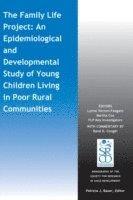
    Family Life Project

    An Epidemiological and Developmental Study of Young Children Living in Poor Rural Communities

    AvLynne Vernon-Feagans,Martha Cox

    Häftad, Engelska, 2013

    Del i serien Monographs of the Society for Research in Child Development (MONO)

    494 kr

    Beställningsvara. Skickas inom 3-6 vardagar. Fri frakt över 249 kr.

    Beskrivning

    About 20% of children in the United States live in rural communities, with child poverty rates higher and geographic isolation from resources greater than in urban communities. Yet, there have been surprisingly few studies of children living in rural communities, especially poor rural communities. The Family Life Project helped fill this gap by using an epidemiological design to recruit and study a representative sample of every baby born to a mother who resided in one of six poor rural counties over a one year period, oversampling for poverty and African American. 1,292 children were followed from birth to 36 months of age. This study used a cumulative risk framework to examine the relation between social risk and children's executive functioning, language development, and behavioral competence at 36 months. Using both the Family Process Model of development and the Family Investment Model of development, observed parenting was examined as a mediator and/or moderator of this relationship. Results suggested that cumulative risk predicted all three major domains of child outcomes and that positive and negative parenting and maternal language complexity were mediators of these relations. Maternal positive parenting was found to be a buffer for the most risky families in predicting behavioral competence. In a final model using both family process and investment measures, there was evidence of mediation but with little evidence of the specificity of parenting for particular outcomes. Discussion focused the implications for possible intervention strategies that might be effective in maximizing the early development of these children.

    Produktinformation

    • Utgivningsdatum:2013-12-27
    • Mått:150 x 224 x 8 mm
    • Vikt:227 g
    • Format:Häftad
    • Språk:Engelska
    • Serie:Monographs of the Society for Research in Child Development (MONO)
    • Antal sidor:316
    • Förlag:John Wiley and Sons Ltd
    • ISBN:9781118863633

    Utforska kategorier

    • Sociala och etiska frågor inom Samhälle och politik
    • Sociologi inom Samhälle och politik
    • Sociala grupper och identitet inom Samhälle och politik

    Mer om författaren

    Lynne Vernon-Feagans (Ph.D., University of Michigan) is the William C. Friday Distinguished Professor of Applied Developmental Science and Special Education in the School of Education at the University of North Carolina at Chapel Hill. She has focused her research on children at risk, including children living in rural poverty and children at risk for poor language and literacy development.Martha Cox (Ph.D., University of Virginia) is a Professor of Psychology and past Director of the Center for Developmental Science at the University of North Carolina at Chapel Hill. She is best known for her longitudinal studies of family processes and relationships and children’s social and emotional development. She has contributed to the development of observational techniques in the study of families.Rand D. Conger (Ph.D., University of Washington) is a Distinguished Professor of Psychology, Human Development, and Family Studies at the University of California–Davis. His program of research focuses on social, cultural, and individual characteristics that either promote successful development or lead to significant developmental problems.

    Innehållsförteckning

    • ABSTRACT vii I. POVERTY, RURALITY, PARENTING, AND RISK: AN INTRODUCTIONLynne Vernon-Feagans and Martha Cox 1II. RECRUITMENT OF THE FAMILY LIFE PROJECT SAMPLEMichael Willoughby, Margaret Burchinal, Patricia Garrett-Peters, Roger Mills-Koonce, Lynne Vernon-Feagans, and Martha Cox 24III. THE DESCRIPTION OF THE FAMILIES AND CHILDRENPatricia Garrett-Peters and Roger Mills-Koonce 36IV. POVERTY AND ASSOCIATED SOCIAL RISKS: TOWARD A CUMULATIVE RISK FRAMEWORKMargaret Burchinal and Michael Willoughby 53V. CUMULATIVE RISK AND ITS RELATION TO PARENTING AND CHILD OUTCOMES AT 36 MONTHSFLP Key Investigators 66VI. DISCUSSION AND IMPLICATIONS FOR CHILDREN LIVING IN RURAL POVERTYFLP Key Investigators 92REFERENCES 109ACKNOWLEDGMENTS 126COMMENTARYRURAL CHILDREN AT RISK 127Rand D. CongerCONTRIBUTORS 139STATEMENT OF EDITORIAL POLICY 142SUBJECT INDEX 144