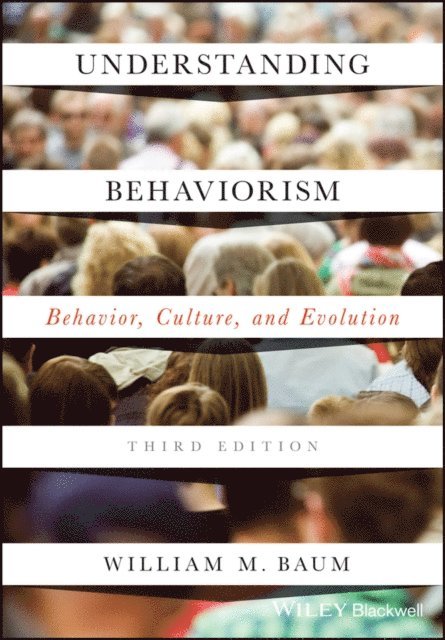
Understanding Behaviorism
Behavior, Culture, and Evolution
Häftad, Engelska, 2017
589 kr
Beställningsvara. Skickas inom 5-8 vardagar. Fri frakt över 249 kr.
Fler format och utgåvor
Beskrivning
Understanding Behaviorism is a classic textbook that explains the basis of behavior analysis and its application to human problems in a scholarly but accessible manner. Now in its third edition, the text has been substantially updated to include the latest developments over the last decade in behaviour analysis, evolutionary theory, and cultural evolution theoryThe only book available that explains behavior analysis and applies it to philosophical and practical problems, written by one of today’s best-known and most highly respected behavioristsExplores ancient concepts such as purpose, language, knowledge, and thought, as well as applying behavioural thinking to contemporary social issues like freedom, democracy, and culturePart of the new evolutionary perspective for understanding individual behavior in general and culture in particular – culminates with practical approaches to improving the lives of all humanity
Produktinformation
- Utgivningsdatum:2017-02-28
- Mått:168 x 241 x 23 mm
- Vikt:431 g
- Format:Häftad
- Språk:Engelska
- Antal sidor:320
- Upplaga:3
- Förlag:John Wiley and Sons Ltd
- ISBN:9781119143642
Utforska kategorier
Mer om författaren
William M. Baum is Professor Emeritus at the University of New Hampshire and a Research Associate at University of California, Davis. He taught for seven years at Harvard University and for more than twenty years at the University of New Hampshire. He has published over one hundred journal articles. These have presented quantitative laboratory research, theoretical contributions, and philosophical contributions. His research interests include choice, cultural evolution, behavioural processes, and philosophy of behaviour.
Recensioner i media
Select Guide Rating
Innehållsförteckning
- Preface to the Third Edition xvAcknowledgements xviiPart I What is Behaviorism? 11 Behaviorism: Definition and History 3Historical Background 3From Philosophy to Science 3Objective Psychology 6Comparative Psychology 7Early Behaviorism 8Free Will Versus Determinism 10Definitions 10Arguments For and Against Free Will 11Social Arguments 12Aesthetic Arguments 13Folk Psychology 15Summary 15Further Reading 17Keyterms 172 Behaviorism as Philosophy of Science 19Realism versus Pragmatism 19Realism 19The Objective Universe 20Discovery and Truth 20Sense Data and Subjectivity 20Explanation 22Pragmatism 22Science and Experience 24Conceptual Economy 25Explanation and Description 27Radical Behaviorism and Pragmatism 28Summary 31Further Reading 32Keyterms 323 Public, Private, Natural, and Fictional 33Mentalism 33Public and Private Events 33Natural Events 34Natural, Mental, and Fictional 35Objections to Mentalism 37Autonomy: Mental Causes Obstruct Inquiry 37Superfluity: Explanatory Fictions are Uneconomical 38Category Mistakes 40Ryle and the Para‐Mechanical Hypothesis 41Rachlin’s Molar Behaviorism 42Private Events 46Private Behavior 46Self‐Knowledge and Consciousness 49Summary 52Further Reading 54Keyterms 55Part II A Scientific Model of Behavior 574 Evolutionary Theory and Reinforcement 59Evolutionary History 59Natural Selection 60Reflexes and Fixed Action Patterns 62Reflexes 62Fixed Action Patterns 62Respondent Conditioning 64Reinforcers and Punishers 66Operant Behavior 66Physiological Factors 68Overview of Phylogenetic Influences 70History of Reinforcement 70Selection by Consequences 71The Law of Effect 71Shaping and Natural Selection 71Historical Explanations 75Summary 77Further Reading 78Keyterms 785 Purpose and Reinforcement 81History and Function 81Using Historical Explanations 82History Versus Immediate Cause 82Gaps of Time 82Functional Units 83Species as Functional Units 84Activities as Functional Units 84Three Meanings of Purpose 86Purpose as Function 86Purpose as Cause 87Purposive Behavior 88Purposive Machines 89Selection by Consequences 90Creativity 90Purpose as Feeling: Self‐Reports 92Talking About the Future 92Talking About the Past 92Feelings as By‐Products 93Summary 94Further Reading 95Keyterms 966 Stimulus Control and Knowledge 97Stimulus Control 97Discriminative Stimuli 98Extended Sequences and Discriminative Stimuli 100Discrimination 101Knowledge 102Procedural Knowledge: Knowing How 103Declarative Knowledge: Knowing About 105Declarative Knowledge and Stimulus Control 105What is a Lie? 106Self‐Knowledge 107Public Versus Private Stimuli 107Introspection 110The Behavior of Scientists 111Observation and Discrimination 111Scientific Knowledge 112Pragmatism and Contextualism 112Summary 113Further Reading 114Keyterms 1157 Verbal Behavior and Language 117What is Verbal Behavior? 117Communication 117Verbal Behavior as Operant Behavior 118Speaking Has Consequences 118The Verbal Community 118Speaker and Listener 119The Verbal Episode 119The Reinforcement of Verbal Behavior 120The Listener’s Role 121Examples 122The Importance of History 122Sign Language and Gestures 123Nonhuman Animals 123Talking to Myself 124Verbal Behavior versus Language 125Functional Units and Stimulus Control 126Verbal Activities as Functional Units 126Stimulus Control of Verbal Behavior 128Common Misunderstandings 129The Generative Nature of Language 129Talking About Talking 129Talking About the Future 130Meaning 131Reference Theories 131Symbols and Lexicons 131The Importance of Context 132Meaning as Use 133Consequences and Context 133Varieties of Use 134Dictionary Definitions 135Technical Terms 135Grammar and Syntax 135Rules as Descriptions 136Competence and Performance 136Grammar and Grammarians 137Where are the Rules? 137Summary 138Further Reading 139Keyterms 1408 Rule‐Governed Behavior and Thinking 141What is Rule‐Governed Behavior? 141Rule‐Governed versus Implicitly Shaped Behavior 141Rules: Orders, Instructions, and Advice 143Always Two Relations 147The Proximate Reinforcement Relation 147The Ultimate Reinforcement Relation 149Learning to Follow Rules 151Shaping Rule‐Following 151Where are the Rules? 152Thinking and Problem‐Solving 152Changing Stimuli 153Precurrent Behavior 155Summary 157Further Reading 158Keyterms 158Part III Social Issues 1599 Freedom 161Uses of the Word Free 161Being Free: Free Will 161Feeling Free: Political and Social Freedom 162Coercion and Aversive Control 163Freedom and Happiness 165Objections to the Behavioral View 165Reinforcement Traps, Bad Habits, and Self‐Control 167Spiritual Freedom 171The Challenge of Traditional Thinking 173Summary 174Further Reading 175Keyterms 17510 Responsibility, Credit, and Blame 177Responsibility and the Causes of Behavior 177Free Will and the Visibility of Control 177Assigning Credit and Blame 178Compassion and Control 179Responsibility and the Consequences of Behavior 181What is Responsibility? 182Practical Considerations: The Need for Control 183Applying Consequences 184What Kind of Control? 184Summary 185Further Reading 186Keyterms 18611 Relationships, Management, and Government 187Relationships 187Mutual Reinforcement 188Individuals and Organizations 189Exploitation 191The “Happy Slave” 192Long‐Term Consequences 192Comparative Well‐Being 193Equity Theory 194Which Comparisons? 196Cooperation 197Control and Counter‐Control 197Counter‐Control 197Equity 200Power 201Democracy 203Summary 204Further Reading 205Keyterms 20612 Values: Religion and Science 207Questions about Value 207Moral Relativism 209Ethical Standards 209The Law of Human Nature 210The Question of Origins 212A Scientific Approach to Values 213Reinforcers and Punishers 214Feelings 215Evolutionary Theory and Values 217Altruism and Cooperation 219Morals 223The Good Life 224Summary 224Further Reading 226Keyterms 22613 The Evolution of Culture 227Biological Evolution and Culture 228Replicators and Fitness 228Societies 229Group Selection 231Definition of Culture 232Culture and Society 232Culture and Fitness 233Traits for Culture 233Behavioral Specializations 234Imitation 236Social Reinforcers and Punishers 237Variation, Transmission, and Selection 238Variation 238Cultural Replicators 239Meme, Culturgen, Practice 239Social Reinforcement and Punishment 241Mutation, Recombination, and Immigration 242Transmission 243Inheritance of Acquired Characteristics 243Transmission by Imitation 244Transmission by Rule‐Governed Behavior 245Selection 246Natural Selection in Culture 246Selective Transmission 246Rule‐Following and Rule‐Making 248The Legend of Eslok 249Cultural Group Selection 249Self‐Interest 250Summary 252Further Reading 254Keyterms 25514 Design of Culture: Experimenting for Survival 257Design from Evolution 257Selective Breeding 258Evaluation 258Survival as a Standard 259Guided Variation 261The Experimental Society 262Experimenting 262Democracy 263Happiness 264Walden Two: Skinner’s Vision 265Interpreting Walden Two 265Is Walden Two Utopian? 266Objections 267Summary 272Further Reading 273Keyterms 274Glossary 275Index 295