• Fri frakt över 249 kr
  • •
  • Snabba leveranser
  • •
  • Billiga böcker
Kundservice

Du är på sajten för privatpersoner.

Företag, bibliotek eller offentlig verksamhet?

Du handlar på classic.bokus.com, där alla dina funktioner finns intakta.
Till classic.bokus.com
Bokus logotyp. Gå till startsidan.
  • Erbjudanden
  • Nyheter
  • Student
  • Topplistor
  • Barn & ungdom
  • Bokus Play
  • E-böcker
  • Pocketböcker
  • Spel & pussel

10% rabatt på allt med kod: NYSTART10 →

Sidfot

Mina sidor

    Hjälp

    • Kundservice
    • Vanliga frågor och svar
    • Frakt och leverans
    • Retur vid ångerrätt
    • Reklamera vara
    • Betalning
    • Köpvillkor
    • Allmänna villkor
    • Information om webbplatsens tillgänglighet

    Om Bokus

    • Om oss
    • Pressrum
    • För studenter
    • För företag
    • För bibliotek och offentlig verksamhet
    • För leverantörer
    • Hållbarhet

    Populärt

    • Aktuella erbjudanden
    • Presentkort
    • Studentlitteratur
    • Nya böcker
    • Topplistor
    • Signerade böcker
    • Engelska böcker

    Inspiration

    • Boktips
    • BookTok
    • Populära bokserier
    • Barnbokskaraktärer
    • Populära författare
    Logotyp för Bokus
    Följ oss på Facebook (extern länk)Följ oss på Instagram (extern länk)Följ oss på YouTube (extern länk)Följ oss på TikTok (extern länk)
    bokus @ CookiesAnpassa cookiesIntegritetspolicyKöpvillkor
    Till Citymail hemsida (extern länk)Till Budbee hemsida (extern länk)Till Postnord hemsida (extern länk)Till Schenker hemsida (extern länk)Till Early Bird hemsida (extern länk)Till Walleys hemsida (extern länk)
    1. Psykologi och pedagogik
    2. Pedagogik
    3. Specialundervisning

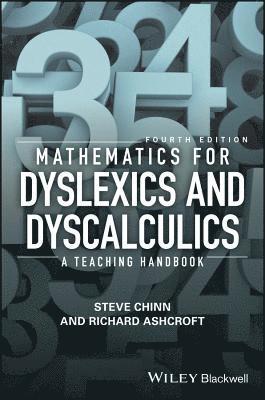
    Mathematics for Dyslexics and Dyscalculics

    A Teaching Handbook

    AvSteve Chinn,Richard Edmund Ashcroft

    Häftad, Engelska, 2017

    503 kr

    Skickas . Fri frakt över 249 kr.

    Beskrivning

    A seminal handbook in the field for more than 20 years, this new and updated edition of Mathematics for Dyslexicsand Dyscalculics contains the latest research and best practices for helping learners with numerical and mathematical difficulties. Provides a complete overview of theory and research in the fields of dyslexia and dyscalculia, along with detailed yet pragmatic methods to apply in the classroomContains enhanced coverage of place value and the role of the decimal point, why fractions can challenge a developed logic for arithmetic, and the complexity of time along with new material on addressing anxiety, fear, motivation, and resilience in the classroom; and links to new resources including standardized tests and recommended reading listsWritten by two mathematics teachers with 50 years of teaching experience between them, much of it in specialist settings for students with specific learning difficultiesOffers effective teaching strategies for learners of all ages in a structured but accessible format

    Produktinformation

    • Utgivningsdatum:2017-01-13
    • Mått:150 x 226 x 18 mm
    • Vikt:454 g
    • Format:Häftad
    • Språk:Engelska
    • Antal sidor:360
    • Upplaga:4
    • Förlag:John Wiley and Sons Ltd
    • ISBN:9781119159964

    Utforska kategorier

    • Specialundervisning inom Psykologi och pedagogik
    • Undervisning i specifika ämnen inom Psykologi och pedagogik

    Mer om författaren

    STEVE CHINN is an independent lecturer, writer and researcher, and Visiting Professor at the University of Derby, UK. He spent 24 years as headteacher of three specialist schools and was a mainstream teacher for 14 years. He was Founder and Principal of Mark College in Somerset, UK, a specialist residential school for young people with specific learning difficulties. In 2011 he set up and chaired the BDA's first subcommittee on dyscalculia. He has received the Marion Welchman International Award for Services to Dyslexia, and the Lady Radnor Award for Lifetime Services to Dyslexia. He has lectured and taught in over 30 countries worldwide and is the author of numerous books. RICHARD ASHCROFT was headmaster at Mark College, UK, a specialist residential school for young people with specific learning difficulties. He taught mathematics at the secondary school level for almost 25 years. During his teaching career, he developed a series of teaching resources specifically for dyslexic students. He retired in 2006.

    Innehållsförteckning

    • Foreword xi1 Dyscalculia, Dyslexia and Mathematics 1Introduction 1Definitions of Dyslexia 3The Evolution of Definitions of (Developmental) Dyscalculia 5The Nature of Mathematics and the Ways it is Taught 192 Factors that may Contribute to Learning Difficulties in Mathematics 23Potential Areas of Difficulty in Learning Mathematics 24General Principles of Intervention 44Summary 463 Cognitive (Thinking) Style in Mathematics 48Introduction 48Qualitative and Quantitative Style 49Cognitive (Thinking) Style in the Classroom 51Examples 54Summary 614 Testing and Diagnosis 62A Diagnostic Test Protocol 64Structure of the Diagnostic Protocol 65Attitude and Anxiety 73Thinking Style or Cognitive Style 74Tests for Dyscalculia 74Summary of the Test Protocol 745 Concept of Number 76Introduction 76Early Recognition of Numbers and Their Values 78The Language of Mathematics (see also Chapter 2) 79Early Number Work 79Visual Sense of Number 82Visual Clues to Number Concept 83Number Bonds/Combinations 84Place Value 86Number Bonds/Combinations for Ten 93Numbers Near Ten, Hundred or Thousand 94Summary 956 Addition and Subtraction: Basic Facts/Number Combinations 96Introduction 96Strategies for Learning/Remembering the Addition and Subtraction Facts 99Overview 107Subtraction Facts 108Extension 1097 The Times Tables Facts/Number Combinations 110Introduction 110Rote Learning Strategies 110Learning by Understanding 113The Commutative Property 115Learning the Table Square 117Summary 1358 Computational Procedures for Addition and Subtraction 136Estimation 138Addition 138Teaching Subtraction as a Separate Exercise 1479 Multiplication 152Introduction 152Multiplying by Ten and Powers of Ten 153Multiplication 157Estimation 163Extension 16310 Division: Whole Numbers 165Introduction 165Introduction to Division 166Estimating 172Division by Powers of Ten 173Division by Multiples of Powers of Ten 174Conclusion 17411 Fractions, Decimals and Percentages: An Introduction 175Introduction 175Fractions 176Decimals 187Percentages 195Overview 20312 Operating with Fractions 204Introduction 204Making Segment Sizes the Same 205Comparing Fractions 207Combining Fractions 210Adding Fractions 212Subtracting Fractions 216Combined Additions and Subtractions 219Multiplying by Fractions 221Multiplying Mixed Fractions 224Dividing with Fractions 22713 Decimals 232Introduction 232Addition and Subtraction 232Multiplication and Division by Powers of Ten 235Division of Decimals 242Summary 24914 Percentages 250Introduction 250An Image of Percentage 250Summary 25615 Time 257What are the Potential Problems with Time? 258Reading the Time 260Time Problems 264Summary 26816 Teaching the Full Curriculum 269Introduction 269Some General Principles 270Teaching the Other Parts of the Curriculum 277Combining the Parts of the Curriculum 282Summary 28617 Attacking and Checking Questions 287Practice Examples 287Preliminary Checks 288Attacking Questions 290Methods of Attacking Questions 291Checking 29818 Important Elements of a Teaching Programme 303Introduction 303Consider the Pupils’ Needs 303The Structure of the Course 304Classroom Management: Making the Lessons Suit the Pupils 308Evolving Expectations and Emphases 309Internal Assessment 313Summary 315AppendicesAppendix 1: Books, Journals, Tests and Games 316Appendix 2: Teaching Materials 321References 324Index 337