• Fri frakt över 249 kr
  • •
  • Snabba leveranser
  • •
  • Billiga böcker
Kundservice

Du är på sajten för privatpersoner.

Företag, bibliotek eller offentlig verksamhet?

Du handlar på classic.bokus.com, där alla dina funktioner finns intakta.
Till classic.bokus.com
Bokus logotyp. Gå till startsidan.
  • Erbjudanden
  • Nyheter
  • Student
  • Topplistor
  • Barn & ungdom
  • Bokus Play
  • E-böcker
  • Pocketböcker
  • Spel & pussel

10% rabatt på allt med kod: NYSTART10 →

Sidfot

Mina sidor

    Hjälp

    • Kundservice
    • Vanliga frågor och svar
    • Frakt och leverans
    • Retur vid ångerrätt
    • Reklamera vara
    • Betalning
    • Köpvillkor
    • Allmänna villkor
    • Information om webbplatsens tillgänglighet

    Om Bokus

    • Om oss
    • Pressrum
    • För studenter
    • För företag
    • För bibliotek och offentlig verksamhet
    • För leverantörer
    • Hållbarhet

    Populärt

    • Aktuella erbjudanden
    • Presentkort
    • Studentlitteratur
    • Nya böcker
    • Topplistor
    • Signerade böcker
    • Engelska böcker

    Inspiration

    • Boktips
    • BookTok
    • Populära bokserier
    • Barnbokskaraktärer
    • Populära författare
    Logotyp för Bokus
    Följ oss på Facebook (extern länk)Följ oss på Instagram (extern länk)Följ oss på YouTube (extern länk)Följ oss på TikTok (extern länk)
    bokus @ CookiesAnpassa cookiesIntegritetspolicyKöpvillkor
    Till Citymail hemsida (extern länk)Till Budbee hemsida (extern länk)Till Postnord hemsida (extern länk)Till Schenker hemsida (extern länk)Till Early Bird hemsida (extern länk)Till Walleys hemsida (extern länk)
    1. Naturvetenskap och teknik
    2. Matematik och naturvetenskap
    3. Matematik
    4. Matematisk statistik

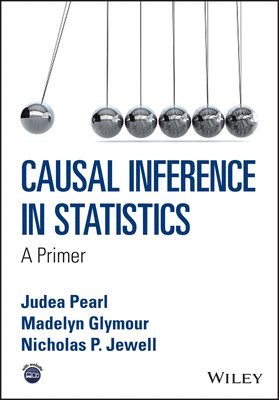
    Causal Inference in Statistics

    A Primer

    AvJudea Pearl,Madelyn Glymour

    Häftad, Engelska, 2016

    499 kr

    Beställningsvara. Skickas inom 5-8 vardagar. Fri frakt över 249 kr.

    Beskrivning

    CAUSAL INFERENCE IN STATISTICSA PrimerCausality is central to the understanding and use of data. Without an understanding of cause–effect relationships, we cannot use data to answer questions as basic as "Does this treatment harm or help patients?" But though hundreds of introductory texts are available on statistical methods of data analysis, until now, no beginner-level book has been written about the exploding arsenal of methods that can tease causal information from data.Causal Inference in Statistics fills that gap. Using simple examples and plain language, the book lays out how to define causal parameters; the assumptions necessary to estimate causal parameters in a variety of situations; how to express those assumptions mathematically; whether those assumptions have testable implications; how to predict the effects of interventions; and how to reason counterfactually. These are the foundational tools that any student of statistics needs to acquire in order to use statistical methods to answer causal questions of interest.This book is accessible to anyone with an interest in interpreting data, from undergraduates, professors, researchers, or to the interested layperson. Examples are drawn from a wide variety of fields, including medicine, public policy, and law; a brief introduction to probability and statistics is provided for the uninitiated; and each chapter comes with study questions to reinforce the readers understanding.

    Produktinformation

    • Utgivningsdatum:2016-03-04
    • Mått:168 x 239 x 18 mm
    • Vikt:227 g
    • Format:Häftad
    • Språk:Engelska
    • Antal sidor:160
    • Förlag:John Wiley & Sons Inc
    • ISBN:9781119186847

    Utforska kategorier

    • Matematisk statistik inom Naturvetenskap och teknik

    Mer om författaren

    Judea Pearl, Computer Science and Statistics, University of California, Los Angeles, USA.Madelyn Glymour, Philosophy, Carnegie Mellon University, Pittsburgh, USA.Nicholas P. Jewell, Biostatistics and Statistics, University of California, Berkeley, USA.

    Recensioner i media

    "Despite the fact that quite a few high-quality books on the topic of causal inference have recently been published, this book clearly fills an important gap: that of providing a simple and clear primer...Use of counterfactuals [in the final chapter] is elegantly linked to the structural causal models outlined in the previous chapters...[while]intriguing examples are used to introduce and illustrate the main concepts and methods...Several thought provoking study questions, in the form of exercises, are given throughout the presentation, and they can be very helpful for a better understanding of the material and looking further into the subtleties of the concepts introduced. In summary, there is no doubt that a discussion of the basic ideas in causal inference should be included in all introductory courses of statistics. This book could serve as a very useful companion to the lectures." (Mathematical Reviews/MathSciNet April 2017)

    Innehållsförteckning

    • About the Authors ixPreface xiList of Figures xvAbout the Companion Website xix1 Preliminaries: Statistical and Causal Models 11.1 Why Study Causation 11.2 Simpson’s Paradox 11.3 Probability and Statistics 71.3.1 Variables 71.3.2 Events 81.3.3 Conditional Probability 81.3.4 Independence 101.3.5 Probability Distributions 111.3.6 The Law of Total Probability 111.3.7 Using Bayes’ Rule 131.3.8 Expected Values 161.3.9 Variance and Covariance 171.3.10 Regression 201.3.11 Multiple Regression 221.4 Graphs 241.5 Structural Causal Models 261.5.1 Modeling Causal Assumptions 261.5.2 Product Decomposition 292 Graphical Models and Their Applications 352.1 Connecting Models to Data 352.2 Chains and Forks 352.3 Colliders 402.4 d-separation 452.5 Model Testing and Causal Search 483 The Effects of Interventions 533.1 Interventions 533.2 The Adjustment Formula 553.2.1 To Adjust or not to Adjust? 583.2.2 Multiple Interventions and the Truncated Product Rule 603.3 The Backdoor Criterion 613.4 The Front-Door Criterion 663.5 Conditional Interventions and Covariate-Specific Effects 703.6 Inverse Probability Weighing 723.7 Mediation 753.8 Causal Inference in Linear Systems 783.8.1 Structural versus Regression Coefficients 803.8.2 The Causal Interpretation of Structural Coefficients 813.8.3 Identifying Structural Coefficients and Causal Effect 833.8.4 Mediation in Linear Systems 874 Counterfactuals and Their Applications 894.1 Counterfactuals 894.2 Defining and Computing Counterfactuals 914.2.1 The Structural Interpretation of Counterfactuals 914.2.2 The Fundamental Law of Counterfactuals 934.2.3 From Population Data to Individual Behavior – An Illustration 944.2.4 The Three Steps in Computing Counterfactuals 964.3 Nondeterministic Counterfactuals 984.3.1 Probabilities of Counterfactuals 984.3.2 The Graphical Representation of Counterfactuals 1014.3.3 Counterfactuals in Experimental Settings 1034.3.4 Counterfactuals in Linear Models 1064.4 Practical Uses of Counterfactuals 1074.4.1 Recruitment to a Program 1074.4.2 Additive Interventions 1094.4.3 Personal Decision Making 1114.4.4 Sex Discrimination in Hiring 1134.4.5 Mediation and Path-disabling Interventions 1144.5 Mathematical Tool Kits for Attribution and Mediation 1164.5.1 A Tool Kit for Attribution and Probabilities of Causation 1164.5.2 A Tool Kit for Mediation 120References 127Index 133