• Fri frakt över 249 kr
  • •
  • Snabba leveranser
  • •
  • Billiga böcker
Kundservice

Du är på sajten för privatpersoner.

Företag, bibliotek eller offentlig verksamhet?

Du handlar på classic.bokus.com, där alla dina funktioner finns intakta.
Till classic.bokus.com
Bokus logotyp. Gå till startsidan.
  • Erbjudanden
  • Student
  • Topplistor
  • Barn & ungdom
  • Bokus Play
  • E-böcker
  • Ljudböcker
  • Pocketböcker
  • Spel och pussel

5% studentrabatt – använd koden KURSBOK27 →

Sidfot

Mina sidor

    Hjälp

    • Kundservice
    • Vanliga frågor och svar
    • Frakt och leverans
    • Retur vid ångerrätt
    • Reklamera vara
    • Betalning
    • Köpvillkor
    • Allmänna villkor
    • Information om webbplatsens tillgänglighet

    Om Bokus

    • Om oss
    • Pressrum
    • För studenter
    • För företag
    • För bibliotek och offentlig verksamhet
    • För leverantörer
    • Hållbarhet

    Populärt

    • Aktuella erbjudanden
    • Presentkort
    • Studentlitteratur
    • Nya böcker
    • Topplistor
    • Signerade böcker
    • Engelska böcker

    Inspiration

    • Boktips
    • BookTok
    • Barnbokskaraktärer
    • Populära författare
    Logotyp för Bokus
    Följ oss på Facebook (extern länk)Följ oss på Instagram (extern länk)Följ oss på YouTube (extern länk)Följ oss på TikTok (extern länk)
    bokus @ CookiesAnpassa cookiesIntegritetspolicyKöpvillkor
    Till Citymail hemsida (extern länk)Till Budbee hemsida (extern länk)Till Postnord hemsida (extern länk)Till Schenker hemsida (extern länk)Till Early Bird hemsida (extern länk)Till Walleys hemsida (extern länk)
    1. Naturvetenskap och teknik
    2. Teknik och industri
    3. Elektronik och kommunikationer

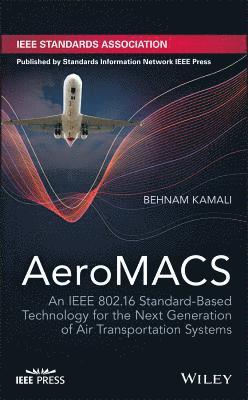
    AeroMACS

    An IEEE 802.16 Standard-Based Technology for the Next Generation of Air Transportation Systems

    AvBehnam Kamali

    Inbunden, Engelska, 2018

    Del i serien Standards Information Network

    1 695 kr

    Beställningsvara. Skickas inom 5-8 vardagar. Fri frakt över 249 kr.

    Fler format och utgåvor

    E-bok

    1 972 kr

    E-bok

    1 961 kr

    Beskrivning

    This is a pioneering textbook on the comprehensive description of AeroMACS technology. It also presents the process of developing a new technology based on an established standard, in this case IEEE802.16 standards suite.The text introduces readers to the field of airport surface communications systems and provides them with comprehensive coverage of one the key components of the Next Generation Air Transportation System (NextGen); i.e., AeroMACS. It begins with a critical review of the legacy aeronautical communications system and a discussion of the impetus behind its replacement with network-centric digital technologies. It then describes wireless mobile channel characteristics in general, and focuses on the airport surface channel over the 5GHz band. This is followed by an extensive coverage of major features of IEEE 802.16-2009 Physical Layer (PHY)and Medium Access Control (MAC) Sublayer. The text then provides a comprehensive coverage of the AeroMACS standardization process, from technology selection to network deployment. AeroMACS is then explored as a short-range high-data-throughput broadband wireless communications system, with concentration on the AeroMACS PHY layer and MAC sublayer main features, followed by making a strong case in favor of the IEEE 802.16j Amendment as the foundational standard for AeroMACS networks.AeroMACS: An IEEE 802.16 Standard-Based Technology for the Next Generation of Air Transportation Systems covers topics such as Orthogonal Frequency Division Multiple Access (OFDMA), coded OFDMA, scalable OFDMA, Adaptive Modulation-Coding (AMC), Multiple-Input Multiple-Output (MIMO) systems, Error Control Coding (ECC) and Automatic Repeat Request (ARQ) techniques, Time Division Duplexing (TDD), Inter-Application Interference (IAI), and so on. It also looks at future trends and developments of AeroMACS networks as they are deployed across the world, focusing on concepts that may be applied to improve the future capacity. In addition, this text:  Discusses the challenges posed by complexities of airport radio channels as well as those pertaining to broadband transmissionsExamines physical layer (PHY) and Media Access Control (MAC) sublayer protocols and signal processing techniques of AeroMACS inherited from IEEE 802.16 standard and WiMAX networksCompares AeroMACS and how it relates to IEEE 802.16 Standard-Based WiMAXAeroMACS: An IEEE 802.16 Standard-Based Technology for the Next Generation of Air Transportation Systems will appeal to engineers and technical professionals involved in the research and development of AeroMACS, technical staffers of government agencies in aviation sectors, and graduate students interested in standard-based wireless networking analysis, design, and development.

    Produktinformation

    • Utgivningsdatum:2018-12-07
    • Mått:155 x 229 x 28 mm
    • Vikt:907 g
    • Format:Inbunden
    • Språk:Engelska
    • Serie:Standards Information Network
    • Antal sidor:480
    • Förlag:John Wiley & Sons Inc
    • ISBN:9781119281108

    Utforska kategorier

    • Elektronik och kommunikationer inom Naturvetenskap och teknik
    • Flyg- och rymdteknik inom Naturvetenskap och teknik

    Mer om författaren

    BEHNAM KAMALI, Ph.D., is Sam Nunn Eminent Scholar of Telecommunications and a Professor of Electrical and Computer Engineering at Mercer University, USA. Dr. Kamali has over 40 years of industry and academic experience in analysis, design, and implementation of digital communications systems, wireless networks, and digital storage devices. He is a Senior Member of the IEEE.Dr. Kamali has published over 100 journal and magazine papers, conference articles, and research reports, several of them on AeroMACS and WiMAX technologies. He has taught at, or worked for, 10 major universities across the globe. Dr. Kamali is a seven-time NASA visiting Summer Research Fellow at Glenn Research Center and Jet Propulsion Laboratory.

    Innehållsförteckning

    • Preface xviiAcronyms xxv1 Airport Communications from Analog AM to AeroMACS 11.1 Introduction 11.2 Conventional Aeronautical Communication Domains (Flight Domains) 21.3 VHF Spectrum Depletion 41.4 The ACAST Project 51.5 Early Digital Communication Technologies for Aeronautics 71.5.1 ACARS 71.5.2 VHF Data Link (VDL) Systems 81.5.2.1 Aeronautical Telecommunications Network (ATN) 81.5.2.2 VDL Systems 81.5.3 Overlay Broadband Alternatives for Data Transmission 101.5.3.1 Direct-Sequence Spread Spectrum Overlay 111.5.3.2 Broadband VHF (B-VHF) 111.5.4 Controller–Pilot Data Link Communications (CPDLC) 121.6 Selection of a Communications Technology for Aeronautics 141.7 The National Airspace System (NAS) 151.7.1 Flight Control 161.7.2 United States Civilian Airports 171.8 The Next Generation Air Transportation System (NextGen) 201.8.1 The NextGen Vision 221.8.2 NextGen Key Components and Functionalities 221.9 Auxiliary Wireless Communications Systems Available for the Airport Surface 251.9.1 Public Safety Mobile Radio for Airport Incidents 261.9.1.1 Public Safety Communications (PSC) Systems Architecture and Technologies 261.9.1.2 Public Safety Allocated Radio Spectrum 271.9.1.3 700 MHz Band and the First Responder Network Authority (FirstNet) 281.9.2 Wireless Fidelity (WiFi) Systems Applications for Airport Surface 301.10 Airport Wired Communications Systems 311.10.1 Airport Fiber-Optic Cable Loop System 341.10.2 Applications of CLCS in Airport Surface Communications and Navigation 351.11 Summary 36References 362 Cellular Networking and Mobile Radio Channel Characterization 412.1 Introduction 412.2 The Crux of the Cellular Concept 422.2.1 The “Precellular” Wireless Mobile Communications Systems 432.2.2 The Core of the Cellular Notion 452.2.3 Frequency Reuse and Radio Channel Multiplicity 482.2.3.1 Co-Channel Reuse Ratio (CCRR), Cluster Size, and Reuse Factor 492.2.3.2 Signal to Co-Channel Interference Ratio (SIR) 502.2.3.3 Channel Allocation 552.2.4 Erlang Traffic Theory and Cellular Network Design 572.2.4.1 Trunking, Erlang, and Traffic 582.2.4.2 The Grade of Service 602.2.4.3 Blocked Calls Handling Strategies 602.2.4.4 Trunking Efficiency 622.2.4.5 Capacity Enhancement through Cell Splitting 642.2.4.6 Capacity Enhancement via Sectorization 672.3 Cellular Radio Channel Characterization 692.3.1 Cellular Link Impairments 692.3.2 Path Loss Computation and Estimation 712.3.2.1 Free-Space Propagation and Friis Formula 732.3.2.2 The Key Mechanisms Affecting Radio Wave Propagation 742.3.2.3 The Ray Tracing Technique 762.3.2.4 Ground Reflection and Double-Ray Model 762.3.2.5 Empirical Techniques for Path Loss (Large-Scale Attenuation) Estimation 812.3.2.6 Okumura–Hata Model for Outdoor Median Path Loss Estimation 822.3.2.7 COST 231-Hata Model 842.3.2.8 Stanford University Interim (SUI) Model: Erceg Model 852.3.2.9 ECC-33 Model 862.3.3 Large-Scale Fading: Shadowing and Foliage 872.3.3.1 Log-Normal Shadowing 882.3.3.2 Estimation of Useful Coverage Area (UCA) within a Cell Footprint 912.3.4 Small-Scale Fading: Multipath Propagation and Doppler Effect 942.3.4.1 Multipath Propagation 952.3.4.2 Double Path Example 972.3.4.3 Doppler Shift 992.3.4.4 Impulse Response of Multipath Channels 1002.3.4.5 Delay Spread and Fading Modes 1022.3.4.6 Methods of Combating Frequency-Selective Fading 1032.3.4.7 Coherence Bandwidth and Power Delay Profiles (PDPs) 1052.3.4.8 Frequency Flat Fading versus Frequency-Selective Fading 1082.3.4.9 Frequency Dispersion and Coherence Time 1092.3.4.10 Classification of Multipath Fading Channels 1102.3.4.11 Probabilistic Models for Frequency Flat Fading Channels 1122.3.4.12 Rayleigh Fading Channels 1122.3.4.13 Rician Fading Channels 1152.4 Challenges of Broadband Transmission over the Airport Surface Channel 1172.5 Summary 118References 1193 Wireless Channel Characterization for the 5 GHz Band Airport Surface Area 1233.1 Introduction 1233.1.1 Importance of Channel Characterization 1233.1.2 Channel Definitions 1253.1.3 Airport Surface Area Channel 1273.2 Statistical Channel Characterization Overview 1293.2.1 The Channel Impulse Response and Transfer Function 1293.2.2 Statistical Channel Characteristics 1303.2.3 Common Channel Parameters and Statistics 1333.3 Channel Effects and Signaling 1343.3.1 Small-Scale and Large-Scale Fading 1343.3.2 Channel Parameters and Signaling Relations 1353.4 Measured Airport Surface Area Channels 1373.4.1 Measurement Description and Example Results 1373.4.2 Path Loss Results 1413.5 Airport Surface Area Channel Models 1433.5.1 Large/Medium-Sized Airports 1443.5.2 Small Airports 1443.6 Summary 144References 1474 Orthogonal Frequency-Division Multiplexing and Multiple Access 1514.1 Introduction 1514.2 Fundamental Principles of OFDM Signaling 1524.2.1 Parallel Transmission, Orthogonal Multiplexing, Guard Time, and Cyclic Extension 1544.2.1.1 Cyclic Prefix and Guard Time 1554.2.2 Fourier Transform-Based OFDM Signal 1564.2.3 Windowing, Filtering, and Formation of OFDM Signal 1574.2.4 OFDM System Implementation 1594.2.5 Choice of Modulation Schemes for OFDM 1604.2.6 OFDM Systems Design: How the Key Parameters are Selected 1614.3 Coded Orthogonal Frequency-Division Multiplexing: COFDM 1614.3.1 Motivation 1624.3.2 System-Level Functional Block Diagram of a Fourier-Based COFDM 1624.3.3 Some Classical Applications of COFDM 1644.3.3.1 COFDM Applied in Digital Audio Broadcasting (DAB) 1644.3.3.2 COFDM Applied in Wireless LAN (Wi-Fi): The IEEE 802.11 Standard 1654.4 Performance of Channel Coding in OFDM Networks 1674.5 Orthogonal Frequency-Division Multiple Access: OFDMA 1694.5.1 Multiple Access Technologies: FDMA, TDMA, CDMA, and OFDMA 1714.5.2 Incentives behind Widespread Applications of OFDMA in Wireless Networks 1754.5.3 Subchannelization and Symbol Structure 1764.5.4 Permutation Modes for Configuration of Subchannels 1784.5.4.1 The Peak-to-Average Power Ratio Problem 1794.6 Scalable OFDMA (SOFDMA) 1794.6.1 How to Select the OFDMA Basic Parameters vis-à-vis Scalability 1804.6.2 Options in Scaling 1824.7 Summary 183References 1845 The IEEE 802.16 Standards and the WiMAX Technology 1895.1 Introduction to the IEEE 802.16 Standards for Wireless MAN Networks 1905.2 The Evolution and Characterization of IEEE 802.16 Standards 1935.2.1 IEEE 802.16-2004 Standard 1935.2.2 IEEE 802.16e-2005 Standard 1945.2.3 IEEE 802.16-2009 Standard 1945.2.4 IEEE 802.16j Amendment 1945.2.5 The Structure of a WirelessMAN Cell 1955.2.6 Protocol Reference Model (PRM) for the IEEE 802.16-2009 Standard 1975.3 WiMAX: an IEEE 802.16-Based Technology 2005.3.1 Basic Features of WiMAX Systems 2005.3.2 WiMAX Physical Layer Characterization 2045.3.2.1 OFDMA and SOFDMA for WiMAX 2055.3.2.2 Comparison of Duplexing Technologies: TDD versus FDD 2065.3.2.3 Subchannelization for Mobile WiMAX 2075.3.2.4 WiMAX TDD Frame Structure 2115.3.2.5 Adaptive (Advanced) Modulation and Coding (AMC) 2155.3.2.6 ARQ and Hybrid ARQ: Multilayer Error Control Schemes 2195.3.2.7 Multiple Antenna Techniques, MIMO, and Space-Time Coding 2195.3.2.8 Fractional Frequency Reuse Techniques for Combating Intercell Interference and to Boost Spectral Efficiency 2275.3.2.9 Power Control and Saving Modes in WiMAX Networks 2305.3.3 WiMAX MAC Layer Description 2315.3.3.1 WiMAX MAC CS; Connections and Service Flows 2325.3.3.2 The MAC CPS Functionalities 2325.3.3.3 WiMAX Security Sublayer 2335.3.3.4 WiMAX MAC Frame and MAC Header Format 2345.3.3.5 Quality of Service (QoS), Scheduling, and Bandwidth Allocation 2355.3.4 WiMAX Forum and WiMAX Profiles 2395.3.4.1 WiMAX System Profiles and Certification Profiles 2405.3.4.2 WiMAX Mobile System Profiles 2415.3.5 WiMAX Network Architecture 2455.3.5.1 WiMAX Network Reference Model as Presented by WiMAX Forum 2465.3.5.2 Characterization of Major Logical and Physical Components of WiMAX NRM 2485.3.5.3 Visual Depiction of WiMAX NRM 2505.3.5.4 The Description of WiMAX Reference Points 2505.3.6 Mobility and Handover in WiMAX Networks 2505.3.7 Multicast and Broadcast with WiMAX 2535.4 Summary 254References 2556 Introduction to AeroMACS 2596.1 The Origins of the AeroMACS Concept 2596.1.1 WiMAX Salient Features and the Genealogy of AeroMACS 2606.2 Defining Documents in the Making of AeroMACS Technology 2626.3 AeroMACS Standardization 2676.3.1 AeroMACS Standards and Recommended Practices (SARPS) 2686.3.2 Harmonization Document 2706.3.3 Overview of Most Recent AeroMACS Profile 2716.3.3.1 The AeroMACS Profile Background and Concept of Operations 2736.3.3.2 AeroMACS Profile Technical Aspects 2756.3.3.3 Profile’s Key Assumptions for AeroMACS System Design 2756.3.3.4 AeroMACS Radio Profile Requirements and Restrictions 2766.3.3.5 AeroMACS Profile Common Part and TDD Format 2776.3.4 AeroMACS Minimum Operational Performance Standards (MOPS) 2796.3.4.1 AeroMACS Capabilities and Operational Applications 2806.3.4.2 MOPS Equipment Test Procedures 2816.3.4.3 Minimum Performance Standard 2816.3.5 AeroMACS Minimum Aviation System Performance Standards (MASPS) 2836.3.6 AeroMACS Technical Manual 2856.4 AeroMACS Services and Applications 2876.5 AeroMACS Prototype Network and Testbed 2956.5.1 Testbed Configuration 2966.5.2 Early Testing Procedures and Results 2976.5.2.1 Mobile Application Testing with ARV 2986.5.2.2 The Results of AeroMACS Mobile Tests with Boeing 737–700 2996.5.2.3 AeroMACS Performance Validation 3006.6 Summary 301References 3027 AeroMACS Networks Characterization 3057.1 Introduction 3057.2 AeroMACS Physical Layer Specifications 3067.2.1 OFDM and OFDMA for AeroMACS 3097.2.2 AeroMACS OFDMA TDD Frame Configuration 3097.2.3 AeroMACS Modulation Formats 3127.2.3.1 How to Select a Modulation Technique for a Specific Application 3137.2.3.2 General Characteristics of Modulation Schemes Supported by AeroMACS 3157.2.4 AeroMACS Channel Coding Schemes 3187.2.4.1 Mandatory Channel Coding for AeroMACS 3187.2.4.2 Optional CC–RS Code Concatenated Scheme 3207.2.4.3 Convolutional Turbo Coding (CTC) Technique 3217.2.5 Adaptive Modulation and Coding (AMC) for AeroMACS Link Adaptation 3237.2.6 AeroMACS Frame Structure 3257.2.7 Computation of AeroMACS Receiver Sensitivity 3267.2.8 Fractional Frequency Reuse for WiMAX and AeroMACS Networks 3277.2.9 Multiple-Input Multiple-Output (MIMO) Configurations for AeroMACS 3287.3 Spectrum Considerations 3297.4 Spectrum Sharing and Interference Compatibility Constraints 3327.5 AeroMACS Media Access Control (MAC) Sublayer 3347.5.1 Quality of Service for AeroMACS Networks 3367.5.2 Scheduling, Resource Allocation, and Data Delivery 3387.5.3 Automatic Repeat Request (ARQ) Protocols 3417.5.4 Handover (HO) Procedures in AeroMACS Networks 3447.5.4.1 MS-Initiated Handover Process 3457.6 AeroMACS Network Architecture and Reference Model 3477.6.1 AeroMACS Network Architecture 3477.6.2 AeroMACS Network Reference Model (NRM) 3497.7 Aeronautical Telecommunications Network Revisited 3537.8 AeroMACS and the Airport Network 3557.9 Summary 356References 3588 AeroMACS Networks Fortified with Multihop Relays 3618.1 Introduction 3618.2 IEEE 802.16j Amendment Revisited 3628.3 Relays: Definitions, Classification, and Modes of Operation 3658.3.1 A Double-Hop Relay Configuration: Terminologies and Definitions 3668.3.2 Relay Modes: Transparent versus Non-Transparent 3688.3.3 Time Division Transmit and Receive Relays (TTR) and Simultaneous Transmit and Receive Relays (STR) 3718.3.4 Further Division of Relay Modes of Operation 3728.3.5 Relays Classification Based on MAC Layer Functionalities: Centralized and Distributed Modes 3738.3.6 Physical Classification of IEEE 802.16j Relays: Relay Types 3748.3.6.1 Relay Type and Latency 3758.3.7 Modes of Deployment of IEEE 802.16j Relays in Wireless Networks 3768.3.8 Frame Structure for Double-Hop IEEE 802.16j TDD TRS 3778.3.8.1 The Detail of IEEE 802-16j Operation with Transparent Relays 3808.3.9 The Frame Structure for TTR–NTRS 3818.3.10 The Frame Structure for STR–NTRS 3828.3.10.1 STR Implementation in Different Layers 3848.4 Regarding MAC Layers of IEEE 802.16j and NRTS 3858.4.1 Data Forwarding Schemes 3858.4.1.1 Routing Selection and Path Management 3868.4.1.2 Initial Ranging and Network Entry 3878.4.2 Scheduling 3888.4.3 Security Schemes 3908.4.4 Quality of Service (QoS) in Relay-Augmented Networks 3908.4.4.1 The Impact of Scheduling and Relay Mode on AeroMACS Network Parameters 3918.5 Challenges and Practical Issues in IEEE 802.16j-Based AeroMACS 3928.5.1 Latency 3928.5.2 The Number of Hops 3928.5.3 The Output Power and Antenna Selection 3938.6 Applications and Usage Scenarios for Relay-Augmented Broadband Cellular Networks 3948.6.1 Some Applications of Relay-Fortified Systems 3958.6.1.1 The European REWIND Project 3958.6.1.2 Vehicular Networks 3968.6.1.3 4G and 5G Cellular Networks 3968.6.1.4 Cognitive Femtocell 3978.6.2 Potential Usage Scenarios of IEEE 802.16j 3978.6.2.1 Radio Outreach Extension 3978.6.2.2 The Concept of “Filling a Coverage Hole” 3998.6.2.3 Relays for Capacity and Throughput Improvement 3998.6.2.4 The Case of Cooperative Relaying 3998.6.2.5 Reliable Coverage for In-Building and In-Door Scenarios 4008.6.2.6 The Mobile Relays 4018.6.2.7 The Temporary Relay Stations 4018.7 IEEE 802.16j-Based Relays for AeroMACS Networks 4018.7.1 Airport Surface Radio Coverage Situations for which IEEE 802.16j Offers a Preferred Alternative 4028.8 Radio Resource Management (RRM) for Relay-Fortified Wireless Networks 4038.9 The Multihop Gain 4058.9.1 Computation of Multihop Gain for the Simplest Case 4058.10 Interapplication Interference (IAI) in Relay-Fortified AeroMACS 4078.11 Making the Case for IEEE 802.16j-Based AeroMACS 4118.11.1 The Main Arguments 4118.11.1.1 Supporting and Drawback Instants 4128.11.2 The Second Argument 4128.11.3 How to Select a Relay Configuration 4138.11.4 A Note on Cell Footprint Extension 4138.12 Summary 414References 415Index 419