• Fri frakt över 249 kr
  • •
  • Snabba leveranser
  • •
  • Billiga böcker
Kundservice

Du är på sajten för privatpersoner.

Företag, bibliotek eller offentlig verksamhet?

Du handlar på classic.bokus.com, där alla dina funktioner finns intakta.
Till classic.bokus.com
Bokus logotyp. Gå till startsidan.
  • Erbjudanden
  • Nyheter
  • Student
  • Topplistor
  • Barn & ungdom
  • Bokus Play
  • E-böcker
  • Pocketböcker
  • Spel & pussel

10% rabatt på allt med kod: NYSTART10 →

Sidfot

Mina sidor

    Hjälp

    • Kundservice
    • Vanliga frågor och svar
    • Frakt och leverans
    • Retur vid ångerrätt
    • Reklamera vara
    • Betalning
    • Köpvillkor
    • Allmänna villkor
    • Information om webbplatsens tillgänglighet

    Om Bokus

    • Om oss
    • Pressrum
    • För studenter
    • För företag
    • För bibliotek och offentlig verksamhet
    • För leverantörer
    • Hållbarhet

    Populärt

    • Aktuella erbjudanden
    • Presentkort
    • Studentlitteratur
    • Nya böcker
    • Topplistor
    • Signerade böcker
    • Engelska böcker

    Inspiration

    • Boktips
    • BookTok
    • Populära bokserier
    • Barnbokskaraktärer
    • Populära författare
    Logotyp för Bokus
    Följ oss på Facebook (extern länk)Följ oss på Instagram (extern länk)Följ oss på YouTube (extern länk)Följ oss på TikTok (extern länk)
    bokus @ CookiesAnpassa cookiesIntegritetspolicyKöpvillkor
    Till Citymail hemsida (extern länk)Till Budbee hemsida (extern länk)Till Postnord hemsida (extern länk)Till Schenker hemsida (extern länk)Till Early Bird hemsida (extern länk)Till Walleys hemsida (extern länk)
    1. Naturvetenskap och teknik
    2. Teknik och industri
    3. Tillverkningsteknik

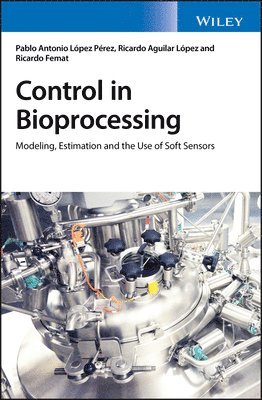
    Control in Bioprocessing

    Modeling, Estimation and the Use of Soft Sensors

    AvPablo A. López Pérez,Ricardo Aguilar López

    Inbunden, Engelska, 2020

    1 664 kr

    Beställningsvara. Skickas inom 5-8 vardagar. Fri frakt över 249 kr.

    Beskrivning

    Closes the gap between bioscience and mathematics-based process engineering This book presents the most commonly employed approaches in the control of bioprocesses. It discusses the role that control theory plays in understanding the mechanisms of cellular and metabolic processes, and presents key results in various fields such as dynamic modeling, dynamic properties of bioprocess models, software sensors designed for the online estimation of parameters and state variables, and control and supervision of bioprocessesControl in Bioengineering and Bioprocessing: Modeling, Estimation and the Use of Sensors is divided into three sections. Part I, Mathematical preliminaries and overview of the control and monitoring of bioprocess, provides a general overview of the control and monitoring of bioprocesses, and introduces the mathematical framework necessary for the analysis and characterization of bioprocess dynamics. Part II, Observability and control concepts, presents the observability concepts which form the basis of design online estimation algorithms (software sensor) for bioprocesses, and reviews controllability of these concepts, including automatic feedback control systems. Part III, Software sensors and observer-based control schemes for bioprocesses, features six application cases including dynamic behavior of 3-dimensional continuous bioreactors; observability analysis applied to 2D and 3D bioreactors with inhibitory and non-inhibitory models; and regulation of a continuously stirred bioreactor via modeling error compensation.  Applicable across all areas of bioprocess engineering, including food and beverages, biofuels and renewable energy, pharmaceuticals and nutraceuticals, fermentation systems, product separation technologies, wastewater and solid-waste treatment technology, and bioremediationProvides a clear explanation of the mass-balance–based mathematical modelling of bioprocesses and the main tools for its dynamic analysisOffers industry-based applications on: myco-diesel for implementing "quality" of observability; developing a virtual sensor based on the Just-In-Time Model to monitor biological control systems; and virtual sensor design for state estimation in a photocatalytic bioreactor for hydrogen productionControl in Bioengineering and Bioprocessing is intended as a foundational text for graduate level students in bioengineering, as well as a reference text for researchers, engineers, and other practitioners interested in the field of estimation and control of bioprocesses.

    Produktinformation

    • Utgivningsdatum:2020-03-26
    • Mått:175 x 246 x 23 mm
    • Vikt:680 g
    • Format:Inbunden
    • Språk:Engelska
    • Antal sidor:296
    • Förlag:John Wiley & Sons Inc
    • ISBN:9781119295990

    Utforska kategorier

    • Tillverkningsteknik inom Naturvetenskap och teknik

    Mer om författaren

    Pablo Antonio López Pérez, PhD, is Professor at Escuela Superior de Apan, Universidad Autónoma del Estado de Hidalgo, México. His research focuses on Modeling, simulation and nonlinear control of Reactors, Bioreactors and Photobioreactors.Ricardo Aguilar López, PhD is Professor at the Department of Biotechnology and Bioengineering, Center for Research and Advanced Studies (Cinvestav), México. His research interests include modeling of biosystems and bioprocesses, dynamic analysis in bioreactors and design of nonlinear control schemes applied to biological systems, as well as the development of online bioprocess monitoring schemes.Ricardo Femat, PhD was the General Director of the Institute for Scientific and Technological Research of San Luis Potosi (IPICYT), and a Professor in the Department of Applied Mathematics in México. His research interests include (i) analysis, characterization and control of systems with complex dynamics, (ii) the regulation of glucose level in diabetics and (iii) the control of processes with reaction and diffusion.

    Innehållsförteckning

    • Preface xiPart I Overview of the Control and Monitoring of Bioprocesses and Mathematical Preliminaries 11 Introduction 31.1 Overview of the Control and Monitoring of Bioprocesses 31.1.1 Why Nonlinear Control in Bioprocesses? 31.2 Improvements to Bioprocesses Productivity 131.2.1 Cell Lines 161.2.1.1 Cell Culture Process General 181.2.2 Microorganism Growth Under Controlled Conditions 181.2.3 On the Environment for the Microorganism’s Growth 191.2.4 Improving the Productivity for Specific Metabolic Products 211.3 Bioprocess Control 221.3.1 What is a Bioprocess? 221.3.2 Bioprocess Monitoring and Control 231.3.3 Stability of Bioprocess 251.3.4 Basic Concepts and Controllers 271.3.5 Advanced Control Schemes: Multivariable Control, Robust, Fuzzy Logic, Model Predictive Control, or Others 301.4 Process Measurements 321.4.1 The Drawback for Monitoring Bioprocess 321.4.2 Primary on-Line Sensor (e.g. Dissolved Oxygen, Temperature, Culture pH, Pressure, Agitation Rate, Flow Rates, Redox, CO2, and Others) 331.4.3 Primary in-Line Sensor 331.4.4 Process Analytical Technologies (Gas Analysis, Spectrometers, Infrared, HPLC, PCR, and Others) 341.4.5 Software Sensor (e.g. Cell Mass Estimation Via Complex Medium, Primary Carbon Substrate, Concentration Product of Line, Metabolites, Sensor to Computer Via Wireless) 361.5 Dynamic Bioprocess Models 401.5.1 Bioprocess Modeling for Control Purposes 401.5.2 Mass and Energy Balance of the Bioprocess 411.5.2.1 Dynamical Mass Balance 411.5.2.2 Batch Process 421.5.2.3 Fed-Batch 421.5.2.4 Continuous 431.5.2.5 Energy Balance 431.5.3 Black Box, White Box, and Gray Box Models 451.5.3.1 Black Box 451.5.3.2 White Box 451.5.3.3 Gray Box 451.5.4 Linear and Nonlinear Models 451.5.5 Segregated and Non-segregated Models 461.5.6 Structured and Unstructured Models 461.5.7 Structured Models 471.6 Process Optimization 511.6.1 Off-Line and On-Line Optimization of Bioprocesses 51References 532 Mathematical Preliminaries 632.1 Systems of Ordinary Differential Equations 632.1.1 Differential Equations, Vector Fields, and State-Space Description 642.2 Linear Systems 702.2.1 The Fundamental Theorem for Linear Systems 702.2.2 Linear Systems in R2 712.2.3 Complex Eigenvalues 712.2.4 Multiple Eigenvalues 722.3 Nonlinear Dynamical Systems and its Analysis 722.3.1 Preliminary Concepts and Definitions 722.3.1.1 Continuous Dynamical Systems 732.3.1.2 Phase Space and Phase Portrait 732.3.1.3 Trajectories of Autonomous and Non-Autonomous Systems 732.3.1.4 The Vector Field 742.3.1.5 Lipschitz Condition 742.3.2 Existence-Uniqueness Theorem 752.3.2.1 Algebraic Properties of Lipschitz Continuous Functions 762.3.3 Dependence on Initial Conditions and Parameters 772.3.4 The Flow Defined by a Differential Equation 782.3.4.1 Differential Flow 782.3.5 Equilibrium Points 792.3.5.1 Equilibrium 792.3.6 The Hartman–Grobman Theorem 802.3.7 The Stable Manifold Theorem 812.3.8 Saddles, Nodes, Foci, and Centers 822.3.9 Center Manifold Theory 842.4 Stability Theory via Lyapunov Approach 842.4.1 Stability Notions 842.4.1.1 Stability 842.4.1.2 Asymptotic Stability 852.4.1.3 Exponential Stability 862.4.2 The Direct Method of Lyapunov (Second Method) 862.4.2.1 Positive Function 862.4.2.2 Theorem of Lyapunov 872.4.2.3 Globally Uniformly Asymptotically Stable of Lyapunov 882.4.2.4 Definition Matrices and Functions 882.4.3 The Indirect Method of Lyapunov (First Method) 902.4.3.1 Linearization 902.4.3.2 Stability by Linearization 902.4.4 Lasalles Invariance Principle 912.4.5 Invariant Set 912.4.6 Input/Output Stability 922.4.7 General Properties of Linear and Nonlinear Systems 932.4.8 Advanced Stability Theory 932.4.8.1 Concepts of Stability for Non-Autonomous Systems 932.4.8.2 Lyapunov-like Analysis Using Barbalat’s Lemma 942.5 Bifurcation Theory 942.5.1 Periodic Orbit 952.5.2 Limit Cycle 952.5.3 Bifurcation of Maps 952.5.4 Hyperbolic and Non-Hyperbolic Equilibrium Points 962.5.5 Bifurcation Point 962.5.6 Lyapunov Exponent 962.5.7 Chaos 972.5.8 Topological Equivalence 972.5.9 Example Bifurcations and Structural Stability of Dynamical Systems 982.6 Overview of Non-Smooth Dynamical Systems 99References 101Part II Observability and Control Concepts 1073 State Estimation and Observers 1093.1 Observability 1093.1.1 Context and Motivations 1093.1.2 Linear Observability 1123.1.3 Nonlinear Observability 1133.1.4 Geometric Conditions of Observability 1143.1.4.1 Differential-Algebraic Observability Approach 1153.1.5 Analytic Conditions for Observability 1163.1.6 Detectability 1163.1.7 Unobservable Subspaces 1163.1.7.1 A Geometric Characterization 1173.1.8 Unconstructive Subspaces 1173.2 Observer Designs for Linear Structures 1173.2.1 Luenberger Observer 1183.2.2 Kalman Filter 1193.2.3 Wiener Filter 1203.3 Observer Designs for Nonlinear Structures 1213.3.1 Extended Luenberger Observer 1213.3.2 Extended Kalman Filter 1223.3.2.1 First-Order Extended Kalman Filter 1223.3.3 Asymptotic Observers 1243.3.3.1 High-Gain Observer 1243.3.4 Adaptive-Gain Observers 1263.3.4.1 Adaptive High-Gain Observer 1263.3.5 Sliding-Mode Observers 1273.3.5.1 Sliding Mode Observers for Linear Uncertain Systems 1273.3.5.2 Nonlinear Approaches to Sliding Mode Observer Design 130References 1314 Control of Bioprocess 1354.1 The Control Idea 1354.1.1 General Definitions 1364.1.2 Controllability of Input/State/Output Systems 1384.1.3 Steady-Output Controllability 1394.1.4 Linear Controllability Analysis LTI Test 1404.1.4.1 Controllable and Reachable Subspaces 1404.1.4.2 Controllable Matrix Test 1404.1.4.3 Eigenvector Test for Controllability 1404.1.4.4 Popov–Belevitch–Hautus 1414.1.4.5 Lyapunov Test for Controllability 1414.1.5 Stabilizability 1414.2 Controllers for Linear Systems 1414.2.1 Linear Feedback 1414.2.2 Proportional, Proportional-Integral, Proportional-Integral-Derivative 1434.2.3 Optimal Control 1434.2.4 Observer Based Controllers 1444.3 Nonlinear Controllers 1454.3.1 Nonlinear Controllability 1454.3.2 Exact Feedback Linearization 1474.3.3 Input-Output Linearization 1474.3.3.1 Lyapunov-Based Control Design Methods 1484.3.3.2 Back-Stepping Control 1484.3.4 Nonlinear Sliding Mode 1494.3.4.1 Sliding Surface Design 1494.3.4.2 Control Law First-Order Sliding Mode Control 1504.3.4.3 Control Law Second-Order Sliding Mode Control 1514.3.4.4 Twisting Algorithm 1524.3.4.5 Super Twisting Algorithm 1524.3.4.6 Variable Structure Systems 1524.3.5 Model Predictive Control 1544.3.6 Control Using Neural Network 1554.3.7 Nonlinear Design of Adaptive Controllers 1564.3.7.1 Identification of Unknown Parameters 1564.3.7.2 Observer-Based Identification 1574.3.7.3 Adaptive Control Under Matching Conditions 1574.3.7.4 Indirect Adaptive Control 1584.3.7.5 Model Reference Adaptive Control 158References 161Part III Software Sensors and Observer-Based Control Schemes for Bioprocess 1695 Dynamical Behavior of a 3-Dimensional Continuous Bioreactor 1715.1 Introduction 1715.2 Bioreactor Modeling 1735.2.1 Estimation of the Kinetic Parameters 1735.3 Main Results 1755.4 Concluding Remarks 181References 1826 Observability Analysis Applied to 2D and 3D Bioreactors with Inhibitory and Non-inhibitory Kinetics Models 1856.1 Introduction 1856.2 Materials and Methods 1866.2.1 Kinetic Models of Inhibition 1866.2.1.1 Dynamics Models 1876.2.2 Observability Criterion 1886.3 Results and Discussion 1886.4 Implementation of a Linear Observer to Check the Results of the Observability Analysis 2006.5 Conclusion 201References 2027 Production System Myco-Diesel for Implementation of “Quality” of the Observability 2057.1 Introduction 2057.2 Methodology 2067.2.1 Local Observability Quality 2067.2.2 Bioreactor Model 2077.3 Main Results 2087.4 Conclusions 213References 2148 Regulation of a Continuously Stirred Bioreactor via Modeling Error Compensation 2178.1 Introduction 2178.2 Materials and Methods 2198.2.1 Bioreactor Modeling 2198.2.2 Mathematical Model 2198.2.3 Mass Balance Modeling 2198.3 Input–Output Identified Model 2218.4 Control Design 2218.5 Main Results 2258.6 Concluding Remarks 228References 2299 Development of Virtual Sensor Based on the Just-In-Time Model for Monitoring of Biological Control Systems 2339.1 Introduction 2339.2 Materials and Methods 2359.2.1 Kinetic and Simulated Mycoparasitism T. harzianum – C. cladosporioides 2359.2.2 Mathematical Model 2369.3 On-line Monitoring (Proposed Nonlinear Observer) 2399.3.1 Sketch of Proof of Proposition 9.1 2409.4 Such Approaches, Known as Proposed Just-in-Time Modeling “Hybrid Systems” 2429.5 Results 2439.6 Conclusions 249References 25010 Virtual Sensor Design for State Estimation in a Photocatalytic Bioreactor for Hydrogen Production 25510.1 Introduction 25510.2 Material and Methods 25710.2.1 Methods 25710.2.2 Desulfovibrio Alaskensis 6SR 25810.3 Mathematical Model Development 25810.3.1 Basic Concepts 25810.3.2 Proposed Model 25810.3.3 Determination of Kinetic Parameters 26110.4 Virtual Sensor Design 26210.5 Results and Discussion 26510.6 Conclusions 272References 273Index 277