Ricardo Femat – författare
1 675 kr
Skickas inom 5-8 vardagar
1 908 kr
Läs direkt efter köp
Closes the gap between bioscience and mathematics-based process engineering
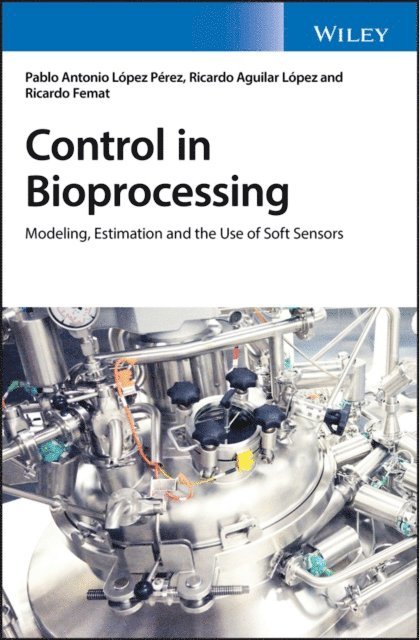
This book presents the most commonly employed approaches in the control of bioprocesses. It discusses the role that control theory plays in understanding the mechanisms of cellular and metabolic processes, and presents key results in various fields such as dynamic modeling, dynamic properties of bioprocess models, software sensors designed for the online estimation of parameters and state variables, and control and supervision of bioprocesses
Control in Bioengineering and Bioprocessing: Modeling, Estimation and the Use of Sensors is divided into three sections. Part I, Mathematical preliminaries and overview of the control and monitoring of bioprocess, provides a general overview of the control and monitoring of bioprocesses, and introduces the mathematical framework necessary for the analysis and characterization of bioprocess dynamics. Part II, Observability and control concepts, presents the observability concepts which form the basis of design online estimation algorithms (software sensor) for bioprocesses, and reviews controllability of these concepts, including automatic feedback control systems. Part III, Software sensors and observer-based control schemes for bioprocesses, features six application cases including dynamic behavior of 3-dimensional continuous bioreactors; observability analysis applied to 2D and 3D bioreactors with inhibitory and non-inhibitory models; and regulation of a continuously stirred bioreactor via modeling error compensation.
Applicable across all areas of bioprocess engineering, including food and beverages, biofuels and renewable energy, pharmaceuticals and nutraceuticals, fermentation systems, product separation technologies, wastewater and solid-waste treatment technology, and bioremediation Provides a clear explanation of the mass-balance–based mathematical modelling of bioprocesses and the main tools for its dynamic analysis Offers industry-based applications on: myco-diesel for implementing "quality" of observability; developing a virtual sensor based on the Just-In-Time Model to monitor biological control systems; and virtual sensor design for state estimation in a photocatalytic bioreactor for hydrogen productionControl in Bioengineering and Bioprocessing is intended as a foundational text for graduate level students in bioengineering, as well as a reference text for researchers, engineers, and other practitioners interested in the field of estimation and control of bioprocesses.
1 925 kr
Läs direkt efter köp
Closes the gap between bioscience and mathematics-based process engineering
This book presents the most commonly employed approaches in the control of bioprocesses. It discusses the role that control theory plays in understanding the mechanisms of cellular and metabolic processes, and presents key results in various fields such as dynamic modeling, dynamic properties of bioprocess models, software sensors designed for the online estimation of parameters and state variables, and control and supervision of bioprocesses
Control in Bioengineering and Bioprocessing: Modeling, Estimation and the Use of Sensors is divided into three sections. Part I, Mathematical preliminaries and overview of the control and monitoring of bioprocess, provides a general overview of the control and monitoring of bioprocesses, and introduces the mathematical framework necessary for the analysis and characterization of bioprocess dynamics. Part II, Observability and control concepts, presents the observability concepts which form the basis of design online estimation algorithms (software sensor) for bioprocesses, and reviews controllability of these concepts, including automatic feedback control systems. Part III, Software sensors and observer-based control schemes for bioprocesses, features six application cases including dynamic behavior of 3-dimensional continuous bioreactors; observability analysis applied to 2D and 3D bioreactors with inhibitory and non-inhibitory models; and regulation of a continuously stirred bioreactor via modeling error compensation.
Applicable across all areas of bioprocess engineering, including food and beverages, biofuels and renewable energy, pharmaceuticals and nutraceuticals, fermentation systems, product separation technologies, wastewater and solid-waste treatment technology, and bioremediation Provides a clear explanation of the mass-balance–based mathematical modelling of bioprocesses and the main tools for its dynamic analysis Offers industry-based applications on: myco-diesel for implementing "quality" of observability; developing a virtual sensor based on the Just-In-Time Model to monitor biological control systems; and virtual sensor design for state estimation in a photocatalytic bioreactor for hydrogen productionControl in Bioengineering and Bioprocessing is intended as a foundational text for graduate level students in bioengineering, as well as a reference text for researchers, engineers, and other practitioners interested in the field of estimation and control of bioprocesses.
Robust Synchronization of Chaotic Systems via Feedback
544 kr
Skickas inom 10-15 vardagar
693 kr
Läs direkt efter köp
1 082 kr
Skickas inom 10-15 vardagar
1 367 kr
Läs direkt efter köp
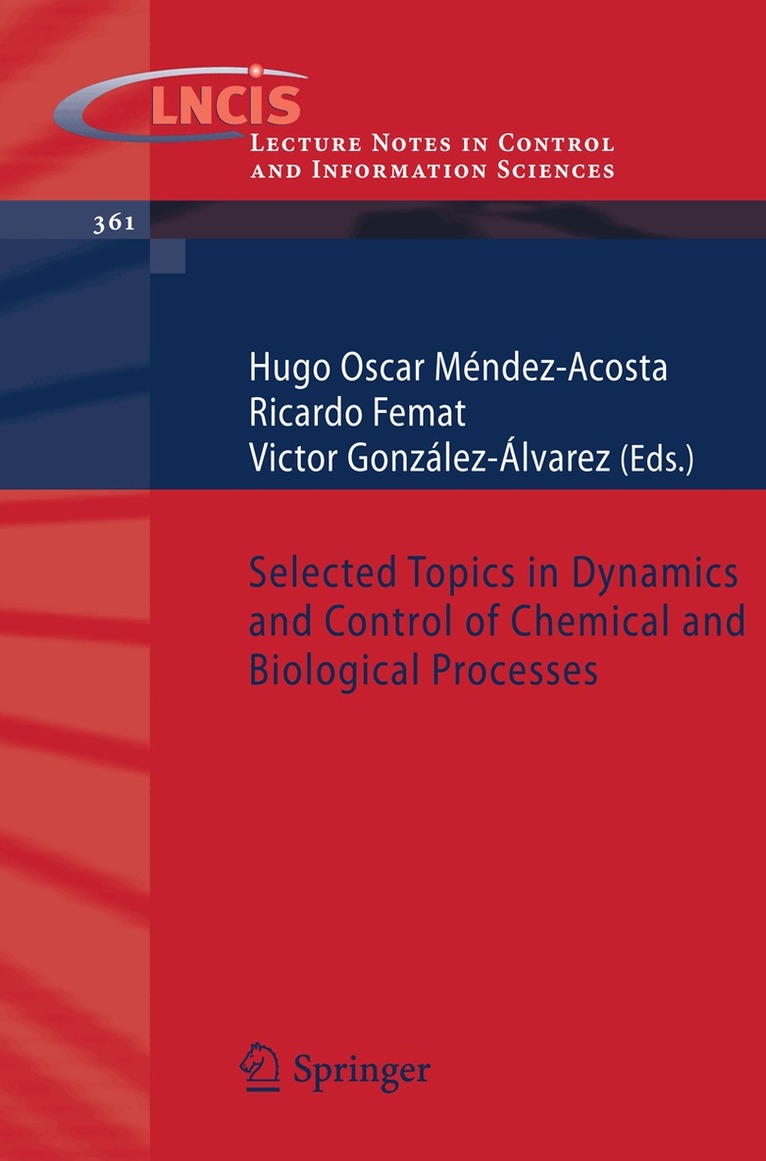
In view of the rapid changes in requirements, it has became necessary to place at the reader''s disposal a book dealing with basic and advanced concepts and techniques for the monitoring and control of chemical and biochemical processes, as well as with the aspects of the implementation of these different robust techniques. To make the ideas covered in this book accessible to a larger audience, the authors attempted to present a balanced view of the theoretical and practical issues of control systems. Different cases are presented to illustrate the controller and observer design procedures and their dynamic effects in the closed-loop. The book consists of peer-reviewed contributions and aims the integration of recent research by a group of colleagues working on theory and practice of the process control. In order to embrace as chemical as control engineering themes, authors have proposed different kind of processes and distinct control scopes. This book is an effort to incorporate and link both theory-practice and chemical-control engineering.