• Fri frakt över 249 kr
  • •
  • Snabba leveranser
  • •
  • Billiga böcker
Kundservice

Du är på sajten för privatpersoner.

Företag, bibliotek eller offentlig verksamhet?

Du handlar på classic.bokus.com, där alla dina funktioner finns intakta.
Till classic.bokus.com
Bokus logotyp. Gå till startsidan.
  • Erbjudanden
  • Nyheter
  • Student
  • Topplistor
  • Barn & ungdom
  • Bokus Play
  • E-böcker
  • Pocketböcker
  • Spel & pussel

Må bättre, för mindre! Upp till 50% rabatt på hälsoböcker

Sidfot

Mina sidor

    Hjälp

    • Kundservice
    • Vanliga frågor och svar
    • Frakt och leverans
    • Retur vid ångerrätt
    • Reklamera vara
    • Betalning
    • Köpvillkor
    • Allmänna villkor
    • Information om webbplatsens tillgänglighet

    Om Bokus

    • Om oss
    • Pressrum
    • För studenter
    • För företag
    • För bibliotek och offentlig verksamhet
    • För leverantörer
    • Hållbarhet

    Populärt

    • Aktuella erbjudanden
    • Presentkort
    • Studentlitteratur
    • Nya böcker
    • Topplistor
    • Signerade böcker
    • Engelska böcker

    Inspiration

    • Boktips
    • BookTok
    • Populära bokserier
    • Barnbokskaraktärer
    • Populära författare
    Logotyp för Bokus
    Följ oss på Facebook (extern länk)Följ oss på Instagram (extern länk)Följ oss på YouTube (extern länk)Följ oss på TikTok (extern länk)
    bokus @ CookiesAnpassa cookiesIntegritetspolicyKöpvillkor
    Till Citymail hemsida (extern länk)Till Budbee hemsida (extern länk)Till Postnord hemsida (extern länk)Till Schenker hemsida (extern länk)Till Early Bird hemsida (extern länk)Till Walleys hemsida (extern länk)
    1. Ekonomi och Ledarskap
    2. Nationalekonomi
    3. Mikroekonomi

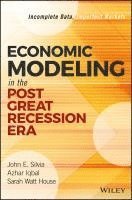
    Economic Modeling in the Post Great Recession Era

    Incomplete Data, Imperfect Markets

    AvJohn E. Silvia,Azhar Iqbal

    Inbunden, Engelska, 2017

    Del i serien Wiley and SAS Business Series

    825 kr

    Beställningsvara. Skickas inom 11-20 vardagar. Fri frakt över 249 kr.

    Beskrivning

    Reality-based modeling for today's unique economic recovery Economic Modeling in the Post Great Recession Era presents a more realistic approach to modeling, using direct statistical applications to address the characteristics and trends central to current market behaviors. This book's unique focus on the reality of today's markets makes it an invaluable resource for students and practitioners seeking a comprehensive guide to more accurate forecasting. While most books treat the economy as if it were in a vacuum, building models around idealized or perception-biased behaviors, this book deals with the economy as it currently stands—in a state of recovery, limited by financial constraints, imperfect information, and lags and disparities in price movements. The authors identify how these characteristics impact various markets' behaviors, and quantify those behaviors using SAS as the primary statistical tool.Today's economy bears a number of unique attributes that usual modeling methods fail to consider. This book describes how to approach modeling based on real-world, observable data in order to make better-informed decisions in today's markets. Discover the three economic characteristics with the greatest impact on various marketsCreate economic models that mirror the current post-recession realityAdopt statistical methods that identify and adapt to structural breaks and lagsFactor real-world imperfections into modeling for more accurate forecastingThe past few years have shown a clear demarcation between policymakers' forecasts and actual outcomes. As the dust settles on the Great Recession, after-effects linger—and impact our current recovery in ways that diverge from past experience and theoretical expectations. Economic Modeling in the Post Great Recession Era provides comprehensive guidance grounded in reality for today's economic decision-makers.

    Produktinformation

    • Utgivningsdatum:2017-03-03
    • Mått:163 x 231 x 38 mm
    • Vikt:544 g
    • Format:Inbunden
    • Språk:Engelska
    • Serie:Wiley and SAS Business Series
    • Antal sidor:400
    • Förlag:John Wiley & Sons Inc
    • ISBN:9781119349839

    Utforska kategorier

    • Mikroekonomi inom Ekonomi och Ledarskap
    • Ekonomisk historia inom Ekonomi och Ledarskap
    • Ekonomisk politik inom Ekonomi och Ledarskap

    Mer om författaren

    JOHN E. SILVIA is a managing director and the chief economist for Wells Fargo. Previously he worked on Capitol Hill as senior economist for the U.S. Senate Joint Economic Committee and chief economist for the U.S. Senate Banking, Housing, and Urban Affairs Committee. AZHAR IQBAL is director and econometrician at Wells Fargo Securities. SARAH WATT HOUSE is vice president of Wells Fargo Securities.

    Innehållsförteckning

    • Preface/Justification xiiiAcknowledgments xxiChapter 1 Setting the Context 1The Problem with Uncritical Assumptions in a Less-Than-Perfect Economy 2The Problem with Models in an Imperfect Economy 3Four Characteristics of a Less-Than-Perfect Economy 4Economic Policy Inconsistencies—The Parable of Strange Bedfellows 13Chapter 2 Dynamic Adjustment in an Economy: Frictions Matter 15Introduction 16Quantifying Frictions: Is the Long-Run Average a Useful Guide for the Future? 32Modeling Dynamic Adjustment due to Economic Frictions: Decision Making in an Evolving World 49Dynamic Economic Adjustment: An Evolution unto Itself 67Appendix 68A Case for the Multiple Markets: 1983–2008 68The Labor Market: 1983–2008 70Chapter 3 Information: Past Imperfect, Present Incomplete, Future Uncertain 73Story Behind the Numbers 76Conclusion 103Chapter 4 Price Adjustment and Search for Equilibrium 105What Barriers Are There to Perfectly Flexible Prices? 107Implications 112Finding Dynamic Adjustment in the Data 116Conclusion 121Chapter 5 Business Investment: This Time Is Different 123Drivers of Business Spending 125Putting It All Together: Explaining Slow Recovery in Capital Investment 134Chapter 6 Corporate Profits: Reward, Incentive, and That Standard of Living 135Introduction: Profits as Essential Partner 136The Role of Profits in the Economic Cycle: Five Drivers 137The Role of Profits: Incentives and Rewards 140Concluding Remarks: Modeling Profits 167Chapter 7 Labor Market Evolution: Implications for Private-Sector and Public-Policy Decision Makers 169Part I: Labor Market Imperfections 171Part II: Heterogeneity in the Labor Market 182Part III: How Do Secular Labor Market Trends Impact Economic Policy? 196Chapter 8 Inflation: When What You Get Isn’t What You Expect 205Introduction 206What Is Inflation? 207Why Does Inflation Matter? 208What Determines Inflation? 212Inflation after the Great Recession 219Application: Predicting if Central Banks Can Achieve Price Stability 230Chapter 9 Interest Rates and Credit: Capital Markets in the Post–Great Recession World 235Imperfect Guidance in an Uncertain World 236A Look at Actual History over the Long Run 247Credit and Administered Rates 250Imperfect Information and Credit 255Conclusion: Shift from Historical Benchmarks 280Chapter 10 Three-Dimensional Checkers: Open Economy, Capital Flows, and Exchange Rates 281Newton’s Third Law 282Introducing a New Price to the Analysis: The Role of Exchange Rates 289Three-Dimensional Checkers on an International Playing Field 295A Perfect Model in an Imperfect World 298Concluding Remarks: Future Looks Different 330Chapter 11 Assessing Economic Policy in an Imperfect Economy 331Generalized Policy Model 333Rules and Reputation: Beyond Economic Benchmarks 338Confronting Our Three Market Imperfections 340Economic Policy in the Context of an Imperfect Economy 359About the Authors 361Index 363