• Fri frakt över 249 kr
  • •
  • Snabba leveranser
  • •
  • Billiga böcker
Kundservice

Du är på sajten för privatpersoner.

Företag, bibliotek eller offentlig verksamhet?

Du handlar på classic.bokus.com, där alla dina funktioner finns intakta.
Till classic.bokus.com
Bokus logotyp. Gå till startsidan.
  • Erbjudanden
  • Student
  • Topplistor
  • Barn & ungdom
  • Bokus Play
  • E-böcker
  • Ljudböcker
  • Pocketböcker
  • Spel & pussel

Upp till 25% på utvalda nyheter →

Sidfot

Mina sidor

    Hjälp

    • Kundservice
    • Vanliga frågor och svar
    • Frakt och leverans
    • Retur vid ångerrätt
    • Reklamera vara
    • Betalning
    • Köpvillkor
    • Allmänna villkor
    • Information om webbplatsens tillgänglighet

    Om Bokus

    • Om oss
    • Pressrum
    • För studenter
    • För företag
    • För bibliotek och offentlig verksamhet
    • För leverantörer
    • Hållbarhet

    Populärt

    • Aktuella erbjudanden
    • Presentkort
    • Studentlitteratur
    • Nya böcker
    • Topplistor
    • Signerade böcker
    • Engelska böcker

    Inspiration

    • Boktips
    • BookTok
    • Populära bokserier
    • Barnbokskaraktärer
    • Populära författare
    Logotyp för Bokus
    Följ oss på Facebook (extern länk)Följ oss på Instagram (extern länk)Följ oss på YouTube (extern länk)Följ oss på TikTok (extern länk)
    bokus @ CookiesAnpassa cookiesIntegritetspolicyKöpvillkor
    Till Citymail hemsida (extern länk)Till Budbee hemsida (extern länk)Till Postnord hemsida (extern länk)Till Schenker hemsida (extern länk)Till Early Bird hemsida (extern länk)Till Walleys hemsida (extern länk)
    1. Naturvetenskap och teknik
    2. Teknik och industri
    3. Maskinteknik och material

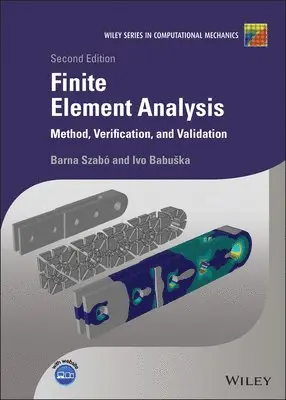
    Finite Element Analysis

    Method, Verification and Validation

    AvBarna Szabó,Ivo Babuška

    Inbunden, Engelska, 2021

    Del i serien Wiley Series in Computational Mechanics

    1 339 kr

    Beställningsvara. Skickas inom 5-8 vardagar. Fri frakt över 249 kr.

    Beskrivning

    Finite Element AnalysisAn updated and comprehensive review of the theoretical foundation of the finite element methodThe revised and updated second edition of Finite Element Analysis: Method, Verification, and Validation offers a comprehensive review of the theoretical foundations of the finite element method and highlights the fundamentals of solution verification, validation, and uncertainty quantification. Written by noted experts on the topic, the book covers the theoretical fundamentals as well as the algorithmic structure of the finite element method. The text contains numerous examples and helpful exercises that clearly illustrate the techniques and procedures needed for accurate estimation of the quantities of interest. In addition, the authors describe the technical requirements for the formulation and application of design rules.Designed as an accessible resource, the book has a companion website that contains a solutions manual, PowerPoint slides for instructors, and a link to finite element software. This important text: Offers a comprehensive review of the theoretical foundations of the finite element methodPuts the focus on the fundamentals of solution verification, validation, and uncertainty quantificationPresents the techniques and procedures of quality assurance in numerical solutions of mathematical problemsContains numerous examples and exercisesWritten for students in mechanical and civil engineering, analysts seeking professional certification, and applied mathematicians, Finite Element Analysis: Method, Verification, and Validation, Second Edition includes the tools, concepts, techniques, and procedures that help with an understanding of finite element analysis.

    Produktinformation

    • Utgivningsdatum:2021-08-20
    • Mått:10 x 10 x 10 mm
    • Vikt:482 g
    • Format:Inbunden
    • Språk:Engelska
    • Serie:Wiley Series in Computational Mechanics
    • Antal sidor:384
    • Upplaga:2
    • Förlag:John Wiley & Sons Inc
    • ISBN:9781119426424

    Utforska kategorier

    • Maskinteknik och material inom Naturvetenskap och teknik

    Mer om författaren

    Barna Szabó is Senior Professor in the Department of Mechanical Engineering and Materials Science at Washington University in St. Louis, USA. He is also co-founder and chairman of Engineering Software Research and Development, Inc. Ivo Babuška is Professor Emeritus of The University of Texas at Austin, USA, Professor of Aerospace Engineering and Engineering Mechanics, Professor of Mathematics, and Senior Research Scientist of the Oden Institute of Computational Engineering and Sciences.

    Innehållsförteckning

    • 1 Introduction to FEM 31.1 An introductory problem 61.2 Generalized formulation 91.2.1 The exact solution 91.2.2 The principle of minimum potential energy 141.3 Approximate solutions 161.3.1 The standard polynomial space 171.3.2 Finite element spaces in one dimension 201.3.3 Computation of the coefficient matrices 221.3.4 Computation of the right hand side vector 261.3.5 Assembly 271.3.6 Condensation 301.3.7 Enforcement of Dirichlet boundary conditions 301.4 Post-solution operations 331.4.1 Computation of the quantities of interest 331.5 Estimation of error in energy norm 371.5.1 Regularity 381.5.2 A priori estimation of the rate of convergence 381.5.3 A posteriori estimation of error 401.5.4 Error in the extracted QoI 461.6 The choice of discretization in 1D 471.6.1 The exact solution lies in Hk(I), k − 1 > p 471.6.2 The exact solution lies in Hk(I), k − 1 ≤ p 491.7 Eigenvalue problems 521.8 Other finite element methods 571.8.1 The mixed method 591.8.2 Nitsche’s method 602 Boundary value problems 632.1 Notation 632.2 The scalar elliptic boundary value problem 652.2.1 Generalized formulation 662.2.2 Continuity 682.3 Heat conduction 682.3.1 The differential equation 702.3.2 Boundary and initial conditions 712.3.3 Boundary conditions of convenience 732.3.4 Dimensional reduction 752.4 Linear elasticity - strong form 822.4.1 The Navier equations 862.4.2 Boundary and initial conditions 862.4.3 Symmetry, antisymmetry and periodicity 882.4.4 Dimensional reduction in linear elasticity 892.4.5 Incompressible elastic materials 932.5 Stokes flow 952.6 Elasticity - generalized formulation 962.6.1 The principle of minimum potential energy 982.6.2 The RMS measure of stress 1002.6.3 The principle of virtual work 1012.6.4 Uniqueness 1022.7 Residual stresses 1062.8 Chapter summary 1083 Implementation 1113.1 Standard elements in two dimensions 1113.2 Standard polynomial spaces 1113.2.1 Trunk spaces 1113.2.2 Product spaces 1123.3 Shape functions 1123.3.1 Lagrange shape functions 1133.3.2 Hierarchic shape functions 1153.4 Mapping functions in two dimensions 1183.4.1 Isoparametric mapping 1183.4.2 Mapping by the blending function method 1213.4.3 Mapping algorithms for high order elements 1233.5 Finite element spaces in two dimensions 1253.6 Essential boundary conditions 1253.7 Elements in three dimensions 1263.7.1 Mapping functions in three-dimensions 1273.8 Integration and differentiation 1293.8.1 Volume and area integrals 1293.8.2 Surface and contour integrals 1313.8.3 Differentiation 1313.9 Stiffness matrices and load vectors 1323.9.1 Stiffness matrices 1333.9.2 Load vectors 1343.10 Post-solution operations 1353.11 Computation of the solution and its first derivatives 1353.12 Nodal forces 1373.12.1 Nodal forces in the h-version 1373.12.2 Nodal forces in the p-version 1403.12.3 Nodal forces and stress resultants 1413.13 Chapter summary 1424 Verification 1434.1 Regularity in two and three dimensions 1434.2 The Laplace equation in two dimensions 1444.2.1 2D model problem, uEX ∈ Hk(), k − 1 > p 1464.2.2 2D model problem, uEX ∈ Hk(), k − 1 ≤ p 1484.2.3 Computation of the flux vector in a given point 1514.2.4 Computation of the flux intensity factors 1534.2.5 Material interfaces 1584.3 The Laplace equation in three dimensions 1604.4 Planar elasticity 1644.4.1 Problems of elasticity on an L-shaped domain 1654.4.2 Crack tip singularities in 2D 1654.4.3 Forcing functions acting on boundaries 1704.5 Robustness 1724.6 Solution verification 1775 Simulation 1855.1 Development of a mathematical model 1865.1.1 The Bernoulli-Euler beam model 1875.1.2 Historical notes 1885.2 FE modeling vs simulation 1905.2.1 Numerical simulation 1905.2.2 Finite element modeling 1925.2.3 Calibration versus tuning 1955.2.4 Simulation governance 1965.2.5 Milestones in numerical simulation 1975.2.6 Example: The Girkmann problem 1995.2.7 Example: Fastened structural connection 2035.2.8 Finite element model 2105.2.9 Example: Coil spring with displacement boundary conditions 2155.2.10 Example: Coil spring segment 2206 Calibration, Validation and Ranking 2256.1 Fatigue data 2266.1.1 Equivalent stress 2276.1.2 Statistical models 2276.1.3 The effect of notches 2286.1.4 Formulation of predictors of fatigue life 2296.2 The predictors of Peterson and Neuber 2306.2.1 The effect of notches - calibration 2326.2.2 The effect of notches - validation 2356.2.3 Updated calibration 2376.2.4 The fatigue limit 2406.2.5 Discussion 2426.3 The predictor Gα 2436.3.1 Calibration of β(V, α) 2446.3.2 Ranking 2466.3.3 Comparison of Gα with Peterson’s revised predictor 2466.4 Biaxial test data 2476.4.1 Axial, torsional and combined in-phase loading 2486.4.2 The domain of calibration 2496.4.3 Out-of-phase biaxial loading 2526.4.4 Validation 2556.4.5 Selection of the prior 2566.4.6 Discussion 2597 Beams, plates and shells 2617.1 Beams 2617.1.1 The Timoshenko beam 2637.1.2 The Bernoulli-Euler beam 2687.2 Plates 2737.2.1 The Reissner-Mindlin plate 2767.2.2 The Kirchhoff plate 2817.2.3 The transverse variation of displacements 2837.3 Shells 2877.3.1 Hierarchic thin solid models 2917.4 Chapter summary 2958 Aspects of multiscale models 2978.1 Unidirectional fiber-reinforced laminae 2978.1.1 Determination of material constants 3008.1.2 The coefficients of thermal expansion 3008.1.3 Examples 3018.1.4 Localization 3048.1.5 Prediction of failure in composite materials 3058.1.6 Uncertainties 3078.2 Discussion 3079 Non-linear models 3099.1 Heat conduction 3099.1.1 Radiation 3099.1.2 Nonlinear material properties 3109.2 Solid mechanics 3109.2.1 Large strain and rotation 3119.2.2 Structural stability and stress stiffening 3149.2.3 Plasticity 3219.2.4 Mechanical contact 3279.3 Chapter summary 335A Definitions 337A.1 Normed linear spaces, linear functionals and bilinear forms 338A.1.1 Normed linear spaces 338A.1.2 Linear forms 339A.1.3 Bilinear forms 339A.2 Convergence in the space X 339A.2.1 The space of continuous functions 339A.2.2 The space Lp() 340A.2.3 Sobolev space of order 1 340A.2.4 Sobolev spaces of fractional index 341A.3 The Schwarz inequality for integrals 342B Proof of convergence 343C Convergence in 3D 345D Legendre polynomials 349D.1 Shape functions based on Legendre polynomials 350E Numerical quadrature 353E.1 Gaussian quadrature 353E.2 Gauss-Lobatto quadrature 355F Polynomial mapping functions 357F.1 Interpolation on surfaces 359F.1.1 Interpolation on the standard quadrilateral element 359F.1.2 Interpolation on the standard triangle 359G Corner singularities 361G.1 The Airy stress function 361G.2 Stress-free edges 363G.2.1 Symmetric eigenfunctions 364G.2.2 Antisymmetric eigenfunctions 365G.2.3 The L-shaped domain 366G.2.4 Corner points 367H Stress intensity factors 369H.1 Singularities at crack tips 369H.2 The contour integral method 370H.3 The energy release rate 372H.3.1 Symmetric (Mode I) loading 372H.3.2 Antisymmetric (Mode II) loading 373H.3.3 Combined (Mode I and Mode II) loading 373H.3.4 Computation by the stiffness derivative method 374I Fundamentals of data analysis 375I.1 Statistical foundations 375I.2 Test data 377I.3 Statistical models 378I.4 Ranking 387I.5 Confidence intervals 387J Fastener forces 389K Useful algorithms 393K.1 The traction vector 393K.2 Transformation of vectors 394K.3 Transformation of stresses 396K.4 Principal stresses 396K.5 The von Mises stress 397K.6 Statically equivalent forces and moments 398K.6.1 Technical formulas for stress 400